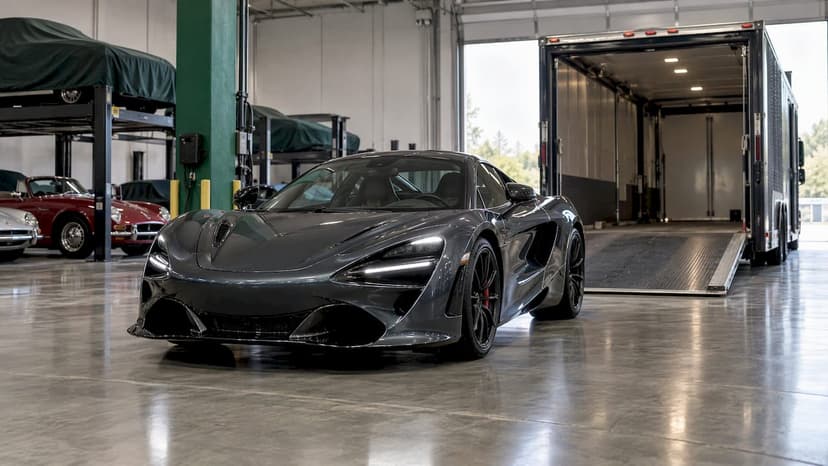
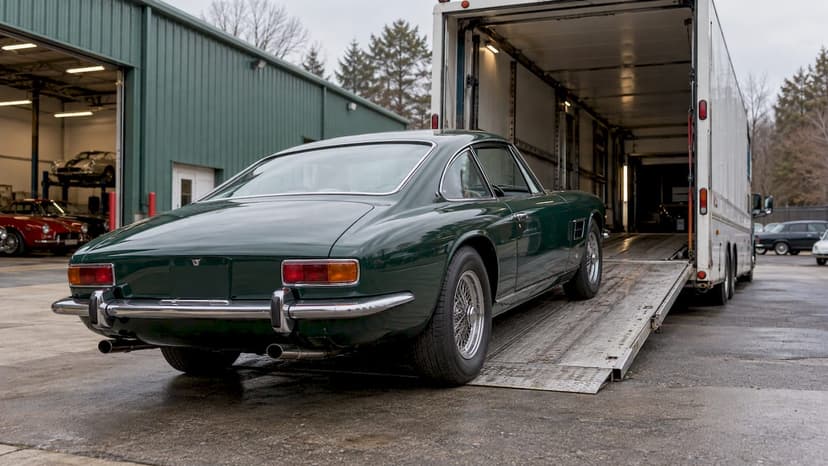
Classic Car Storage: How to Choose, Prepare and Budget

The best classic car storage is an enclosed, secure indoor space that keeps temperature and humidity steady, protects the battery and lets you reach the car when you want it. Outdoor and carport parking cost less, but a car you care about usually belongs indoors. Climate control matters most when the car has original paint, leather or wood, or sits for months. Below you’ll find the storage types, the conditions that matter, a facility checklist, a prep routine and what storage typically costs in the US.
Napgaragenapgarage.comProtect Your Classic Car in StorageNapGarage pairs climate-controlled storage with battery maintenance, fluid checks, detailing, and photo check-ins managed through a mobile app.VisitTL;DR
- Choose enclosed indoor storage for any collector car. Add climate control if the car has original leather, wood or paint, is stored for months, or lives in a humid, coastal or cold-winter region.
- Look for 24/7 monitoring, camera coverage, fire and leak protection, and battery care. Tell your insurer where the car is kept.
- Prepare the car before drop-off: detail it, change the oil, handle fuel as your manual or specialist advises, set tire pressure and put the battery on a tender.
- Budget roughly $100 to $500 a month for professional storage, with big cities and full-service facilities at the top of the range.
- Ask how cars are moved and exercised, so access is easy without extra cold starts.
Table of Contents
- The main types of classic car storage
- When climate control is worth it
- What to look for in a facility
- How to prepare the car for storage
- Balancing easy access with protection
- What classic car storage costs
- Our perspective
- Find enthusiast-grade storage near you
- FAQ
- Sources
The main types of classic car storage
Vehicle storage in the US ranges from open parking to enclosed, climate-controlled garage space. StorTrack’s January 2026 market data counts about 33,000 locations offering some form of vehicle storage, including 4,800 dedicated facilities and 28,500 hybrid ones. Hybrid means a facility that also stores boats, RVs or general goods. You will find options in all 50 states.
State Farm sorts the choices into four groups:
| Type | What it is | Best for |
|---|---|---|
| Outdoor | Gated lot, often monitored, exposed to weather | Daily drivers, short-term budget storage |
| Covered | Canopy or partly walled structure | A middle ground when indoor space is not available |
| Indoor | Fully enclosed building or unit | Collector cars, long-term storage |
| Personal garage | Your own space | Owners with room, who still need to prepare the car and review insurance |
Indoor space is where most collectors land. Some indoor options are simple units. Others are car-club-style facilities that cost thousands per year but offer broader services than a basic storage unit. You’ll also see enclosed garage-style spaces, car condos and managed collections, where staff look after the cars for you.
What insurers accept
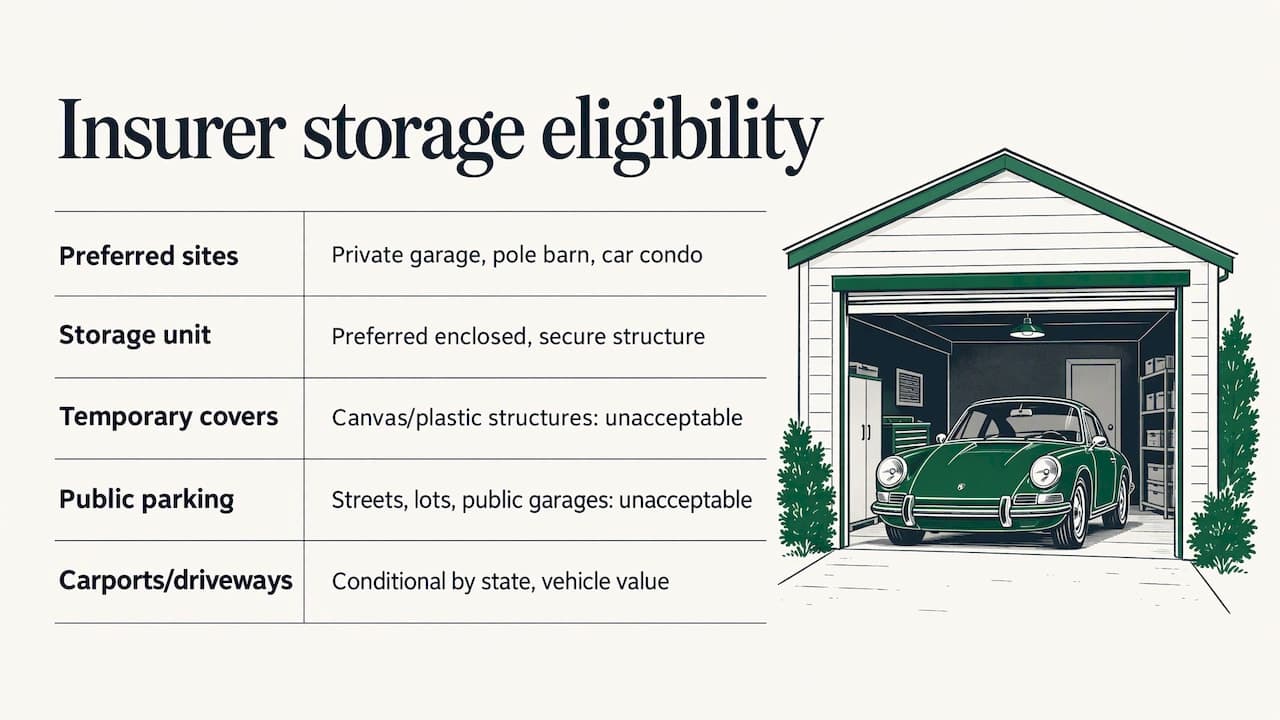
If the car is insured through a specialty collector policy, the policy may limit where it can be kept. Hagerty’s eligibility guidelines prefer an enclosed, secure structure such as a private garage, pole barn, car condo or storage unit. They list temporary canvas or plastic structures, streets, parking lots and public parking garages as unacceptable. Carports and driveways are considered only under conditions that vary by state and vehicle value. Read your own policy, and ask your agent before you sign a storage contract.
When climate control is worth it
An enclosed building keeps out rain, sun, dust and most thieves. Climate control goes further. It manages the two things that quietly damage old cars: temperature swings and moisture.
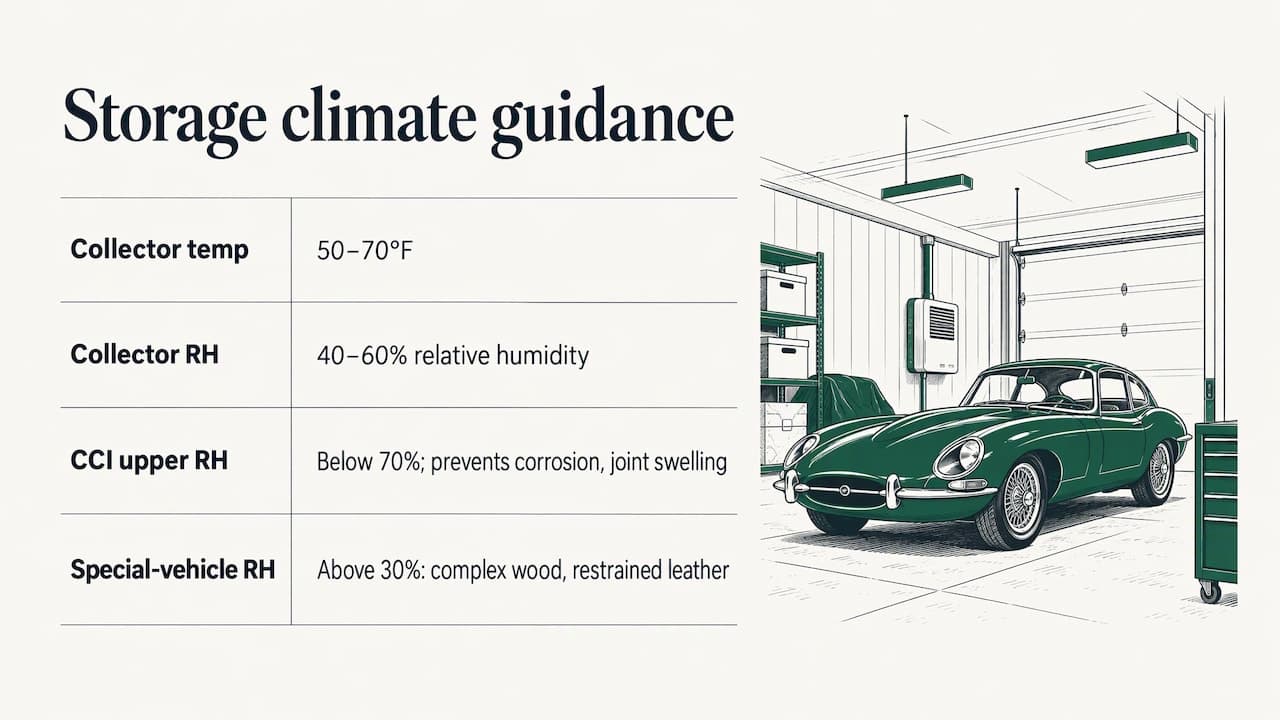
One published benchmark for collector storage is a steady 50 to 70 degrees Fahrenheit with relative humidity between 40 and 60 percent. The Canadian Conservation Institute, a federal heritage body, gives guidance for preserving vehicles. It advises keeping relative humidity below 70% to prevent rapid corrosion and swelling of wooden joints. It also advises keeping it above 30% for vehicles with complex wooden parts or restrained leather. Cooler storage slows the breakdown of rubber and plastic, but lowering heat without managing humidity can push humidity up.
The practical reading: you want a cool, stable space with humidity actively controlled, not just a heated or unheated box.
Signs you should pay for it
- The car has original paint, leather, wood trim or a soft top.
- It will sit for six months or longer, such as over a northern winter.
- You live on the coast, where salt air speeds corrosion, or somewhere with big seasonal swings.
- The car’s value or originality is the reason you own it.
An unheated garage still beats exposure. Progressive notes that it is better than somewhere more open to the elements, and that any garage helps deter theft. If you park under a carport, avoid grass and dirt, which trap humidity.
What to look for in a facility
Security and care are what separate a parking space from proper collector storage. Use this checklist on every tour or call.
Security and safety
- Monitoring. Chubb recommends a centrally monitored alarm, ideally UL listed, with door and window contact sensors, glass-break and motion sensors, smoke and heat detection, and a cellular backup.
- Fire and water. The same guidance points to clean-agent extinguishers that use inert gas rather than fine powder, plus gas-leak and water-leak detection, digital video recording and a backup generator.
- Cameras and access. American Collectors Insurance suggests confirming that access is limited to daylight hours and that staff verify the building is empty each day. It also suggests asking for a camera facing your unit that will share footage if something happens.
- Gates and surveillance. State Farm also lists gated premises and video surveillance as services worth comparing alongside price.
Care while the car sits
- Battery maintenance with a proper tender. Chubb advises choosing a climate-controlled facility with power and a battery maintenance device.
- Periodic starts or exercise drives by trained staff. State Farm mentions personnel who regularly start and drive the car.
- Fluid checks, detailing and written inspection reports.
- Enclosed transport if you cannot drop the car off yourself.
These are the services we focus on at NapGarage, and they are the ones worth asking every provider about.
Insurance
Even good storage is not a substitute for coverage. American Collectors Insurance points out that general storage facilities are generally not as secure as a home. It also advises telling your insurer the storage location, since rates may change and an unreported location can cause problems after a theft or vandalism claim. Ask facilities whether they carry their own garage-keepers coverage, and keep your own policy current.
How to prepare the car for storage
A good facility does a lot, but a car that arrives prepared stays healthier. Follow your owner’s manual or marque specialist first. These steps are common across the sources.
- Detail it inside and out. Wash, wax and clean the interior. American Collectors Insurance recommends starting with a thorough detail.
- Change the oil and filter. Used oil carries contaminants you do not want sitting in the engine.
- Handle fuel deliberately. Many guides say to fill the tank, add stabilizer and drive the car so it circulates. Progressive notes the debate: draining the tank is the most cautious route, while some experts fill it and stabilize. Ask your specialist which suits your car.
- Top up fluids. State Farm lists brake fluid, windshield fluid and coolant.
- Protect the battery. Use a battery tender, not a plain trickle charger, or disconnect the cables. Batteries lose roughly 5% to 10% of their charge per month when idle.
- Set the tires. Guides suggest adding a few psi. AMA’s storage tips say to add 10 PSI for storage under 45 days. Tire cradles also prevent flat spots.
- Leave the parking brake off. Use a wheel chock instead.
- Keep pests out. Seal the exhaust tip and air inlet, and use deterrents. AMA also suggests desiccant packs for moisture.
- Use a breathable cover. Even indoors, it keeps off dust and animal damage.
- Protect against ground moisture. If the floor is not hard concrete, American Collectors Insurance advises a polyurethane tarp under the car. Progressive suggests a plastic vapor barrier.
For short-term storage, Ford’s owner guidance says to move a stored vehicle at least 25 feet every 15 days. It also says to run the engine for a minimum of 15 minutes at that interval. A facility that offers exercise drives takes that job off your plate.
Balancing easy access with protection
Many owners want to visit the car, show it off or take it out for a weekend. The trade-off is how the facility moves vehicles. American Collectors Insurance warns that in stacker storage, a car at the bottom gets started and moved whenever someone above wants out. That can add dozens of cold starts a year, which is hard on older cars and 6-volt batteries.
Questions that protect both your access and your car:
- How much notice do you need to give for a pickup or drive-out?
- Who moves the car, and how is it moved?
- Can you see the car without visiting, through photos or reports?
- Is there enclosed transport if you want the car delivered?
This is where the technology matters. When a facility sends photo check-ins and inspection reports to your phone and lets you request a pickup in an app, you stay informed without extra trips, and the car is handled only when it needs to be.
What classic car storage costs
Prices depend on location, enclosure type, climate control, car size and service level. Published ranges:
- A HomeAdvisor estimate puts US car storage at $45 to $450 a month, with elaborate, secure units costing the most.
- One collector-car guide puts professional storage at $100 to $500 a month, depending on quality and location.
- Classic Motorsports reports spots in cities like New York and Los Angeles running as high as $750 a month, and as low as $150 in cheaper areas.
- On square footage, StorTrack’s January 2026 data shows enclosed units at hybrid facilities averaging $1.09 per square foot and purpose-built enclosed storage averaging $0.70. Uncovered parking averages about $0.35.
What moves the price within those ranges:
- Climate control. Usually the biggest step up from a plain enclosed unit.
- Services. Battery tending, exercise drives, detailing and inspections cost more than a bare space.
- Metro area. Suburban and rural locations are typically cheaper than urban cores.
- Vehicle size. Long cars take more space and handling.
- Access frequency. More pickups and drive-outs mean more labor.
NapGarage doesn’t publish a price, because the cost is set by the facility you choose. Request quotes for your car and compare them like for like: same enclosure, same climate standard, same services.
Our perspective
Most people shop classic car storage by price per month. We think that is the wrong first filter. The first question is what the car needs: a stable environment, a charged battery, regular movement and someone who notices when something changes.
That is why we focus only on enthusiast-grade storage. The facilities we work with are built around collector, exotic and classic cars. Climate-controlled space, battery maintenance, fluid checks, detailing and exercise drives are part of how they care for a car, not afterthoughts.
The other half is information. A car in storage should not be a black box. Inspection reports and photo check-ins on your phone tell you how it is doing. The app lets you request a pickup or details without calling around. You stay close to the car without driving to the building.
If you are choosing between a parking space and real care, think about what the car is worth to you, not just what the space costs.
Vitali
Find enthusiast-grade storage near you
If you are ready to compare options, NapGarage helps you find climate-controlled storage for exotic, classic and collector cars, with services like battery maintenance, detailing, fluid checks, exercise drives, inspection reports, photo check-ins and enclosed transport. You manage pickups and updates from the app.

Start with exotic and classic car storage to see what is available, or browse storage by city to look near you. Examples include Sterling, Virginia, Indianapolis and San Diego. Submit a quote request and the facility will come back with availability and pricing for your car.
FAQ
Do I need climate-controlled storage for a classic car?
Not every car does, but it helps most when a car has original paint, leather or wood, sits for months, or lives in a humid, coastal or cold-winter area. Controlling temperature and humidity guards against corrosion, mold and drying materials. If the car is a valuable original, we recommend it.
How much does classic car storage cost per month?
Published US ranges run from about $100 to $500 a month for professional storage, with cities like New York and Los Angeles reaching $750 for a spot. Climate control, services and location drive the difference. Ask for a written quote that lists exactly what is included.
Should I keep gas in the tank?
Sources disagree. Draining the tank as much as possible is the most cautious route, while others fill it, add stabilizer and drive the car first. Follow your owner’s manual or ask a specialist for your particular car.
Do I have to tell my insurer where the car is stored?
Yes. American Collectors Insurance advises notifying your insurer of the storage location, as rates may change and an unreported location can cause problems after a claim. Check your policy’s storage requirements before you move the car.
Sources
- The U.S. Vehicle, Boat & RV Storage Market, StorTrack
- How to Find the Best Classic Car Storage, GearJunkie
- Preparing for Long Term Car Storage, State Farm
- Eligibility Guidelines, Hagerty
- How to Store a Collector Car, Modern Car Collector
- Caring for vehicles, Canadian Conservation Institute
- Classic Car Storage Tips, Progressive
- 10 tips for safely storing your vehicle, Chubb
- Best Practices for Classic Car Storage, American Collectors Insurance
- Storing Your Vehicle, Ford Service Content
- Vehicle Storage Tips for Your Idle Automobile, AMA
- Classic Car Statistics, Tool Troopers
- What you need to know about classic car storage, Classic Motorsports