Cost of Car Storage: What You'll Pay by Type and City

Cost of Car Storage: What You’ll Pay by Type and City
Most drivers pay around $105 a month to store a car, but the range is wide: about $17 for an outdoor space up to $450 or more at a staffed, climate-controlled facility built for collector cars, according to Driven Life’s November 2026 roundup of listings data. The gap between those two numbers is not markup. It is the difference between parking a car and caring for one. If your car is exotic, classic or simply irreplaceable, the useful question is what each dollar buys: climate control, battery upkeep, inspections, exercise drives and a person who notices when something changes.
NapGaragenapgarage.comStorage That Cares for Collector CarsNapGarage combines climate-controlled storage with battery maintenance, fluid checks, detailing, exercise drives and photo check-ins on your phone.VisitKey Takeaways
- Typical US pricing runs from about $17 a month (outdoor) to $450 or more (staffed, climate-controlled collector storage). Most people pay around $105.
- Climate control adds roughly $25 to $50 a month on a standard indoor unit. Collector-grade care is priced as a service, not as square footage.
- City matters more than almost anything else. Collector-car spots in New York and Los Angeles can reach $750 a month, while less expensive areas have been seen near $150.
- Compare facilities on what the monthly rate includes: battery maintenance, fluid checks, detailing, exercise drives, inspection reports and pickup notice.
- Multiply the monthly rate by the months you will store the car, then add insurance and servicing, to see the true yearly cost.
Table of Contents
- What car storage costs per month in the US
- Why prices differ so much by city
- The factors that move your monthly rate
- What a collector-grade rate should include
- The real yearly cost of storing a collector car
- How to compare quotes
- Perspective
- Find climate-controlled storage near you
- FAQ
- Sources
What car storage costs per month in the US
The figures below come from Storage.com listings data (updated September 11, 2026) as reported by Driven Life on November 8, 2026. They are a snapshot of listing prices for that period. Listings change as demand and inventory move, so treat them as a guide to the shape of the market and get a fresh quote before you decide.
| Storage type | Typical monthly range | What you get |
|---|---|---|
| Outdoor, uncovered | $17 to $100 | A parking space, usually fenced or gated |
| Covered (carport style) | $50 to $200 | Roof overhead, open sides |
| Indoor, enclosed unit | $150 to $270 | Walls and a door, self-serve access |
| Climate control add-on | +$25 to $50 | Temperature and humidity moderation |
| Staffed collector facility | Often $350 to $500 and up | Care services, reporting and handled pickups |
The last row is a pattern in posted prices rather than a published range. One example in Raleigh, NC posted $350 a month for members, $450 for non-members and $500 for short-term storage. That rate included a battery trickle charge, 24-hour video surveillance, pick-up and drop-off six days a week on two hours’ notice, and condition photos signed off at every check-in and check-out, per the same Driven Life report.
Size shifts the number too. By Storage.com’s figures, a 10x20 unit averages about $119 a month, a 10x25 about $127 and a 10x30 about $149. A single car fits in a 10x20, so unit size rarely explains why one quote is double another. The service level does.
Why prices differ so much by city
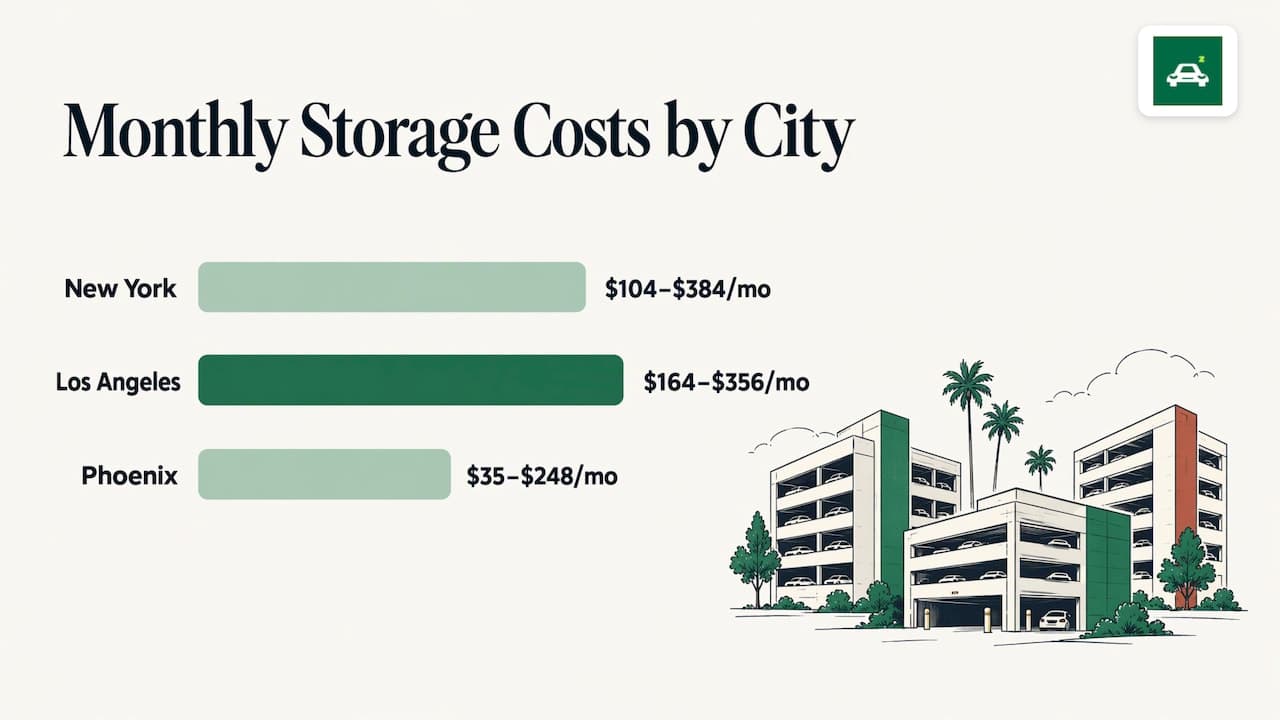
Car storage is local. Driven Life reports Storage.com’s 2026 city ranges as $104 to $384 a month in New York, $164 to $356 in Los Angeles and $35 to $248 in Phoenix. Each range spans a basic space to a premium one, so the city sets the floor and the facility’s service level sets where you land in it.
For collector cars the effect is stronger. Classic Motorsports reports that a collector-car parking spot in a major city such as New York or Los Angeles can cost as much as $750 a month, while in less expensive areas prices have been seen as low as $150. The same article notes that collectors don’t want to travel more than 10 to 15 minutes to get their cars for events, which is why a facility in one suburb doesn’t compete with one in the next and why urban car barns can charge premium prices despite limited real estate.
That is worth planning around. A rate that looks high in your city may be fair once you factor in how quickly you can have the car out for a Saturday drive. You can browse exotic and classic car storage by city to see which markets have facilities near you.
The factors that move your monthly rate
Climate control and building quality
Climate control is the most common upgrade, adding about $25 to $50 a month on top of an indoor unit. For a car with original paint, leather, rubber seals or a carbureted engine, steady temperature and humidity are the main reason to store indoors. Building details matter as well. Floor finish, for instance, affects dust and how easy a space is to keep clean, and this comparison of garage floor finish options explains how sealed concrete and epoxy differ.
Self-serve versus staffed
Driven Life notes that self-serve units cost less than facilities that bring the car out on notice. That is a real difference in labor: someone has to move your car, keep it charged and be there when you ask for it. If you want to keep the car without managing it, staffed storage is where the work of ownership gets handled.
Contract length
Short-term rates are higher. In the Raleigh example above, short-term storage was $500 a month against $450 for a regular non-member. Long-term contracts usually carry lower monthly rates than short ones, so if you know the car is staying for a season or more, say so when you request a quote.
Season and region
Indoor storage can cost more in winter in cold regions when demand rises. If you live somewhere with snow, the cheapest time to arrange storage is usually before the first cold snap pushes everyone to book at once.
Access limits
Classic Motorsports points out that most storage units limit how many times a car can come and go without extra charges. If you drive your car every weekend, ask what the access policy is before you compare headline rates.
What a collector-grade rate should include
A price per month only means something next to a list of what it covers. For an exotic, classic or collector car, these are the line items to ask about:
- Battery maintenance. A charger or trickle charge keeps a car from coming out to a dead battery.
- Fluid checks. Leaks and low levels are easier to catch on a schedule.
- Exercise drives. Cars that sit develop problems. Classic Cars Arena’s David Mercer warns that a car that sits can develop seized calipers, perished seals, flat-spotted tires and varnished fuel, and says carrying costs should assume a few thousand miles of exercise a year.
- Detailing. Dust cover or regular wash and wipe-down so the car is ready when you are.
- Inspection reports and photo check-ins. Documented condition at drop-off and during storage, ideally sent to your phone.
- Pickup and notice. How fast the car can be brought out, and on which days.
- Enclosed transport. If the facility is not near you, a covered way to move the car.
These are the services NapGarage is built around: climate-controlled storage with battery maintenance, detailing, fluid checks, exercise drives, inspection reports, photo check-ins, enclosed transport, and pickup requests through a mobile app. When a facility bundles them, you can compare quotes on one basis instead of adding up optional extras.
The real yearly cost of storing a collector car
Storage is one line in a larger budget. Classic Cars Arena’s January 2026 ownership guide gives annual ranges for classic luxury cars: agreed-value insurance of $400 to $1,500 a year, climate-controlled storage of $1,200 to $3,600 and routine servicing of $800 to $3,000.

Insurance and storage are also linked. Classic car policies usually limit use and come with storage requirements: insurers enforce conditions such as a secured garage when the vehicle isn’t in use. Professional indoor storage satisfies that requirement, and it is worth telling your insurer where the car is kept.
A simple worked example for a car stored year-round at a staffed facility:
| Line | Monthly | Yearly |
|---|---|---|
| Storage with care services | $450 | $5,400 |
| Agreed-value insurance (mid-range) | about $75 | $900 |
| Routine servicing (mid-range) | about $150 | $1,800 |
| Total | about $675 | about $8,100 |
The storage figure is an illustration based on the Raleigh posted rate, and the insurance and servicing figures are the midpoints of the ranges above. Your quote will differ, but the method holds. Husky Liners’ storage guide suggests multiplying the monthly cost by the number of months stored and comparing the total with the vehicle’s value. For a collector car whose value is far above a year of storage, that comparison is easy.
How to compare quotes
Two quotes that look $100 apart are often not for the same service. Work through them in this order:
- Write down your usage. How many times a month will you take the car out, and do you need it on short notice?
- Ask for the inclusions in writing. Battery, fluids, detailing, exercise drives and reports should each be listed as included, extra or unavailable.
- Check the building. Ask about climate control, fire and security systems, and whether your car is stored enclosed.
- Ask about access. Notice period, days of pickup and any limit on trips in and out.
- Confirm term pricing. Ask for the monthly rate at one month, six months and twelve months.
- Match the insurance. Tell your insurer the address and ask whether any storage condition applies.
- Price the commute. A facility 10 to 15 minutes away makes it easier to use the car. A facility farther away may be worth it only if transport is covered.
Perspective
The most common mistake we see in budgeting is comparing the price of a parking space with the price of care. A space keeps the rain off. Care means the battery is maintained, the fluids are checked, the car is driven and cleaned, and you know all of it happened.
That is why we focus only on enthusiast-grade storage. Our approach is to put the information in your hands: inspection reports and photo check-ins on your phone, and pickup requests through the app, so you can keep up with your car without driving to the facility.
When you compare cost, compare the whole package. A rate that includes climate control, exercise drives, detailing and reporting is a rate you can plan a year around.
NapGarage Team
Find climate-controlled storage near you
NapGarage lists exotic and classic car storage facilities and lets you compare them in one place. The service is built around climate-controlled storage, battery maintenance, detailing, fluid checks, exercise drives, inspection reports and photo check-ins, with pickups and details requested from the mobile app.

Start with all exotic and classic car storage, or go straight to a city: Los Angeles, Philadelphia, Indianapolis or Miami. For a longer walk through choosing and preparing, read our guide to classic car storage and budgeting.
FAQ
How much should I pay for car storage per month?
For a typical car, listings data puts most payments around $105 a month, with a spread from about $17 outdoors to $450 or more at a staffed climate-controlled facility. For an exotic or classic car, budget toward the upper part of that range because it includes care services. The right number depends on your city and on what the rate includes.
Is climate-controlled storage worth the extra cost?
Climate control typically adds $25 to $50 a month to an indoor unit. For a car with original paint, leather, rubber and seals, stable temperature and humidity are the main benefit of indoor storage. Many collector facilities include it as standard.
Does the monthly rate include insurance?
Generally no. Insurance is a separate cost, and classic car policies often come with storage conditions such as a secured garage. Classic Cars Arena’s guide gives agreed-value insurance at $400 to $1,500 a year for classic luxury cars, so budget for it alongside storage.
Are short-term rates higher than long-term rates?
Yes, usually. Long-term contracts typically carry a lower monthly rate. The Raleigh example reported by Driven Life shows $500 a month short-term against $450 for regular non-member storage. If you know how long the car will stay, ask for a quote at that term.
Sources
- How Much Does Car Storage Cost? Monthly Prices by Type (Driven Life)
- What you need to know about classic car storage (Classic Motorsports)
- Classic Luxury Car Ownership Costs: A Complete Buying Guide (Classic Cars Arena)
- How to Prepare Your Car for Storage (Husky Liners)
- Classic Car Insurance in California (Insurify)
- Polished Concrete vs. Grind & Seal vs. Epoxy (garage floors)