Battery Tender for Stored Cars That Works
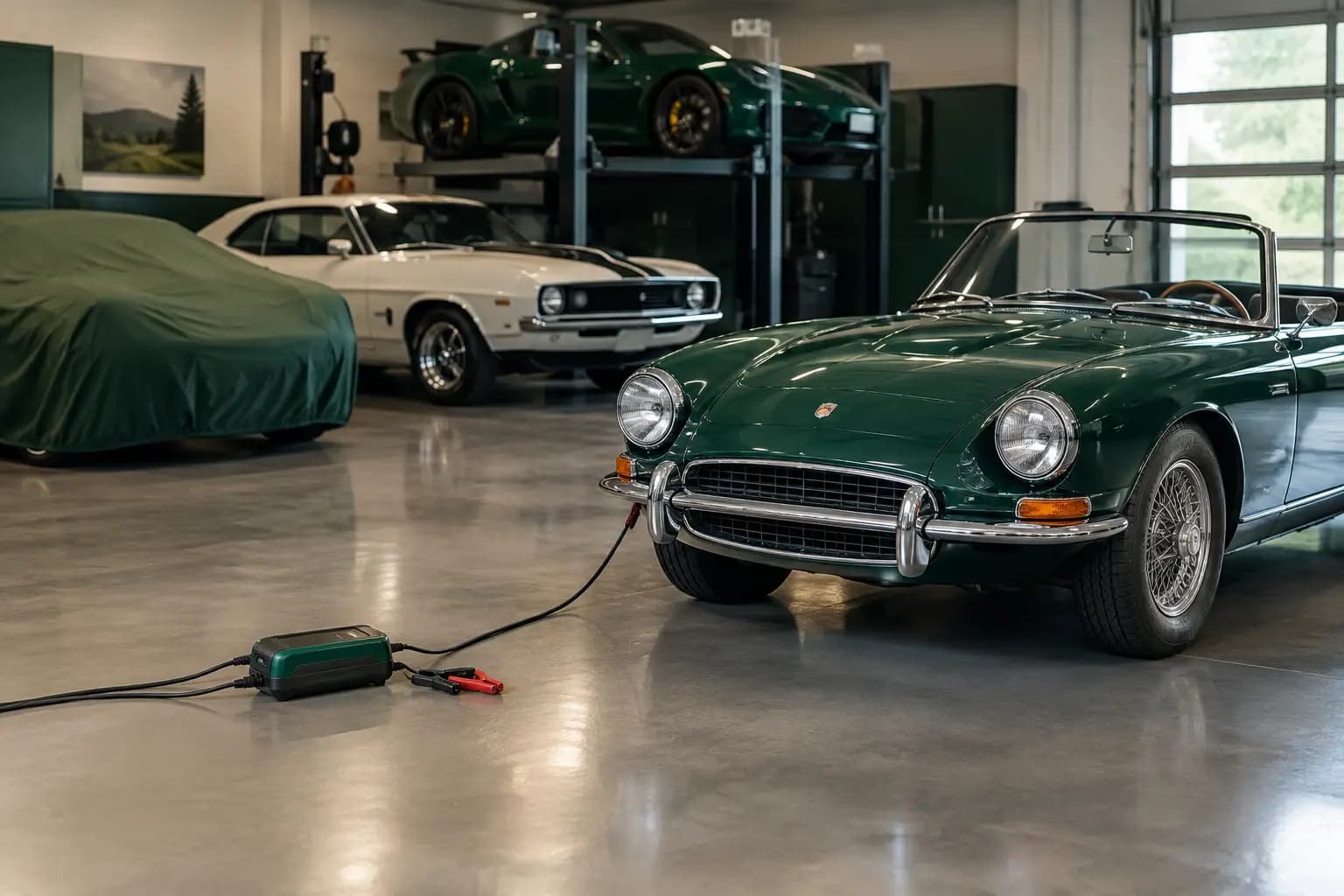
A battery tender for stored cars is not a minor convenience. For a collector car sitting for weeks or months, it is one of the simplest ways to prevent an avoidable no-start situation, protect battery life, and keep pickup day from becoming a service call. The key is not merely plugging in a charger. It is using the correct unit, connecting it safely, and confirming that someone is actually monitoring the result.
Modern exotics can have meaningful parasitic draw even when parked. Alarm systems, keyless-entry receivers, control modules, trackers, and aftermarket accessories all consume power in the background. Older classics have different issues: a battery may discharge slowly through a small electrical fault, or it may simply lose charge while sitting through a long seasonal layup. Either way, a depleted battery can mean more than an inconvenient jump-start. Deep discharge can shorten its service life, and voltage loss can create avoidable electronic faults in newer vehicles.
What a Battery Tender Actually Does
The phrase “battery tender” is often used for any device connected to a parked car, but the distinction matters. A basic battery charger delivers power to recharge a low battery. A battery maintainer monitors battery voltage and supplies a controlled amount of current only when needed. A true smart tender reduces or stops charging as the battery reaches full capacity, then resumes maintenance as voltage falls.
For long-term storage, that maintenance function is the point. Leaving a conventional charger connected indefinitely can overcharge some batteries, generate excess heat, or reduce battery life. A quality smart maintainer is designed to remain connected for extended periods, provided it is compatible with the battery chemistry and used according to its instructions.
Most collector cars in storage will have one of three battery types: flooded lead-acid, AGM, or lithium. Flooded and AGM batteries are common across classics, late-model performance cars, and many luxury vehicles. Lithium batteries are increasingly common in lightweight exotic and high-performance applications, but they require a lithium-specific charger or maintainer. Connecting a standard lead-acid tender to a lithium battery is not a shortcut worth taking.
Choosing a Battery Tender for Stored Cars
Start with the battery type, not the vehicle badge. The correct tender needs to match the battery chemistry and voltage, which is usually 12 volts for passenger vehicles. If the car uses a lithium battery, confirm both that the maintainer is lithium-compatible and that the battery manufacturer permits long-term maintenance charging.
Output matters, though bigger is not always better. A lower-amperage smart maintainer is generally sufficient for a healthy battery in static storage. Higher-output units can recharge a depleted battery faster, but storage is not about fast charging. It is about maintaining a stable state of charge without stressing the battery.
Connection style is also worth considering before the car enters storage. Alligator clips are useful for temporary work, but a fused quick-disconnect lead attached directly to the battery is neater and less likely to be disturbed during routine inspections. On many collector cars, the battery is under a cover, behind a panel, or in the trunk. A properly routed lead allows a facility team to confirm connection status without repeatedly removing trim or reaching around painted bodywork.
The tender should also have clear status indicators. A simple display showing charging, charged, fault, or disconnected gives the people caring for your car a quick visual checkpoint. The indicator does not replace a voltage test, but it makes routine inspection more consistent.
The Tender Is Only as Good as the Storage Process
A tender can fail to protect a battery if the outlet trips, a connector comes loose, or the unit enters fault mode without anyone noticing. That is why a documented storage process matters as much as the device itself.
Before storage begins, the battery should be inspected for age, corrosion, swelling, loose terminals, and evidence of leakage. A maintainer cannot revive a battery that is already at the end of its life. If the battery is weak before storage, it may continue to decline despite a tender appearing to operate normally.
The vehicle should then be connected with the ignition off and the tender positioned where its cords will not be pinched, pulled, or placed near moving parts. In a professional facility, the cable route should be tidy enough that staff can work around the car without snagging it. The unit should be connected to a suitable power source and kept away from fluids, standing water, and areas where detailing activity could disturb it.
At intake, a good practice is to record the tender make and model, connection point, initial battery condition, and visible charging status. A photo of the installed lead and status light creates a useful baseline. For vehicles with sensitive electrical systems, the facility may also record resting voltage or confirm any owner-specific instructions, such as whether a master cutoff switch should remain on or off.
How Often Should a Stored Car Be Checked?
There is no single interval that fits every car. A stable, climate-controlled environment and a healthy battery require less intervention than a vehicle with known parasitic draw, an aging battery, or an aftermarket tracker. Still, the tender status should be part of a regular visual inspection, not an assumption made at the end of the storage term.
A practical inspection routine confirms that the tender has power, its status light shows normal operation, the connection is secure, and there are no signs of battery distress. For higher-value or longer-term storage, documented check-ins can include photos and a brief condition note. That gives an owner a record of care without requiring a drive across town just to see whether the car is still connected.
If a tender indicates a fault, staff should not simply reset it and move on. They should inspect the connection, check the outlet, and test battery voltage if appropriate. Repeated faults may point to a failing battery, a parasitic draw beyond what the tender can manage, or an issue with the maintainer itself.
Climate Control Helps, but It Does Not Replace Maintenance
Climate-controlled storage reduces the temperature extremes that accelerate battery stress and can make electronics less predictable. It also supports the broader preservation plan for tires, interior materials, seals, paint, and fluids. But climate control does not eliminate parasitic draw or fix a battery with a damaged cell.
Humidity control matters indirectly as well. Corrosion at battery terminals and ground connections can create resistance and unreliable starting, particularly in vehicles stored near coastal markets or through damp seasons. A clean, secure terminal connection is every bit as relevant as the tender brand on the wall.
For cars stored over winter, ask whether the facility monitors ambient temperature and whether battery checks are included in the service level. For vehicles stored year-round, ask how a disconnected tender, tripped breaker, or battery warning is escalated. The right answer should be operationally specific, not simply “we keep an eye on it.”
When a Tender May Not Be the Right Answer
Some situations call for a different approach. If a car will be stored for a very long period without regular facility access, disconnecting the battery may be appropriate for certain vehicles. However, that decision can reset clocks, radio presets, adaptive settings, and security systems. On newer exotics, it can also create complications that require a careful recommissioning process.
A battery disconnect is also not automatically safer for every vehicle. Some cars have factory procedures for storage, specific terminal order requirements, or systems that should remain powered. Follow the manufacturer guidance and, when the car is under warranty or uses complex electronics, consult a qualified marque specialist.
Exercise drives are separate from battery maintenance. Starting a vehicle briefly and idling it may not replenish the energy used to start it, particularly with modern electrical loads. If a facility offers exercise drives, they should follow an owner-approved plan that brings the car fully to operating temperature when conditions and insurance allow. A tender remains useful between those drives.
Questions to Ask Your Storage Facility
When comparing storage options, ask whether battery maintenance is included, optional, or owner-supplied. Confirm the type of tender used, how compatibility is verified, and whether the facility provides quick-disconnect leads or expects the car to arrive prepared.
Also ask how status is documented. A photo check-in, inspection report, and clear exception process are more valuable than a vague promise. If the tender disconnects or the battery tests weak, you should know whether the team contacts you for approval, replaces the battery on request, or coordinates service with your preferred shop.
NapGarage helps owners compare collector-focused facilities on the care details that standard parking listings often omit, including climate control, battery-tender status, inspections, and ready-on-arrival service. Those details make a meaningful difference when your car is being stored for preservation, not simply parked.
A well-managed tender should be quiet evidence that the car is being cared for: connected correctly, checked routinely, and supported by a team that can act before a small electrical issue becomes an unwelcome surprise on the day you want to drive.