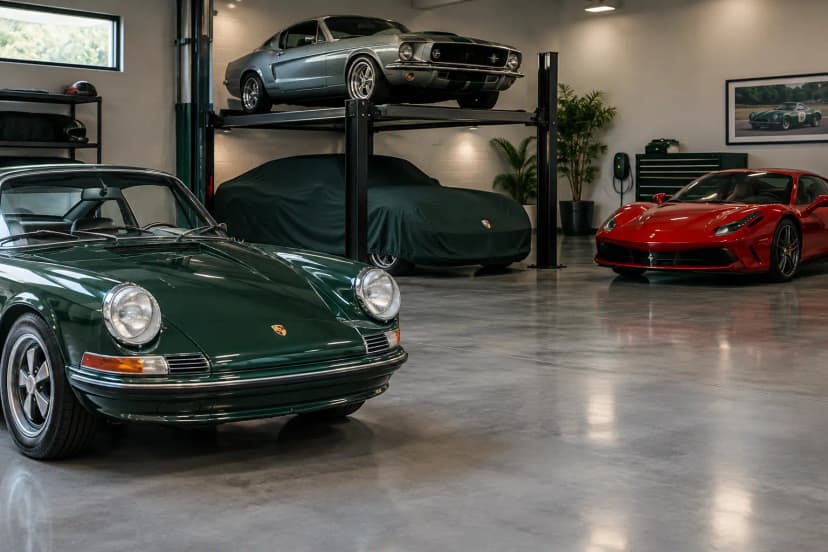
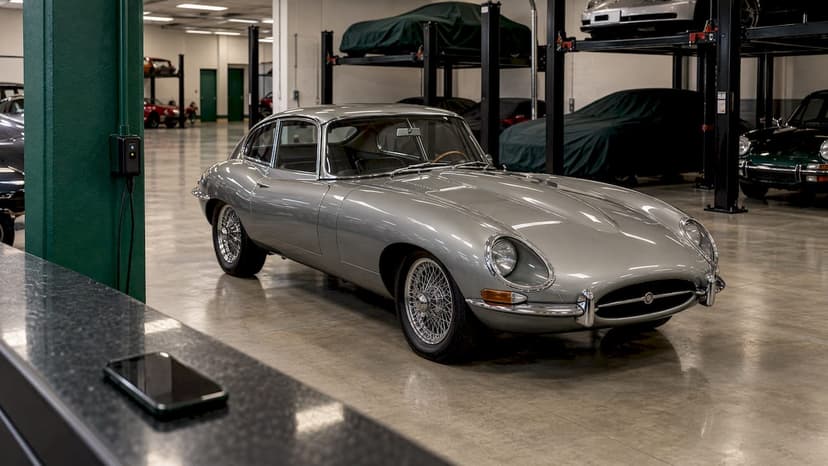
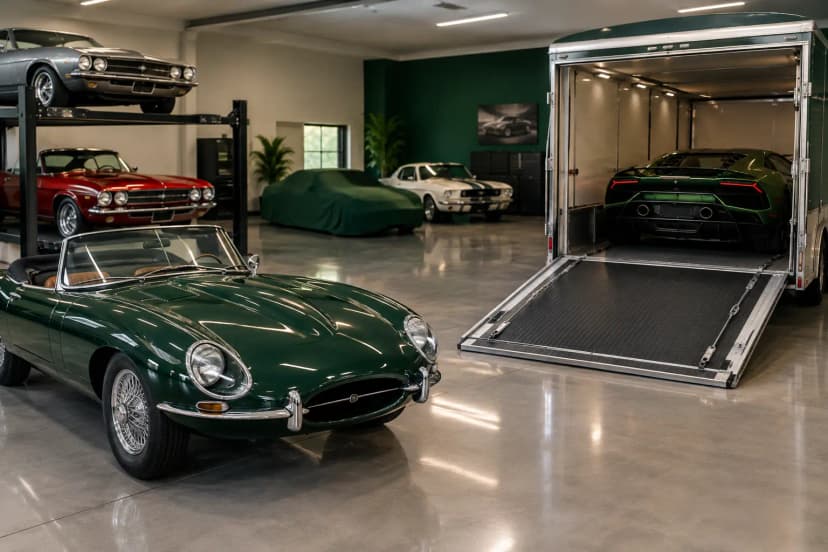
Exotic Car Storage: What to Look For and What It Costs
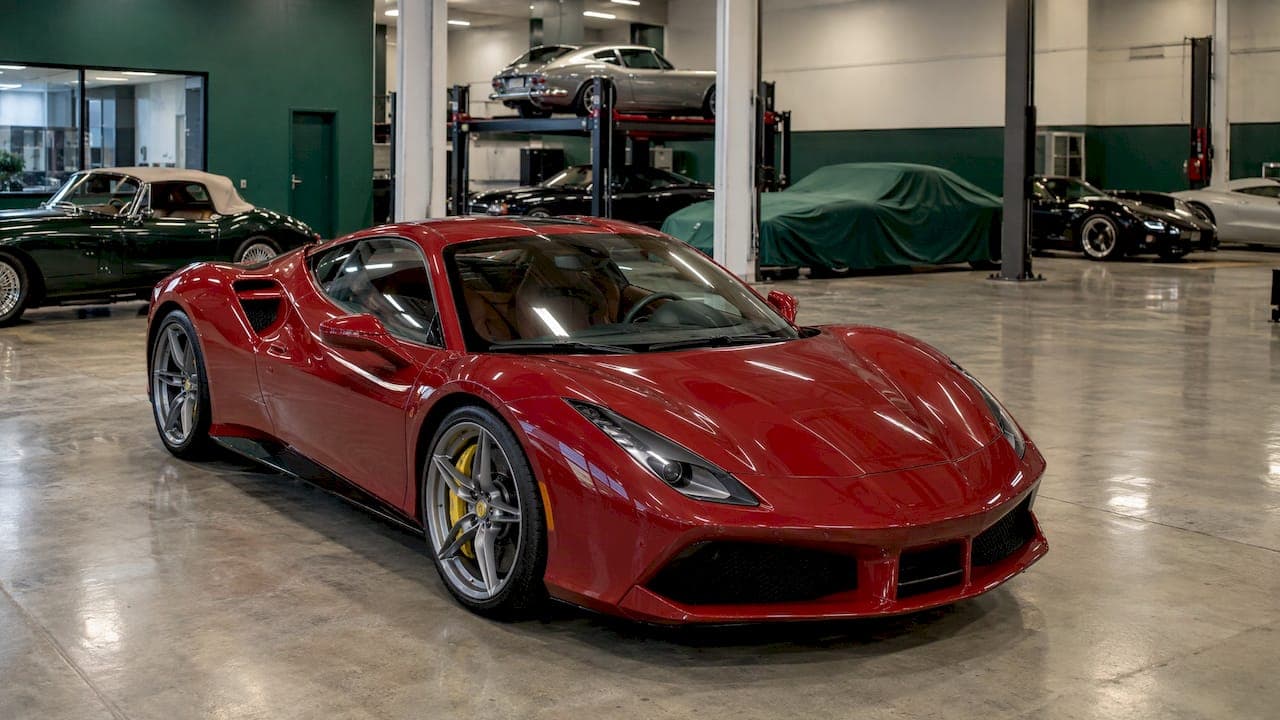
Good exotic car storage is a climate-controlled, secured indoor space where someone also looks after the car: battery, fluids, tires, cleaning and regular check-ins. A plain parking space only holds the car. Specialty storage protects it, and it should tell you how the car is doing without making you drive to the facility. We built NapGarage around that idea: you can compare enthusiast-grade facilities, request a quote, and manage pickups and updates from your phone.
This guide covers what separates exotic storage from ordinary vehicle storage, what to check on a tour, how pricing works, and how to find a facility near you.
NapGarageKeep Your Exotic Car Cared ForNapGarage combines climate-controlled storage with practical vehicle care and phone updates, so you can stay informed while your car is stored.- ✓Climate-controlled storage
- ✓Battery maintenance and fluid checks
- ✓Detailing and exercise drives
- ✓Inspection reports and photo check-ins
Key Takeaways
- Exotic storage is a service, not a space: climate control, security and routine care (battery, fluids, exercise drives) are what you are paying for.
- Published ranges run from about $150 to $750 a month depending on the metro area, and extra charges for moving the car in and out are common.
- Check access rules, lock and camera security, fire and water protection, and your insurer’s storage requirements before you sign.
- Inspection reports and photo check-ins to your phone let you stay on top of the car without visiting.
- Compare several facilities in your area through one quote request instead of calling around.
Table of Contents
- What Exotic Car Storage Actually Includes
- Why Climate Control and Routine Care Matter
- Security: What to Check Before You Sign
- How Exotic Storage Differs From a Standard Unit or Lot
- What Exotic Car Storage Costs
- Access: Can You Get to Your Car When You Want?
- Insurance: Storage Does Not Replace Your Policy
- Preparing the Car for Storage
- How to Find Exotic Car Storage Near You
- Find a Facility Through NapGarage
- Our Perspective
- FAQ
- Sources
What Exotic Car Storage Actually Includes
Ordinary vehicle storage is built around volume: a unit, a covered lot or a shared warehouse where cars sit until the owner returns. Exotic, classic and collector storage is built around condition. The car you put in should be the car you pick up, with the battery alive, the fluids in order and no dust, damp or dings.
A well-run enthusiast facility typically bundles the following, and these are the things we organize our service around:
- Climate-controlled indoor space. Stable temperature and humidity protect paint, leather, rubber seals and electronics.
- Battery maintenance. Modern exotics have parasitic drains that can flatten a battery in weeks.
- Fluid checks. Leaks and low levels show up before they become damage.
- Exercise drives. Short, controlled drives keep seals, brakes and the drivetrain from seizing up.
- Detailing. The car comes out clean and the paint is looked after while it sits.
- Inspection reports and photo check-ins. You see the condition of the car on your phone.
- Enclosed transport. Your car travels to and from storage shielded from weather and road debris.
If a facility offers only a locked door and a price per month, you are buying a parking space. Ask which of the items above are included, which are add-ons and how each is documented.
Why Climate Control and Routine Care Matter
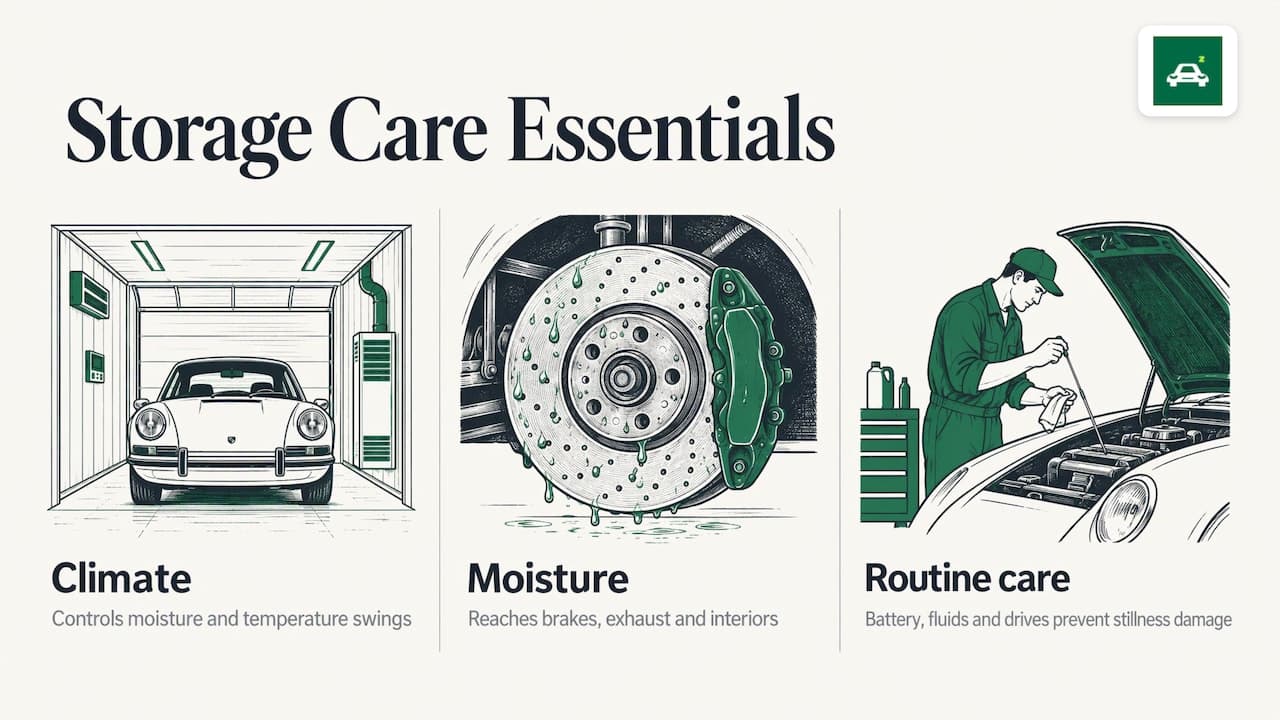
Cars deteriorate when they sit. Insurer guidance on storing a vehicle points to moisture, corrosion, rodents and battery care as the practical risks, and says secure indoor storage plus proper preparation reduces them, as Progressive’s classic-car storage guidance lays out. Moisture is the quiet one: humidity gets into brakes, exhaust components and interiors, and a car left in an unheated, unventilated building can develop problems that do not show until spring.
Climate control answers the moisture and temperature swings. Routine care answers the rest. A battery that is tended, fluids that are checked and a car that is started and driven on a schedule avoid the flat tires, stale fuel and stuck components that come from months of stillness.
This is why exercise drives and fluid checks are worth looking for. They are not luxuries on a high-value car. They are the reason the car starts and drives the day you come back for it.
Security: What to Check Before You Sign
A high-value car needs real protection from theft, fire and water. Chubb’s guidance on storing a vehicle recommends centrally monitored alarms and, where appropriate, linking cameras, water or gas detection and backup power. Use that as a checklist on a tour.
Ask the facility:
- Who can get in? Insurers set standards here. Hagerty’s underwriting guidelines say an acceptable rental unit is an individual secure space that is not open to the public and that only the owner can access. Its published auto guidelines also say a parking garage needs 24-hour security, limited access and preferably assigned enclosed spaces, and that public elevated parking decks are unacceptable.
- Is the alarm monitored? A siren no one hears is not security. Ask whether alarms are monitored around the clock.
- Is the building verified empty at close? American Collectors Insurance advises asking whether the facility is checked to be empty at the end of every day, and verifying lock and access security.
- What about cameras? The same source notes that many general storage facilities will not share video footage even after a police report. Ask how footage is kept and who can request it.
- What protects against fire and water? Ask about detection, suppression and how the building handles flooding and power loss.
A specialty facility that stores only collector cars tends to have thought through these answers, because its customers ask. That is a good reason to start with enthusiast-grade facilities rather than general storage.
How Exotic Storage Differs From a Standard Unit or Lot
| Feature | Standard storage unit or lot | Exotic and collector car storage |
|---|---|---|
| Environment | Often unheated, or only covered | Climate-controlled indoor space |
| Care while stored | None, you handle everything | Battery maintenance, fluid checks, exercise drives |
| Updates | You visit to see the car | Inspection reports and photo check-ins to your phone |
| Neighbors | Furniture, boats, household goods | Other collector and exotic cars |
| Cleaning | Not offered | Detailing available |
| Transport | Arrange it yourself | Enclosed transport and pickup requests |
The row that matters most is care. A unit gives you space. A collector facility gives you a plan for the car.
What Exotic Car Storage Costs
Prices vary more by location than by anything else. A 2026 report in Classic Motorsports found that storage can run as low as $150 per month in less expensive areas and as high as $750 per month in New York or Los Angeles. Prices change, so use that as a range for planning, not a quote.
For context on ordinary storage, GearJunkie’s December 2022 piece reports a HomeAdvisor estimate of $45 to $450 per month for car storage depending on whether it is outdoor, covered, indoor or climate-controlled indoor. It adds that club-style facilities with broader services can cost thousands of dollars a year. Exotic storage with maintenance services sits at the upper end of those figures because you are paying for care and not only square footage.
What moves the price:
- Metro area. Real estate drives the monthly rate. Los Angeles and New York sit at the top of the range.
- Climate control and security level. A fully conditioned, monitored building costs more than a covered bay.
- Services. Battery tending, detailing, exercise drives and inspection reports may be included or billed separately.
- Car size and count. Larger vehicles and multi-car collections can change the rate.
- Contract length. Longer commitments can lower the monthly figure.
- Movement fees. Classic Motorsports notes that facility storage can reduce handling risks, but frequent vehicle movements can trigger extra charges. If you plan to drive the car often, ask exactly how in-and-out access is priced.
When you request quotes, ask for the monthly rate, what it includes, what each add-on costs and how access and transport are billed, so you compare like for like.
Access: Can You Get to Your Car When You Want?
Collectors fall into two groups. Some store a car for the winter and want it untouched. Others want to take it out for a weekend drive or a show and bring it back. Both are fine, but the facility’s access policy decides how smooth that is.
Ask about:
- Hours and notice. Is access by appointment, or can you arrive during set hours? How much notice does a pickup need?
- Fees per movement. Some facilities charge for each time the car is moved, so frequent use changes the real cost.
- Who moves the car. On a high-value car, you want to know who drives it and how it is handled.
- Remote requests. Being able to request a pickup or details from your phone saves a call and a trip. This is how our app works: you request pickups and details in the app, and you can see updates on the car without visiting the facility.
Insurance: Storage Does Not Replace Your Policy
GearJunkie’s guidance is plain that storing a car does not mean you should cancel your own insurance policy. The car is still your asset and still exposed to fire, theft and water damage while in someone else’s building.
Three steps to take before the car moves in:
- Tell your insurer where the car will be. American Collectors Insurance advises owners to notify their insurer of the storage location. Some policies set conditions on where the car is kept.
- Ask what your policy requires of the facility. Insurer standards, like the Hagerty ones above, can specify access and security features. Get the requirement in writing from your insurer or agent, who is the right person to confirm it for your policy.
- Check the facility’s own coverage. Ask what its insurance covers and what it does not, so you know where your own coverage picks up.
If the car is financed on a lease, the insurance question has another layer, because the lessor usually has a stake in the vehicle. Read up on insuring a car under financial lease and confirm the requirements with your lessor and insurer before you store.
Preparing the Car for Storage
Even with a facility that does the maintenance, a car goes in best when it is prepared. Typical preparation covers:
- A full wash and a clean interior, so dirt and moisture do not sit on surfaces.
- Fresh oil and a full tank with a fuel stabilizer if the car will sit for months.
- Tires inflated to the recommended pressure.
- The battery connected to a tender, or left to the facility’s battery maintenance.
- Documents, keys and instructions for the car’s quirks handed over, so the people looking after it know what to do.
Progressive’s guidance on moisture, corrosion, rodents and battery care is a useful reference for the owner’s side of that list. With a service that includes detailing, battery maintenance and fluid checks, much of the ongoing work moves from you to the facility.
How to Find Exotic Car Storage Near You
Searching for storage near you works best when you start from your metro area and narrow by what the facility offers. A short process:
- Set your must-haves. Climate control, enclosed transport, exercise drives, a monitored building, or all four.
- Pick your radius. Closer is convenient for drop-ins. A facility farther out may cost less per month, but the pickup or transport adds up.
- Request quotes from more than one facility. Rates and inclusions differ, and so do access terms.
- Tour the one you like. Walk through the checklist from the security section and look at the cars already inside.
- Confirm insurance and access in writing.
We list enthusiast-grade facilities across the country on our storage directory and by city. Examples include Los Angeles, Miami, Orlando, Chicago, Sterling, Virginia and Stuart, Florida. You submit one quote request and the facilities respond, so you do not repeat yourself on five phone calls.
Find a Facility Through NapGarage
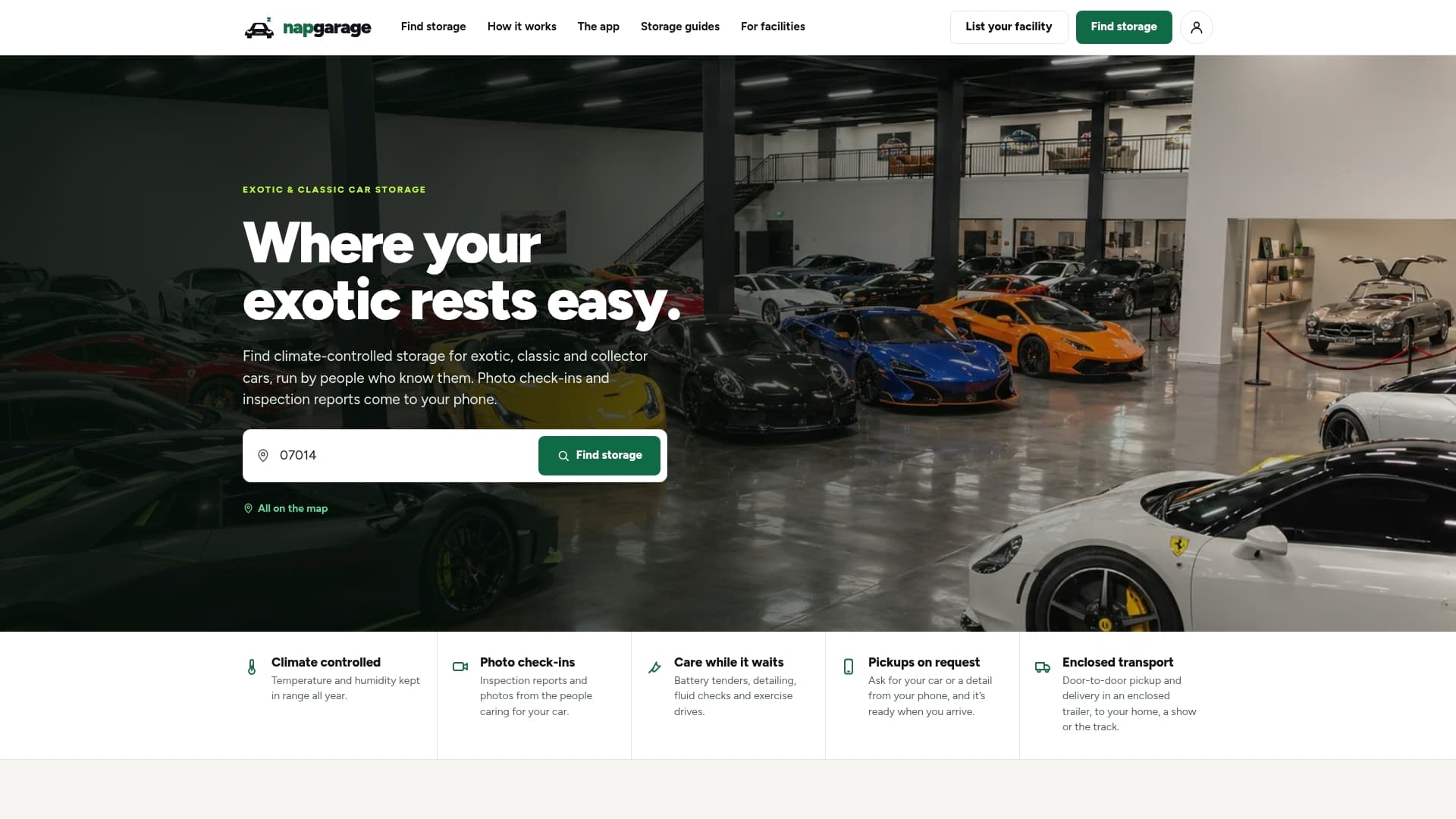
If you want storage that goes beyond a locked door, NapGarage is a place to start. You can look at climate-controlled facilities for exotic, classic and collector cars, request a quote, and then use the app to request pickups and details, receive inspection reports and see photo check-ins on your phone. Battery maintenance, fluid checks, detailing, exercise drives and enclosed transport are part of the care we organize around.
Browse exotic and classic car storage and send your quote request when you find a location that fits.
Our Perspective
Most collectors do not lose sleep over the building. They lose sleep over not knowing. Is the battery holding? Did anyone look at the car this month? Has anything changed since the last visit?
That is why we focus only on enthusiast-grade storage. A car that sits in a climate-controlled space with battery maintenance, fluid checks and exercise drives is in a very different position from one parked in a generic unit. Add inspection reports and photo check-ins on your phone, and you stop wondering and start seeing.
We also think managing a car should not require a drive across town. Requesting a pickup or details from the app means your collection fits your schedule, whether you travel, own several cars or just want the weekend car ready on Friday.
When you compare facilities, look for the ones that treat storage as care. That is the standard we hold the listings on our site to.
NapGarage Team
FAQ
How much does exotic car storage cost per month?
Published ranges run from about $150 a month in lower-cost areas to about $750 a month in New York or Los Angeles, according to Classic Motorsports. Services, security and access terms change the total, so ask each facility for what the rate includes.
Is climate-controlled storage necessary for an exotic car?
It is the standard for high-value cars. Stable temperature and humidity limit the moisture and corrosion risks that insurer guidance names for stored vehicles. Combined with battery maintenance and fluid checks, it keeps the car ready to drive.
Do I still need insurance on a car in storage?
Yes. Storage does not replace your policy, and your insurer may set conditions on where the car is kept. Tell your insurer the storage location and confirm any facility requirements with your agent before the car moves in.
Can I drive my car while it is in storage?
Usually yes, but check the facility’s access rules and fees first. Frequent movements can trigger extra charges at some facilities, so ask how pickups and in-and-out access are billed. With NapGarage you can request pickups and details through the app.
How do I find exotic car storage near me?
Start with your metro area and request quotes from enthusiast-grade facilities rather than general storage. Compare what each includes, then tour your favorite. Our city directory lists locations you can request a quote from.
Sources
- What you need to know about classic car storage, Classic Motorsports
- How to Find the Best Classic Car Storage, GearJunkie
- Classic Car Storage Tips, Progressive
- 10 tips for safely storing your vehicle, Chubb
- Hagerty Auto Guidelines
- Best Practices for Classic Car Storage, American Collectors Insurance
- Insuring a car under financial lease