Remote Car Monitoring for Stored Collector Cars

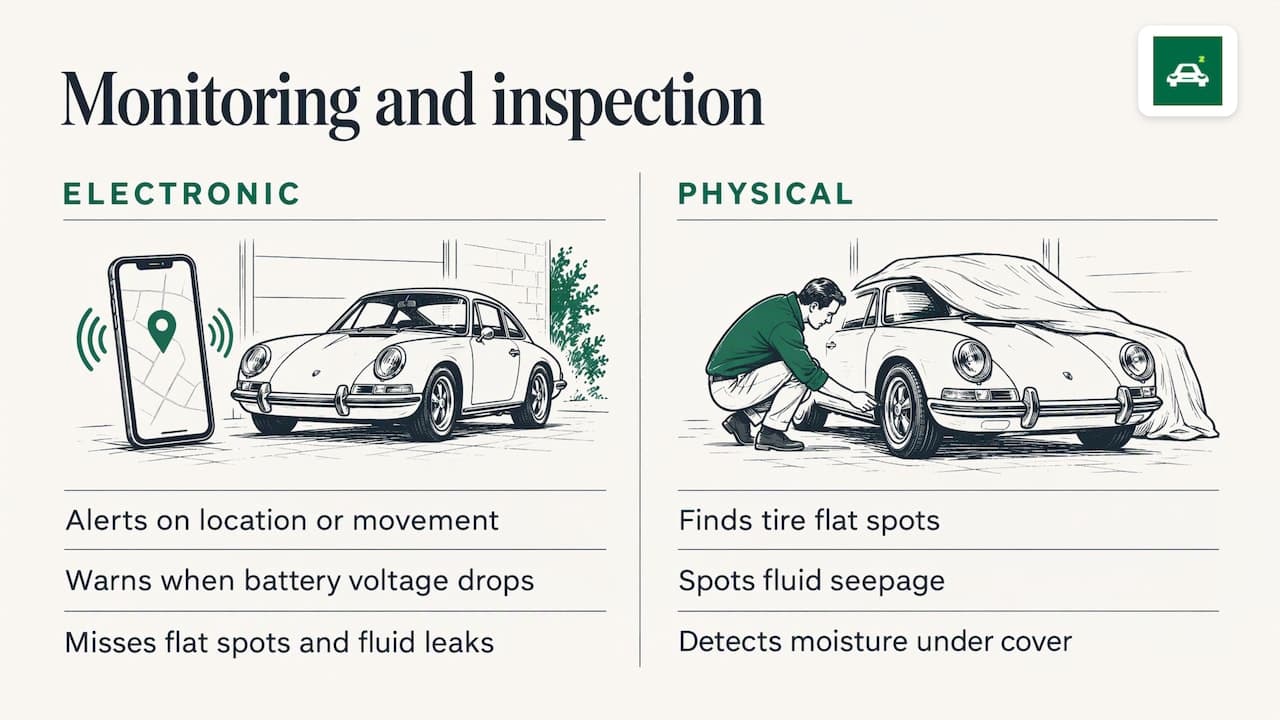
The best way to monitor a stored car remotely is to combine two layers: digital alerts that tell you where the car is and whether its battery is healthy, and regular human checks that tell you what condition it is in. Alerts alone cannot see a slow leak, a flat spot or a mouse nest. That is why collectors increasingly choose storage where inspection reports and photo check-ins arrive on their phone, and where requests for pickups and details are handled in an app.
This guide covers what remote monitoring can and cannot do, the main equipment types, how to set up alerts you will act on, and what to confirm is being checked while you are away.
NapGarageKeep Stored Cars in ViewNapGarage sends inspection reports and photo check-ins to your phone, with app-based requests for pickups and details.VisitKey Takeaways
- Remote monitoring answers location and power questions: has the car moved, is it inside its zone, is the battery holding up.
- It cannot answer condition questions such as tires, fluids, leaks, moisture or pests. Those need eyes on the car.
- Cellular signal, power source and subscriptions decide whether a monitor still works in month four of storage, so check all three before you leave the car.
- Alerts only help if you tune them. A few meaningful notifications beat a daily stream you learn to ignore.
- Storage that sends inspection reports and photo check-ins to your phone covers the condition side that devices miss. See NapGarage storage options.
Table of Contents
- What remote monitoring actually tells you
- What remote monitoring cannot tell you
- Ways to monitor a stored car remotely
- How to set up alerts you will actually act on
- What to confirm is being checked while you are away
- Signal, power and privacy limits to know about
- Storage with the monitoring built in
- Our perspective
- FAQ
- Sources
What remote monitoring actually tells you
Remote monitoring means getting information about a car without standing next to it. For a stored collector car, that information falls into a few categories.
Location and movement. Is the car where you left it? Did it move overnight? A tracker or connected-car service with a geofence (a virtual boundary drawn around the storage address) can alert you when the car crosses it. This is the core theft and unauthorized-move signal.
Battery health. A car that sits for months loses charge, and a dead or sulfated battery is the most common surprise at the end of a storage season. Some devices report battery voltage and warn you when it drops. Our guide to a battery tender for stored cars explains how maintenance charging fits into this.
Vehicle status. Some carmakers’ apps show things such as lock state, fuel or charge level and location. As one example, Aston Martin’s Connect service in the U.S. lists vehicle status, locate, geofence alert, theft alert and remote lock/unlock among its features, managed through a subscription in the owner’s app.
Environment. In a private collector garage, sensors can report temperature and humidity. In a professional facility, a climate-controlled building handles that for you, and you rely on the facility’s reporting instead of your own sensors.
A useful way to think about it: a building security system protects the space the car is in. Monitoring the vehicle itself tells you about the car. You want both, but they are different jobs.
What remote monitoring cannot tell you
A phone alert will not tell you that a tire is developing a flat spot, that a fluid is seeping onto the floor, that the cover is trapping moisture, or that something has chewed a wire harness. None of those trigger a location or voltage alert.
That gap matters most for exotic and classic cars, where small neglected problems become expensive. Flat spots on tires are a good example, and our guide on preventing tire flat spots in storage shows why a device cannot catch what a person rolling or inspecting the car can.
The practical conclusion is simple. Treat electronic monitoring as the early-warning layer, and treat scheduled physical inspection as the condition layer. A car with an alert but no inspection is half monitored.
Ways to monitor a stored car remotely
There are four main types of setup. They differ in what they report, what powers them and what they cost over time.
1. The carmaker’s connected-services app
Many newer cars already include an app that can locate the car and report some status. It runs on the car’s own power, and the features depend on model, trim and enrollment. Two cautions apply. First, confirm the subscription will still be active when you come back, not just on the day you drop the car off. Second, if the car’s battery is disconnected or on a maintainer, the connected module may not behave as it does when the car is in daily use.
Carmaker systems also lean on the car’s diagnostic port and onboard electronics. If you are curious how the diagnostic side works, this overview of OBD2 scanner types explains the different tools that read that port.
2. Plug-in trackers
Small devices that plug into the diagnostic port or hide in the car can report location and movement over a cellular connection. They are easy to fit, but a plug-in that draws power from the car can run down a battery that is already sitting idle. Look for low-power designs.
3. Self-powered, battery-based trackers
These carry their own multi-year battery, so the car can sit disconnected through several winters and the tracker keeps reporting. Because a stored car does not need constant real-time updates, a handful of location reports a day is usually enough and saves power. Discreet mounting matters too, since you do not want to alter original components on a car whose value depends on originality.
4. Battery monitors
A standalone 12V monitor watches voltage over the mobile network and warns you when the battery weakens. It tells you nothing about location, so it covers the power question only.
5. Facility reporting
The fifth option is not a device at all. A specialist storage facility inspects the car on a schedule and sends you the result. On NapGarage, storage includes inspection reports and photo check-ins sent directly to your phone, along with battery maintenance, detailing, fluid checks and exercise drives. That is condition monitoring done by people, delivered remotely. If you want to see what a check-in looks like in practice, read about car storage photo check-ins.
| Method | Tells you | Misses | Main thing to confirm |
|---|---|---|---|
| Carmaker app | Location, some status, alerts | Physical condition | Subscription active for the whole storage period |
| Plug-in tracker | Location, movement | Condition, sometimes battery draw | Power draw on a parked car |
| Self-powered tracker | Location, movement, geofence | Condition | Battery life and reporting interval |
| 12V battery monitor | Battery health | Location, condition | Cellular coverage at the storage site |
| Facility inspections and photo check-ins | Condition, fluids, battery maintenance, visuals | Real-time movement between visits | Inspection frequency and report format |
How to set up alerts you will actually act on
Most monitoring failures are setup failures. Here is a sequence that avoids the common ones.
- Install and register the device days before storage. Do not do it in the parking lot on drop-off day. You want time to fix a registration problem.
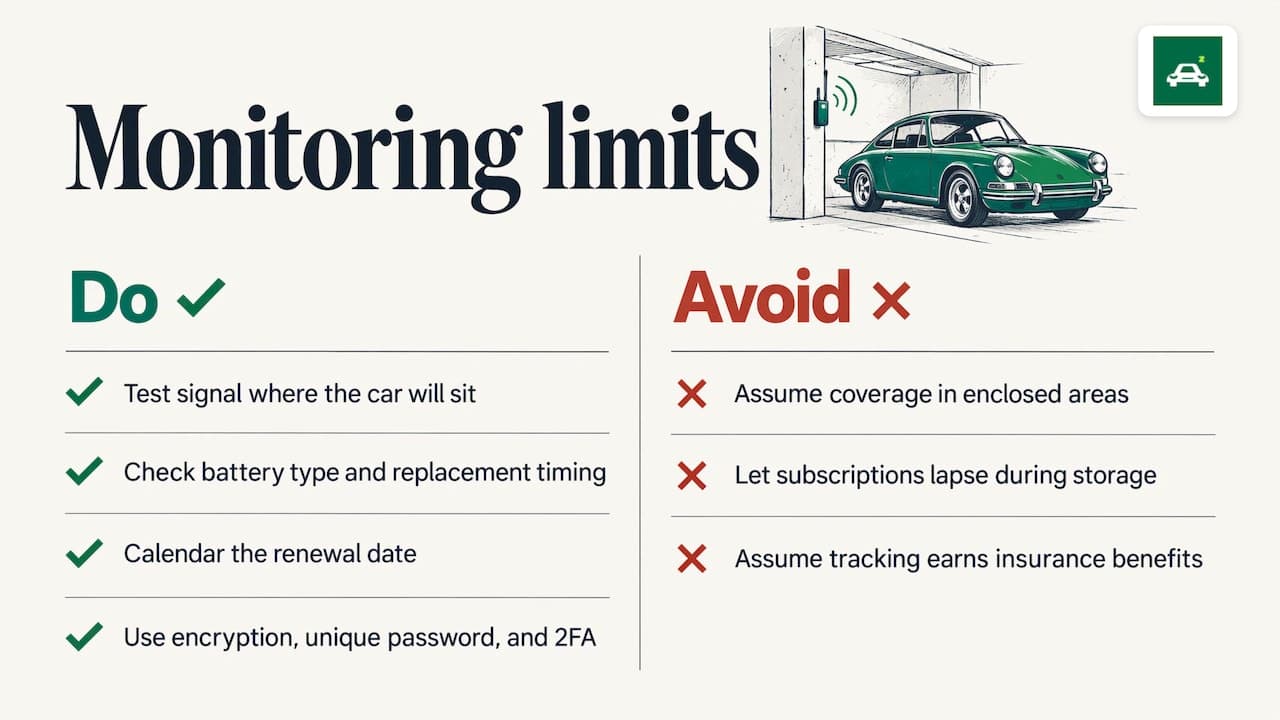
- Test it where the car will sit. Park the car indoors and confirm the device reports from there. Record the device ID and the time of the last report.
- Screenshot the app’s position view. If something ever goes wrong, you will have a record of where the car was and when.
- Set a geofence with room to spare. GPS has a margin of error, and a boundary drawn too tightly around one parking space will throw false exit alerts. Include the parking row and access lane.
- Turn on movement and towing alerts. These are the ones you must never miss.
- Add a last-seen check. If the device has not reported in a set number of days, you want to know, because silence can mean a dead battery or lost coverage.
- Trigger one alert on purpose. Have someone move the car slightly, or leave the zone, and confirm the notification reaches your phone.
- Keep alerts few. Notify only when something meaningful happens: unexpected movement, crossing the boundary, low battery. If every minor event pings you, you will start swiping them away.
Who responds to an alert?
A self-monitored app does nothing until you look at it. Decide in advance who you will call when an alert fires: the facility manager, local police, your insurer. If you are away or asleep when it triggers, you need someone else on the list. Storing the car at a facility with staff on site gives you someone to call first.
What to confirm is being checked while you are away
If you store the car at a professional facility, you are outsourcing the condition layer. Ask what is checked, how often, and how you will be told. A good routine covers:
- Battery: is it on a maintainer, and is voltage verified at each visit?
- Fluids and leaks: is the floor under the car checked for drips, and are fluid levels looked at?
- Tires: are pressures checked, and is there a plan to avoid flat spots?
- Exterior and interior: are there photos showing paint, cover and cabin, so you can compare them over time?
- Exercise drives: will the car be started and driven periodically, and is that logged?
- Environment: is the building climate controlled, and is the temperature and humidity range appropriate for rubber, leather and paint?
- Access: how do you request a pickup or a detail, and how fast does the facility respond?
Our vehicle storage inspection checklist for collectors goes through each item in more depth. If you are storing over the cold months, winter car storage preparation covers the prep that makes any monitoring easier.
One point on climate: a smart-home integrator’s collector-garage guide puts standard targets at 65 to 70°F and 40 to 50% relative humidity to protect vintage rubber, leather and painted finishes. That is a useful range to hold a facility to, and it is the kind of environment climate-controlled collector storage is built around.
Signal, power and privacy limits to know about
Cellular coverage. Every cellular device needs a signal. Thinkware’s U.S. terms note that cellular signal, GPS signal and sufficient battery are required for app services to operate, and that features may be unavailable in enclosed areas such as underground parking. A steel-and-concrete storage building can be exactly that kind of place. This is why you test the device where the car will sit.
Power. A device that depends on the car’s battery depends on a battery that may be disconnected or on a maintainer. A device with its own battery depends on that battery lasting. Know which you have and when it needs replacing.
Subscriptions. Connected services and trackers often charge monthly or yearly. A lapse mid-storage silences the alerts without warning. Put the renewal date in your calendar before you leave the car.
Privacy. Location data travels from the device over a cellular network and sits in a provider’s cloud. The U.S. has no single federal law specifically governing GPS location data, and rules differ by state; California, for example, gives residents rights over personal information, which in many cases includes precise geolocation. Choose a provider that encrypts data in transit and at rest, use a strong unique password and two-factor sign-in on the account, and see how long your history is retained.
Insurance. Some insurers look favorably on tracking, but collector-car policies vary widely, so ask your own insurer what it recognizes before you assume any discount or claim benefit.
Storage with the monitoring built in
If you would rather not assemble a device, an app, a subscription and an inspection routine yourself, NapGarage connects you with specialty storage for exotic, classic and collector cars where that care is part of the service. You get inspection reports and photo check-ins on your phone, battery maintenance, fluid checks, detailing and exercise drives, and you can request pickups and details in the NapGarage mobile app, with enclosed transport available when the car needs to move.
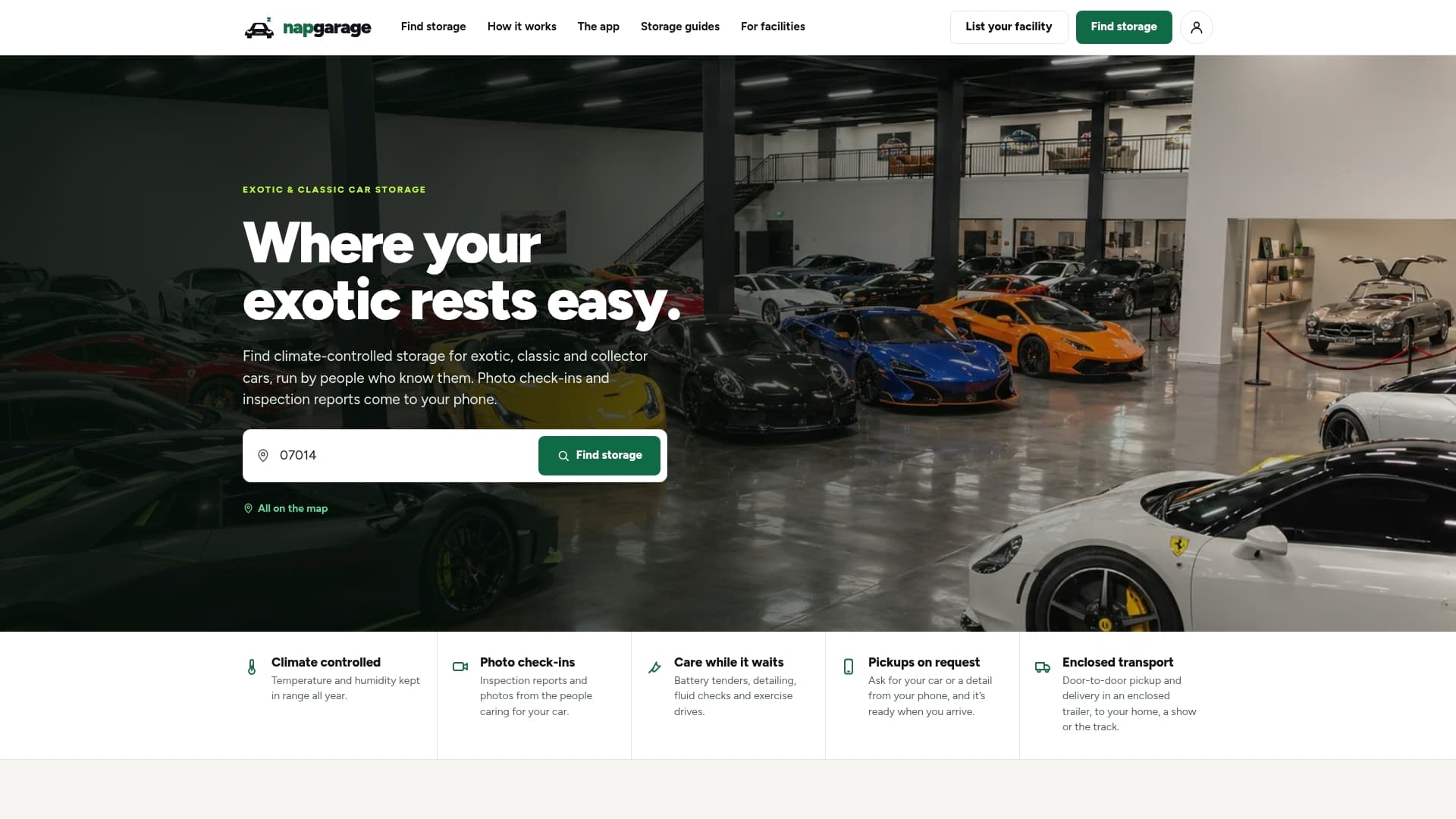
That means you can see what is happening with your car without driving to the facility. Browse exotic and classic car storage to find a facility near you, or look at storage by city. When it is time to bring the car home, the pickup and delivery guide explains how the process works.
Our perspective
We built NapGarage around one idea: a collector should not have to choose between keeping a car safe and staying close to it. A tracker can tell you the car has not moved. It cannot tell you the battery is being maintained, the fluids are where they should be or the tires are holding their shape.
That is why our focus is on enthusiast-grade storage with technology that brings the facility to your phone. Inspection reports and photo check-ins show you the condition of the car, not just its coordinates. Requesting a pickup or a detail in the app means managing your car takes minutes, not a trip.
Electronic monitoring is a good layer, and we encourage collectors to use it where it suits their car. But for a car you care about, the strongest setup is a climate-controlled building, people who know exotic and classic cars, and a steady stream of proof that everything is fine.
NapGarage Team
FAQ
Can I monitor a stored car remotely without installing anything?
If your car came with a connected-services app, you may be able to see its location and some status from your phone, depending on model, trim and enrollment. Confirm the subscription will stay active for the whole storage period. For condition, photo check-ins and inspection reports from your storage facility fill the gap.
Will a tracker drain my battery while the car is stored?
It can, if it draws power from the car. A self-powered tracker with its own multi-year battery avoids that, and a battery maintainer keeps the car’s battery topped up. Test whatever you choose before the car goes into storage, and check the battery at each inspection.
What alerts matter most for a car in storage?
Unexpected movement or towing, crossing a geofence boundary, low battery, and a missed check-in from the device. Keep the list short so each alert gets your attention, and decide ahead of time who you will call when one fires.
Can monitoring replace in-person inspections?
No. Devices report location and power, but they cannot see tires, leaks, moisture or pests. Regular inspections with photos and written reports are what confirm the car’s actual condition, and they are included in storage on NapGarage.
Does remote monitoring work inside a storage building?
Only if the device can reach a cellular network from where the car sits. Dense buildings and underground spaces can block signal, so test the device at the exact spot before relying on it.
Sources
- Connect | Aston Martin USA
- Connected Terms and Conditions US | Thinkware
- Smart Home Technology for Car Collectors | Global Wave Integration
- How your phone quietly shares GPS data with your carrier | LoneStar Tracking
- OBD2 Scanner Types: Which One Fits Your Garage