Fuel Stabilizer for Car Storage: How to Use It Right
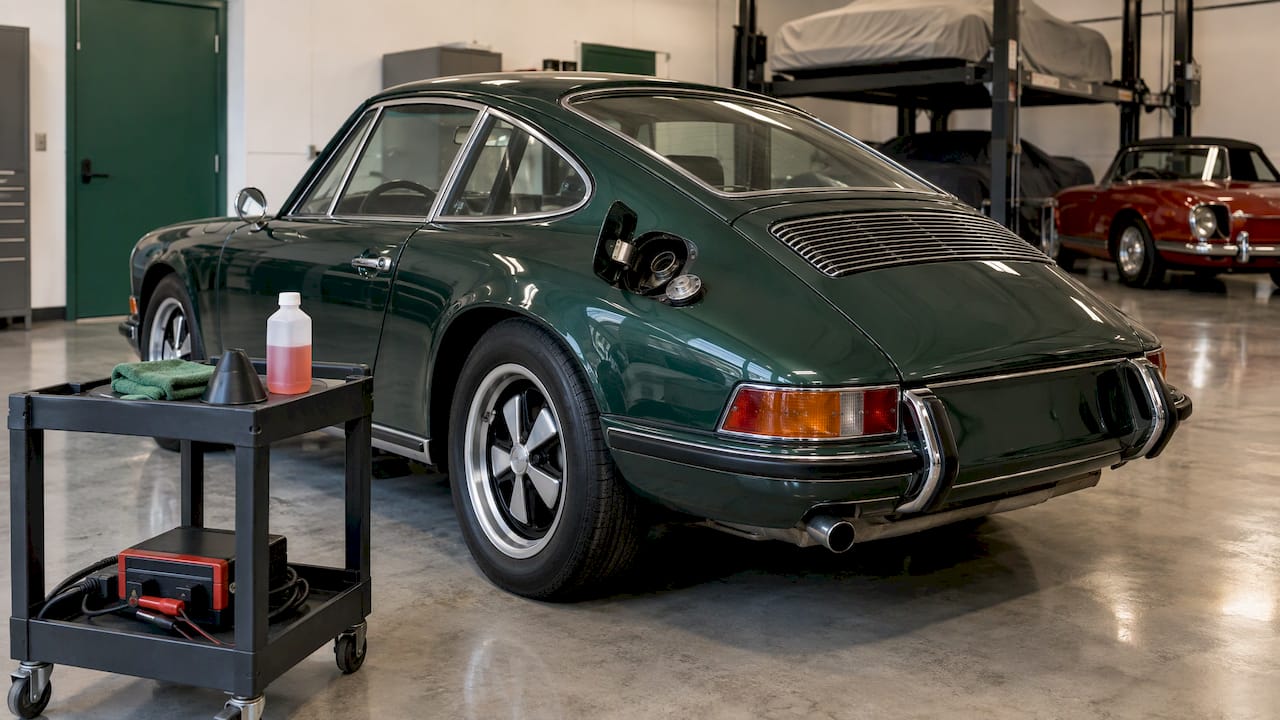
Fuel stabilizer works when you add it to fresh gasoline, fill the tank nearly to the top, and run the engine long enough for treated fuel to reach the whole fuel system. Done in that order, it slows the breakdown that leaves varnish, gum and corrosion in a car that sits. Done with old gas or a quarter tank, it does much less. For a classic or exotic that stays parked for months, the stabilizer is one part of a routine that also covers the battery, the fluids and regular checks. That is the routine we cover here, and it is the one our storage listings are built around.
NapGarageKeep Your Stored Car Cared ForNapGarage pairs climate-controlled storage with battery maintenance, fluid checks, and photo check-ins to help collectors keep tabs on stored cars.- ✓Climate-controlled storage
- ✓Battery maintenance and fluid checks
- ✓Inspection reports and photo check-ins
- ✓Exercise drives
Key Takeaways
- Gasoline can start to go bad in as little as 30 days when a car is not in regular use, according to Gold Eagle, which makes the stabilizer for any storage of a month or more.
- A stabilizer protects fuel that is still good. It cannot reverse bad gas, so add it to fresh fuel just before parking the car.
- Fill the tank at least 95% full, add the labeled dose, and run the engine about 5 minutes (check your product’s label) so treated fuel reaches the entire system.
- Even treated fuel is not permanent. The stabilizer slows degradation, but you still need a plan for the battery, fluids and periodic checks.
- For collector cars, the easiest way to keep that plan on schedule is storage with inspection reports, photo check-ins, battery maintenance and exercise drives.
Table of Contents
- Why gasoline goes bad in a parked car
- What a stabilizer does, and what it does not
- How to stabilize fuel for storage, step by step
- How much stabilizer to use
- Storage formula or all-in-one: choosing the product
- What to do about old gas
- Fuel is not the only thing that fails in storage
- Where the routine gets easier
- Our point of view
- FAQ
- Sources
Why gasoline goes bad in a parked car
Gasoline is perishable. Its lighter, more volatile components evaporate over time, and what is left oxidizes into gum and varnish. Consumer Reports says gas can start to go bad in as little as three months, and that the two most important protective steps are filling the tank completely and adding fuel stabilizer. AAA’s engineering director describes gasoline there as “a living chemical”: old gas darkens, smells like varnish and turns gummy.
The timeline depends on the fuel. AAA puts typical gasoline life at 3 to 6 months, and ethanol-blended gas at the short end, 1 to 3 months. Most pump gasoline in the US contains ethanol, which absorbs water. Holley explains that ethanol is hygroscopic: it pulls moisture from the air, and that water can settle as a whitish sludge at the lowest point of the tank.
What that does inside a car is where collectors should pay attention. Varnish clogs carburetor jets and injectors, gums up fuel pumps and lines, and corrodes metal. NAPA’s technical notes say untreated stored fuel can completely varnish a carburetor within six months. On a car with a numbers-matching carburetor or a fuel-injected exotic, that is a repair you would rather not pay for.
What a stabilizer does, and what it does not
A storage stabilizer is a chemical package that slows oxidation and protects metal surfaces in the fuel system. Gold Eagle states that its STA-BIL Storage product keeps fuel fresh for up to 24 months, depending on gasoline quality and storage conditions, and that it is designed for vehicles stored 30 days or longer.
Two limits are worth knowing so you set the right expectations:
- It stops further degradation. It does not restore. Gold Eagle’s FAQ says a stabilizer will not improve old gasoline, and AAA’s engineer says it “can’t reverse the chemicals of bad gas.” That is why timing matters: the stabilizer goes into fuel that is fresh.
- It does not stop volatility loss. Gasoline stored for more than 12 months tends to lose volatility, which can cause hard starting, and Gold Eagle notes that no additive prevents it. A full tank and cool, shaded storage help with this.
That is also why we treat the 24-month figure as a ceiling under good conditions, not a promise. For a collector car, the conditions around the fuel (temperature, a full tank, someone looking at the car) matter as much as the bottle.
How to stabilize fuel for storage, step by step
This is the routine most manufacturers and storage guides agree on. Each step also shows where it tends to go wrong.
- Pick your parking date. Plan to treat the fuel on the day you park the car, or within a day or two of it. The stabilizer needs to be in the tank before the fuel has had time to age.
- Start from fresh fuel. Run the tank low enough that you can fill it with fresh gas. Hagerty warns that topping off a quarter tank of fuel older than 12 months with fresh gas and stabilizer is flirting with disaster, because the old fuel has already broken down and left deposits. Its fix is to run at least a full tank through the engine just before storage so only freshly pumped fuel goes into storage. Holley suggests the lowest-ethanol gasoline you can find, ideally ethanol-free.
- Add the stabilizer first, then fill. Pour the labeled dose into the tank before you fill it, so the incoming fuel mixes it. Measure by the gallons the tank will hold, not by the gallons you add.
- Fill the tank at least 95% full. Gold Eagle’s directions call for a tank at least 95% full. A full tank leaves little room for air, so there is less oxygen and moisture to work on the fuel. Ford’s owner guidance for its own vehicles is to fill to the first automatic shutoff, which is a practical way to avoid overfilling.
- Run the engine so treated fuel reaches everything. The product label sets the run time: Gold Eagle says 5 minutes, and Lucas Oil’s data sheet says at least 5 minutes. Holley recommends at least 10 minutes. If your car is carbureted, a longer run is the safer reading, because the float bowl has to fill with treated fuel too. Idling in a closed garage is a poor idea, so do this outdoors or with ventilation.
- Write it down. Note the date, the product and the dose, and keep the note with the car. When you or someone else wakes the car up a year later, that note answers the first question anyone asks.
- Finish the rest of the storage prep. Change the oil and filter before storage, as Ford advises, park in a dry, ventilated place out of sunlight, and deal with the battery. Our step-by-step storage checklist covers the full list.
A word on the last step. The fuel routine is easy to do once. The part owners find hard is everything after the car is parked: remembering the battery, checking fluids, noticing a slow leak or a flat spot. That is where a facility that checks on the car regularly changes the picture.
How much stabilizer to use
The dose is on the bottle, and it varies by product. Use the label of the product you buy, not a number from a forum. These are the published doses for three common products:
| Product | Storage dose | Run time after adding | Stated fuel life |
|---|---|---|---|
| STA-BIL Storage | 1 oz per 2.5 gallons | 5 minutes | Up to 24 months |
| Lucas Fuel Stabilizer | 1 oz per 2.5 gallons | At least 5 minutes | Not stated on the data sheet |
| Sea Foam Motor Treatment | About 1 oz per gallon, per its storage guide | Run to circulate | Up to 2 years |
A worked example: a 20-gallon tank treated with STA-BIL Storage needs 8 ounces (20 divided by 2.5). A 16-ounce bottle treats up to 40 gallons, so one bottle covers two fills of that tank.
Over-treating is a common worry. Gold Eagle says an overdose of its product is not harmful but recommends not going beyond four times the labeled amount, and diluting the fuel if you do. In practice, measure carefully and you will not come near that.
If your car already carries ethanol-blended gas, note that Lucas says its product is alcohol-free and works in gasolines including ethanol blends up to E85. Check that the product you choose says the same for your fuel.
Storage formula or all-in-one: choosing the product
Stabilizer lines usually come in two types. Gold Eagle distinguishes its Storage formula, built for long-term freshness, from its 360 Protection product, which targets ethanol effects, corrosion protection and fuel-system cleaning. For a car going into months of storage, the storage formula is the one made for the job. For a car you drive every few weeks, an ethanol-protection product matches how it is used.
Three practical notes for a collector car:
- Match the product to the storage length. A 30-day parking spell and a 12-month winter are different jobs.
- Check the bottle’s age. NAPA says an opened bottle of stabilizer has about a two-year shelf life, and that very dark red or brown liquid points to lost effectiveness.
- Keep one product per tank. Mixing several additives in one tank adds variables without a stated benefit. Treat with one product at its label dose.
What to do about old gas
The question comes up whenever a car has sat longer than planned. Stabilizer will not bring it back, but the fuel is not automatically ruined either.
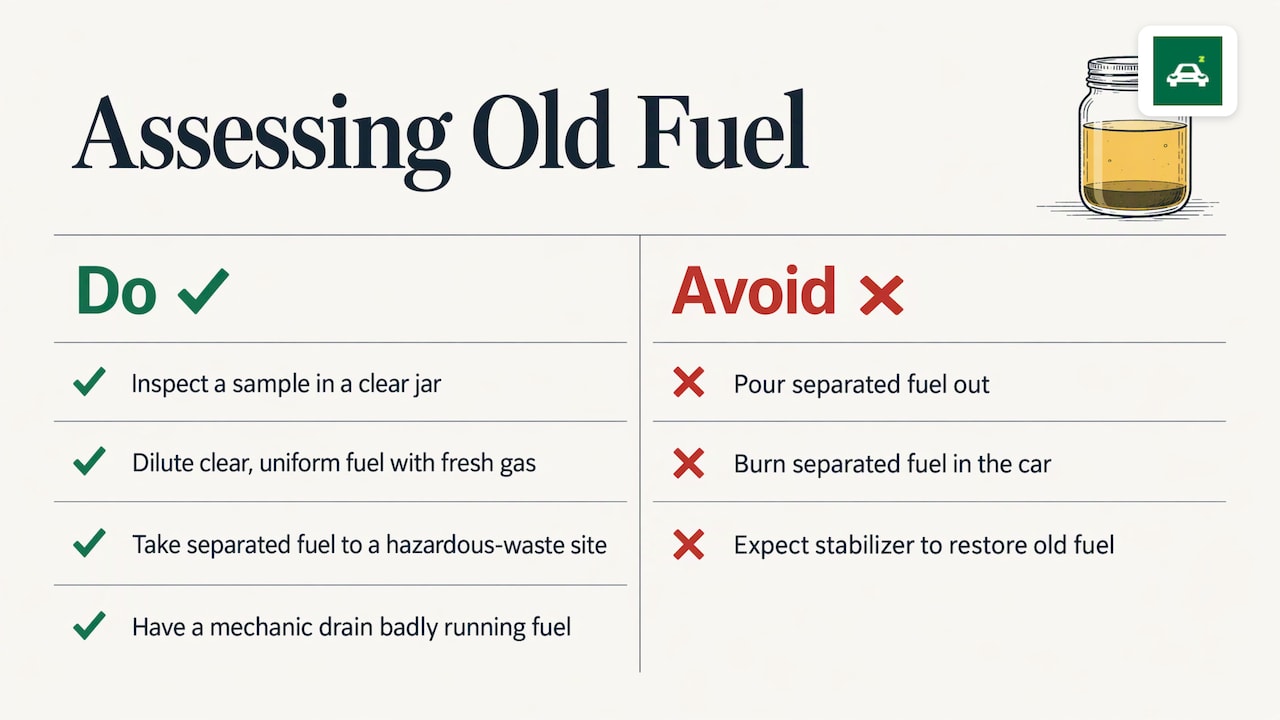
Bell Performance says moderately aged fuel that is still clear and uniform, with no visible water, no layers and no strong sour or varnish smell, may be usable when diluted with fresh gasoline and treated. Fuel that has separated into distinct layers should be removed and taken to a household hazardous-waste site, not poured out or burned in the car.
A quick look tells you a lot. Draw a small sample into a clear jar and check three things: color (darker than fresh gas is a warning), layers (a water or sludge layer means drain it) and smell (varnish or sour means drain it). Classic DeLorean Motor Company’s support page suggests that for storage past 90 days you add stabilizer, run the engine to circulate it, and drain the system. Not everyone agrees on draining, which is covered below.
If fuel is bad enough that the car runs rough or will not start, have a qualified mechanic drain the tank and check the lines, pump and carburetor or injectors. On an exotic with a complex fuel system, that is not a driveway job.
Fuel is not the only thing that fails in storage
Skip the drain-the-tank approach. Some owners drain the tank to avoid the fuel problem entirely. Holley’s David Bellm argues that this falls apart in practice: you cannot get the system completely dry, rubber and plastic fuel components were not designed to sit exposed to air and can crack, and an empty tank holds more moisture-laden air. A full tank of fresh, stabilized fuel is the safer path.
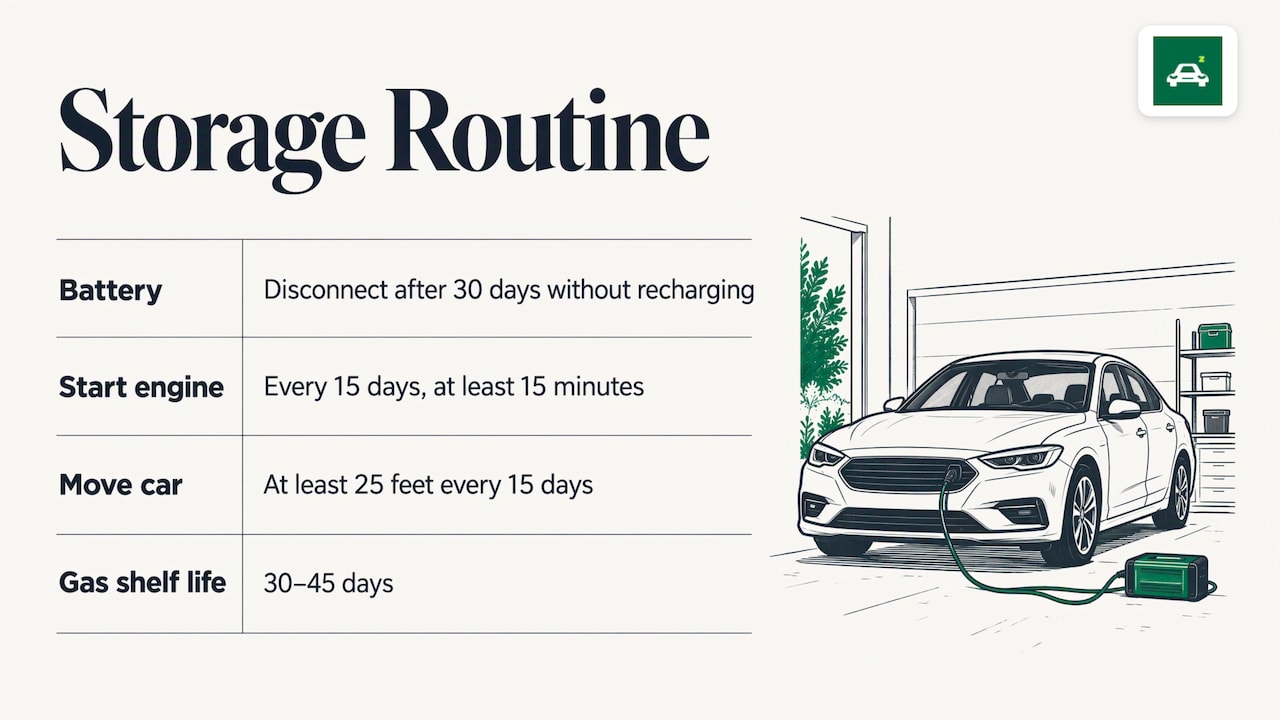
The battery. A car that sits will drain its battery. Ford’s guidance is to disconnect the battery cables if storing for more than 30 days without recharging. A maintenance charger is the other option, and our guide to using a battery tender for car storage explains how.
Starting and moving the car. Ford recommends starting the engine every 15 days for at least 15 minutes, and its performance-vehicle storage manual says to move the car at least 25 feet every 15 days to prevent tire flat spots. Whatever you do, do it on a schedule. AAA’s Northeast club notes that gasoline typically has only a 30 to 45 day shelf life, which is one more reason to treat the fuel and keep the routine regular.
Humidity and temperature. Moisture is the common thread in fuel sludge, corrosion and musty interiors. Our guide to humidity levels for car storage covers the target range.
Coming out of storage. When the car goes to a show or a drive after sitting, a clean car and tidy presentation matter. If you are getting ready for an event, this guide to car show display preparation walks through the details.
For wider planning, our guides on how to store a classic car, classic car winter storage and how to choose, prepare and budget for classic car storage go deeper.
Where the routine gets easier
Treating the fuel takes an afternoon. Keeping a collector car in good shape for months is a longer job: the battery, the fluids, the tires and the question of whether anything has changed since you last looked.
NapGarage connects car owners with climate-controlled storage for exotic, classic and collector cars. The facilities in the marketplace offer care such as battery maintenance, detailing, fluid checks and exercise drives, along with inspection reports and photo check-ins sent to your phone, and enclosed transport. Through the mobile app you can request a pickup or ask for details without visiting the facility. You can see where we list facilities on our storage page, or browse by city: Miami, Las Vegas, Philadelphia and Sterling, VA, among others.

If you are comparing options, start with the exotic and classic car storage listings and send a quote request to the facility that fits your car and your route.
Our point of view
We built NapGarage around one idea: a collector car should not have to be a chore while it sleeps. Fuel stabilizer is a good example. The chemistry is simple, the steps are well documented, and most owners can do it right once. The harder part is the following months.
A stabilized tank still sits next to a battery that drains, tires that settle and seals that dry. The cars we care about are not appliances. They are investments, and they reward regular attention.
That is why we focus only on enthusiast-grade storage. Climate control keeps temperature swings and moisture down, which are exactly what age fuel and corrode metal. Battery maintenance, fluid checks and exercise drives keep the car’s systems working. Inspection reports and photo check-ins on your phone mean you see the car’s condition without driving to the facility.
Our answer to the question “how do I keep my car right while it is stored” is a routine you do not have to remember. You prepare the car well, with fresh, stabilized fuel and a full tank, and then storage with regular care carries it from there.
NapGarage Team
FAQ
How long can gasoline sit in a car with fuel stabilizer?
Gold Eagle says its STA-BIL Storage product keeps fuel fresh for up to 24 months, depending on the gasoline and the storage conditions. Gasoline stored more than 12 months tends to lose volatility, and no additive prevents that, so a full tank and cool, shaded parking matter as much as the bottle.
Does adding fuel stabilizer to old gas help?
It will not repair it. A stabilizer stops further breakdown of fuel that is still good, but it cannot reverse varnish, gum or water contamination that has already formed. If the fuel is clear and smells normal, diluting it with fresh gas and treating the blend may work. If it has layers or a varnish smell, have it removed.
Do I need fuel stabilizer for a car that will sit for just a month?
Gasoline can start going bad in as little as 30 days when a car is not in regular use, and Gold Eagle designs its storage formula for vehicles stored 30 days or longer. For a classic or exotic, the dose is small compared with the cost of cleaning a fuel system.
Should I drain the tank or keep it full?
For most cars, keep it full. Residual fuel still gums, rubber and plastic parts can crack when exposed to air, and an empty tank holds more moist air. A tank at least 95% full of fresh, stabilized gasoline is the approach Gold Eagle’s directions and Consumer Reports describe.
How much stabilizer do I put in a classic car’s tank?
Use the dose printed on your product. For STA-BIL Storage it is 1 ounce per 2.5 gallons, so a 15-gallon tank takes 6 ounces. Add it before filling with fresh fuel, then run the engine for the time the label gives.
Sources
- Gold Eagle: STA-BIL Storage Fuel Stabilizer
- Gold Eagle: Differences among STA-BIL products
- Consumer Reports: How to keep the gas fresh in your car
- AAA: Does gasoline go bad?
- AAA Northeast: Do’s and don’ts of winter car storage
- Hagerty: Fall car storage mistakes to avoid
- Holley: Winter storage and your fuel system
- Ford: Preparing a gas-powered vehicle for long-term storage
- Lucas Oil: Fuel Stabilizer data sheet
- Sea Foam: How to store a vehicle
- NAPA Know-How: How to use fuel stabilizer
- Bell Performance: Getting old gas out