Battery Tender for Car Storage: Keep a Stored Car Starting
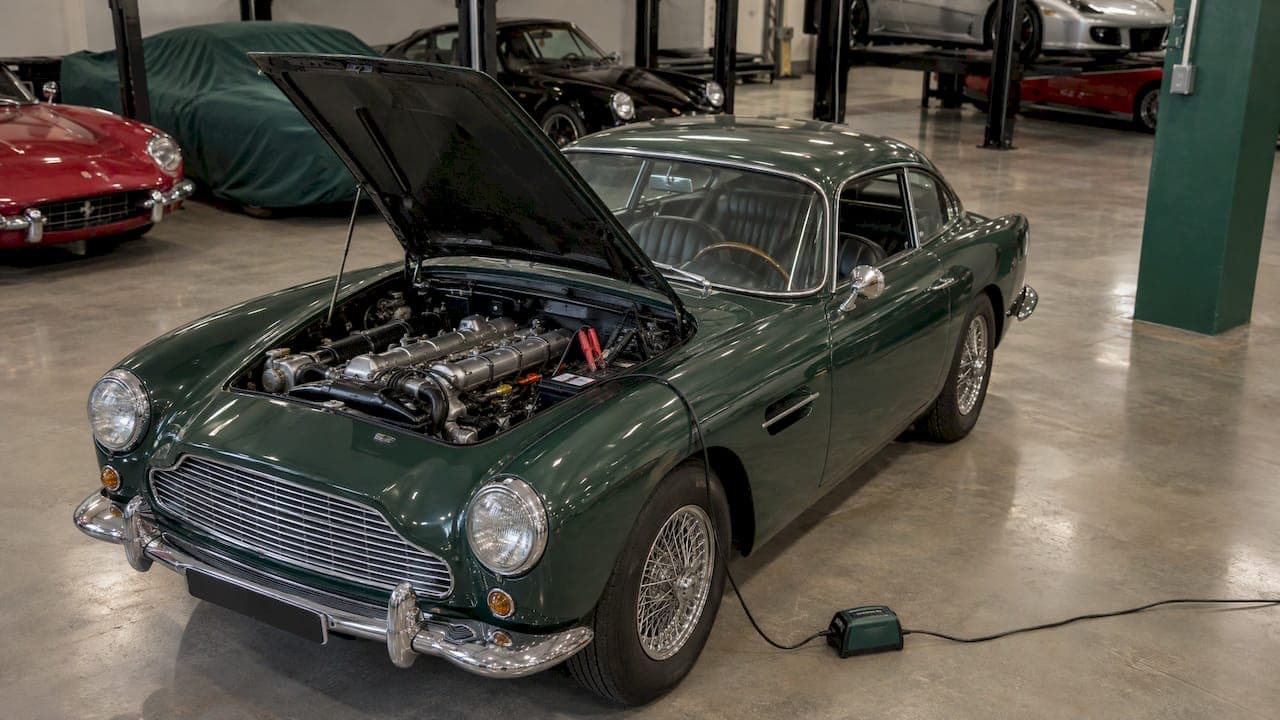
A stored car’s battery drains slowly, and a battery that sits low can be permanently damaged within weeks. The fix is a smart maintainer, a charger that tops the battery up and then holds it at a safe float level, connected correctly and checked on a schedule. If your car is a collector piece, the easier route is storage where battery maintenance is part of the care, so the battery is looked after while you get inspection reports and photo check-ins on your phone. This guide covers how it works, how to do it right, and what to look for in a facility.
NapGarageKeep Stored Car Batteries MaintainedNapGarage includes battery maintenance in climate-controlled storage, with inspection reports and photo check-ins sent to your phone.VisitKey Takeaways
- A parked car still draws power from its onboard modules, and a battery left partly discharged can sulfate and lose capacity. A maintainer exists to stop that.
- Charging and maintaining are different jobs. For storage you want a unit that switches to a float mode on its own, not a basic trickle charger you must unplug.
- Match the voltage and battery type, connect to the battery or the manufacturer’s charging points, and keep the area ventilated.
- Hybrids, EVs and cold climates add their own rules, so follow the maker’s storage guidance.
- Collectors who would rather not manage this can choose storage with battery maintenance, exercise drives and app-based updates built in.
Table of Contents
- Why a Stored Battery Dies
- Charger, Trickle Charger or Maintainer?
- How to Set Up a Maintainer for Car Storage
- What If There Is No Outlet?
- Why Collector Cars Need More Than a Tender
- Doing It Yourself vs. Storage That Handles It
- Our Perspective
- Find Storage With Battery Care Built In
- What to Ask a Facility About Battery Care
- FAQ
- Sources
Why a Stored Battery Dies
A car that is switched off is not fully asleep. Ford’s battery guide says a stored vehicle draws about 20 to 30 milliamps from its onboard modules, and that batteries left discharged for more than 60 days can suffer permanent damage and shortened life from lead sulfate buildup and acid stratification.
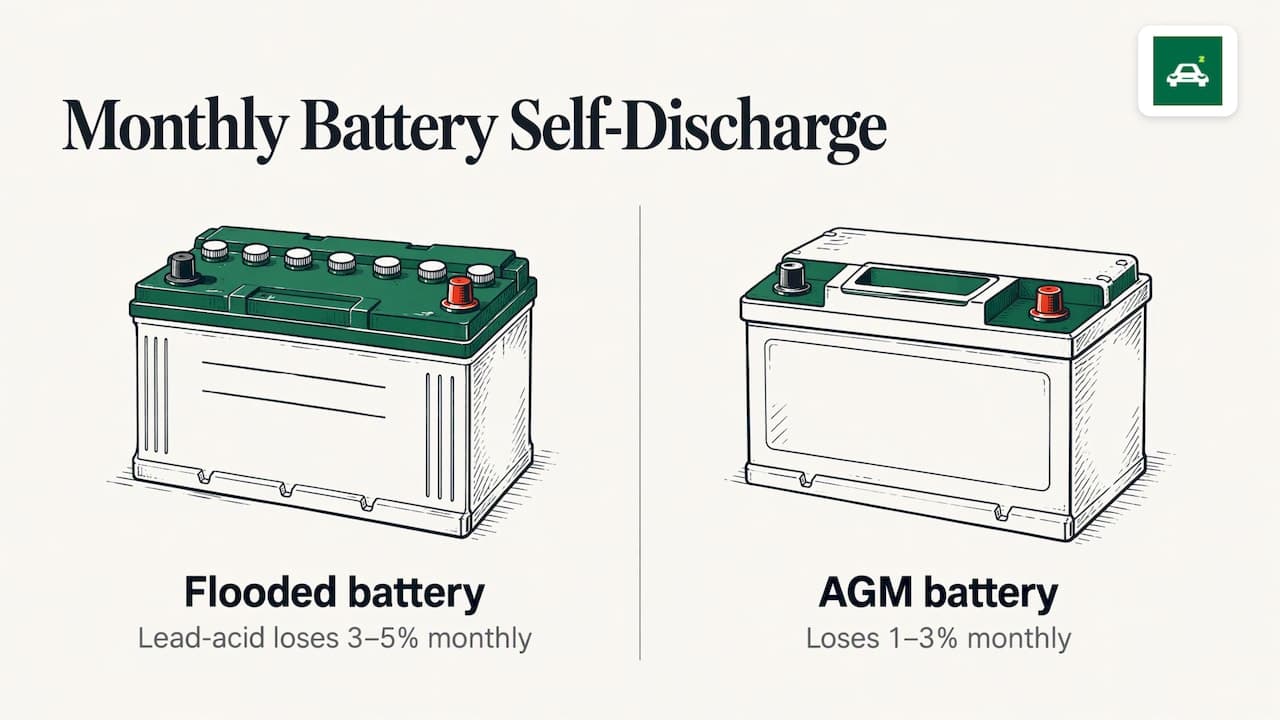
That drain is small, but it never stops. Add the battery’s own self-discharge: flooded lead-acid batteries lose roughly 3 to 5 percent a month, AGM batteries about 1 to 3 percent. Over a winter, a healthy battery can fall to the point where the car will not start, and a battery that stays low is the one that does not recover.
Heat speeds this up. Odyssey’s maintenance manual states that for every 18°F rise in temperature, the storage time before a freshening charge is needed is cut in half, so a battery at 95°F needs attention in about 12 months versus 24 months at 77°F. Cold has a different risk. The same battery FAQ notes a fully charged lead-acid battery will not freeze until around minus 80°F, while a completely discharged one can freeze at 32°F. Harley-Davidson’s service bulletin makes the same point: an undercharged battery stored in the cold can freeze and crack, and a sulfated one is not serviceable.
The lesson is simple: a stored battery wants to be full, and it wants to stay full.
Charger, Trickle Charger or Maintainer?
These three terms get mixed up, and the difference matters for storage.
- Charger: replenishes a partly discharged battery at higher amperage.
- Trickle charger: supplies a small, steady current. Car and Driver’s testing guide warns that one which keeps pushing current after the battery is full can overcharge it, so it must be watched and disconnected at the right time.
- Maintainer (often called a tender): a smart unit that detects a full battery and drops to a regulated float, so it can stay connected unattended.
The same guide recommends a model that can both charge and, once the battery is full, switch automatically to maintenance mode. For long storage, that automatic switch is the feature that counts. A storage maintenance charger should hold voltage in the range of 13.1 to 13.5 volts at no more than 1 amp, according to the same battery FAQ.
A small maintainer is meant to keep a good battery full. If a battery is already flat, it generally needs a proper charge first, then the maintainer takes over.
How to Set Up a Maintainer for Car Storage
This is the routine, with the points where it usually goes wrong. Our own battery tender guide for stored cars goes deeper on product choice.
1. Charge fully before you park it
Start with a full battery. GEM’s storage guide warns that batteries left at a low charge for 30 days or more can be permanently damaged, and it tells owners to fully charge before storing. Going into storage half-empty is the most common way a maintainer ends up being asked to do a job it was not built for.
2. Match voltage and battery type
Most modern cars use 12V, but many classics run 6V or 8V, and some are positive ground. Pick a unit with the right voltage and a mode for your battery type: flooded, AGM, gel or lithium. The wrong mode can shorten battery life. Check the polarity before connecting on any positive-ground car.
3. Ventilate and connect in the right order
Chevrolet’s owner support page says to charge in a well-ventilated area because charging releases highly flammable hydrogen, and never to charge a frozen battery, which may explode. Connect the clamps before plugging the unit in, and unplug it before removing the clamps. Many modern cars have a dedicated charging post under the hood, and the owner’s manual shows it.
4. Choose the right storage option for the battery
Chevrolet gives two options for extended storage: remove the negative cable or connect a trickle charger. Disconnecting stops the parasitic drain but does not stop self-discharge, so the battery still needs periodic charging. Toyota’s long-term storage bulletin takes the same approach, directing removal of the 12V ground cable and, after that, inspecting the battery with a diagnostic tool at 60 days and every 30 days after. Harley-Davidson adds that if the battery stays in the vehicle without a tender, the main fuse should be removed to prevent parasitic loads.
5. Plan the restart
After reconnecting a battery, some cars need a relearn. Chevrolet instructs turning the ignition on without starting for at least three minutes, then starting and running the engine for at least 30 seconds, so the electronic throttle control relearns its position. Check your own manual for the equivalent.
6. Check on it
A tender does not replace looking at the car. A reading around 12.6 volts at rest is a healthy full 12V battery, and the maintainer’s indicator light should show it is in float mode. Look at the cable, the outlet and the clamps now and then. Our vehicle storage inspection checklist lists what else to check on a stored collector car.
What If There Is No Outlet?
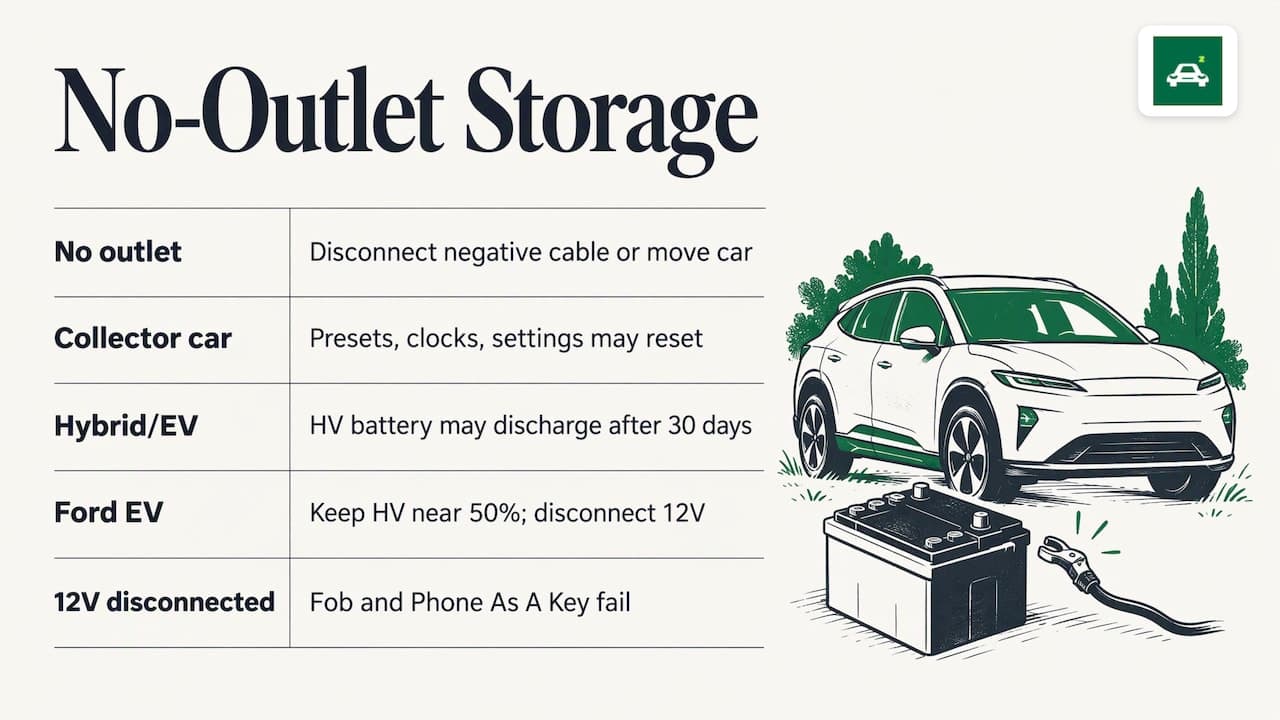
Plenty of garages have no power near the car, which is the exact situation many owners search about. Your options are to disconnect the negative cable as the manufacturers above describe, or to move the car somewhere that has power and attention. Disconnecting has side effects on a collector car: radio presets, clocks and adaptive settings can reset, and some cars need a relearn at startup.
Electric and hybrid vehicles are different again. Toyota’s bulletin notes that hybrid, plug-in hybrid and battery-electric high-voltage batteries may discharge if the vehicle sits for 30 days or more, so the high-voltage charge level has to be maintained before long-term storage. Ford’s guidance for its EVs is to keep the high-voltage battery near 50 percent, then disconnect the 12V battery, and notes that the key fob and Phone As A Key will not work while 12V power is disconnected. Follow your manufacturer’s exact procedure.
Why Collector Cars Need More Than a Tender
A maintainer solves one problem. A stored exotic or classic has several, and they interact.
- Fluids and seals: a car that never moves can have fluids settle and seals dry out. Our guide to how often to drive a stored car sets out a practical schedule.
- Humidity: moisture works on brake rotors, leather and electrics. See what humidity level is best for car storage.
- Temperature swings: heat shortens battery storage life, and freezing threatens a discharged battery. Climate control removes both extremes. Our winter car storage guide covers cold-weather prep.
- Oversight: the real risk is a tender that came unplugged in month two and nobody noticed.
That last point is why many collectors move the whole job to a facility. A maintainer in your own garage depends on you being there to catch a tripped breaker or a loose clamp. In climate-controlled storage with a documented care routine, you are told what is happening to the car.
Doing It Yourself vs. Storage That Handles It
The table compares the two approaches on what matters to a collector.
| What matters | Maintainer at home | Climate-controlled storage with battery care |
|---|---|---|
| Battery kept topped up | Yes, if the unit stays powered and connected | Battery maintenance is part of the care package |
| Someone confirms it is working | You, on every visit | Inspection reports and photo check-ins to your phone |
| Fluids, exercise, detailing | Your time and schedule | Fluid checks, exercise drives and detailing available |
| Temperature and humidity | Whatever your garage gives you | Climate-controlled space |
| Getting the car out | You are on site | Request pickups and details through the mobile app, with enclosed transport |
For a car you drive on weekends and park in a heated garage with an outlet, a good maintainer and a monthly look is a reasonable routine. For a car worth more than the house it sits behind, or one you will not touch for months, the second column removes the failure points.
Our Perspective
We built NapGarage around one idea: a collector car in storage should be cared for, not just parked. A battery is the clearest example. It is a small, inexpensive part that can ruin a long-awaited drive if it is neglected, and the neglect is almost always quiet. Nothing announces that a charger tripped off three weeks ago.
That is why we focus exclusively on enthusiast-grade storage and pair it with technology. Battery maintenance, fluid checks, exercise drives and detailing sit alongside inspection reports and photo check-ins that arrive on your phone. You see the state of the car without driving to the facility, and you can request a pickup or details through the app when you want to use it.
When owners ask us about tender brands and amp ratings, we are glad to help, and the larger answer is usually the same: the right setup is the one that gets checked. Care that is documented and visible is care you can trust.
NapGarage Team
Find Storage With Battery Care Built In
NapGarage connects exotic, classic and collector car owners with climate-controlled storage that includes battery maintenance, fluid checks, exercise drives, detailing, inspection reports and photo check-ins, plus enclosed transport and pickup requests through a mobile app.

Browse exotic and classic car storage, or look up facilities by city, including Sterling, Virginia, Miami and Las Vegas. The full city directory shows what is near you, and you can submit a quote request from there.
What to Ask a Facility About Battery Care
When you compare storage near you, battery care is a good test of how seriously a facility treats collector cars. Useful questions:
- Is battery maintenance included, and how is it documented in the inspection report?
- Are exercise drives scheduled, and how often? Driving also charges the battery and moves the fluids.
- Can the facility accommodate your car’s voltage and battery type, for example a 6V or positive-ground classic, or a lithium battery in a modern exotic?
- Can you see photos on your phone and request a pickup in the app?
- Is the space climate-controlled, given how much heat and cold matter for batteries?
Our guide to storing a classic car walks through the preparation that goes with the answers.
FAQ
Can a battery tender charge a dead car battery?
Not reliably. Maintainers are designed to hold a charged battery at full, while chargers replenish a discharged one at higher amperage. Car and Driver describes the two jobs separately and recommends a unit that can do both. If the battery has been flat for a long time, it may be sulfated and need replacing.
How long can a battery stay on a tender?
With a smart maintainer that has a float mode, it can stay connected through a whole storage season. A basic trickle charger is different: it can overcharge a full battery if left on, so it has to be monitored and disconnected.
Is it better to disconnect the battery or use a tender?
Manufacturers accept either for extended storage. Chevrolet lists removing the negative cable or using a trickle charger as the options. A tender keeps the battery full and avoids resets, while disconnecting stops the parasitic drain. In either case, a stored battery still needs periodic attention.
Can a battery be stored outside?
It can, but temperature matters. Keep it fully charged and in a dry, ventilated place, because a discharged lead-acid battery can freeze at 32°F, and heat shortens how long it holds charge. A climate-controlled space avoids both problems.
Do I need a tender if the car is in climate-controlled storage?
Battery maintenance is one of the services in the care packages we describe above, so you do not need to bring your own equipment. Ask the facility how it maintains and documents the battery.
Sources
- Chevrolet: Basic Battery Care Tips
- Toyota Long-Term Vehicle Storage Guidelines (NHTSA)
- Harley-Davidson service bulletin (NHTSA)
- Ford 12V battery charging and testing guide
- Ford: preparing an electric vehicle for long-term storage
- GEM storage tips
- Odyssey installation, operation and maintenance manual
- Vehicle Service Pros: Battery storage FAQs
- Car and Driver: Best Battery Chargers and Maintainers