Preparing a Car for Storage: A Step-by-Step Checklist
Preparing a car for storage comes down to six jobs: clean it, change the oil, deal with the fuel, protect the battery, set the tires, and seal it against moisture and rodents. Done well, it takes about a half-day. Done badly, you pay for it in a dead battery, stale fuel, flat-spotted tires or a mouse nest in the heater vents. For exotic, classic and collector cars, the easiest way to get all of it right is climate-controlled storage that keeps doing the work after you drive away: battery maintenance, fluid checks, exercise drives, detailing, and inspection reports with photo check-ins on your phone. The checklist below covers the full routine, and shows where a good storage program takes steps off your hands.
NapGarageKeep Your Car Cared For in StorageNapGarage offers climate-controlled storage with battery maintenance, fluid checks, detailing, and exercise drives for collector cars.- ✓Climate-controlled storage
- ✓Battery maintenance and fluid checks
- ✓Detailing and exercise drives
- ✓Inspection reports with photo check-ins
Key Takeaways
- Change the oil, fill the tank and add fuel stabilizer before you park the car, then run it so the treated fuel reaches the engine.
- Keep the battery on a smart tender that shuts off when fully charged, or disconnect it for long stays.
- Moisture and rodents do more damage than most owners expect: use desiccants, a breathable cover and blocked openings (removed before you start the engine).
- Indoor, climate-controlled space gives the most protection, and humidity can even affect insurance coverage.
- Waking the car up has its own checklist: look first, start in a ventilated area and take a short test drive.
Table of Contents
- Decide how long and where before you start
- Step 1: Wash, wax and detail the car
- Step 2: Change the oil
- Step 3: Fill the tank and treat the fuel
- Step 4: Protect the battery
- Step 5: Set the tires
- Step 6: Seal out moisture and rodents
- Step 7: Check insurance and paperwork
- Extra steps for classic cars
- Waking the car up
- Why regular driving beats parking and forgetting
- Put the checklist to work
- FAQ
- Sources
Decide how long and where before you start
The routine changes with the length of storage. Ford’s owner guidance treats 30 days or more as the point where a vehicle needs a proper storage routine: a dry, ventilated place out of direct sunlight, fresh oil, a full tank and a plan for the battery. Hagerty’s seasonal storage guide splits the job into stages, with short-term storage covering up to three months, and suggests keeping a written record of everything you did so you can undo it when the car returns to the road.
Location matters as much as preparation. State Farm describes three types of facility: outdoor, covered and indoor, and says indoor space offers the most protection. For a classic car or a winter stay it points to a climate-controlled indoor unit. If you are comparing options for a valuable car, our guide on how to choose collector car storage walks through what to look for.
Step 1: Wash, wax and detail the car
Bugs, bird droppings, tree sap and road salt eat into paint while a car sits. Ford says to wash off dirt, grease, oil, tar and mud from the exterior, the rear wheel housings and the undersides of the front fenders. Honda’s long-term storage instructions add that the exterior must be washed and completely dry, and that paint chips should be repaired before storage. Ford also recommends touching up exposed metal to prevent rust and protecting chrome and stainless steel with a thick coat of wax.
Where it goes wrong: trapping water. Wax goes on a fully dry car, and the cover goes on only after that.
Inside, vacuum the carpets as far under the seats as you can reach and remove every bit of trash and food. Kelley Blue Book notes that crumbs and garbage attract pests and add to odors during storage. Protect interior trim from fading as Ford advises, and use a windshield sunshade if any light reaches the car.
A detail before storage is worth the money on a collector car, and a car in our storage can also be detailed while it stays put. We cover that in detailing while your car is stored.
Step 2: Change the oil
Used oil holds acids and moisture that sit against engine surfaces for months. Ford, AAA-style guides and Hemmings all agree on changing the oil and filter before storage. Hemmings’ classic-car guide has a useful order of operations: take a half-hour drive first to burn off exhaust moisture and warm the oil, top off the fuel, then drain and change the oil and filter once the engine has cooled.
Check the coolant at the same time. Hemmings says to test it with a hydrometer, a simple float tool that measures antifreeze strength, to confirm protection down to at least -40°F. State Farm adds that brake fluid, windshield fluid and coolant should be topped up before storage.
With storage through NapGarage, fluid checks are part of the care while the car is stored, so the levels you set before you leave are checked again while you are away.
Step 3: Fill the tank and treat the fuel
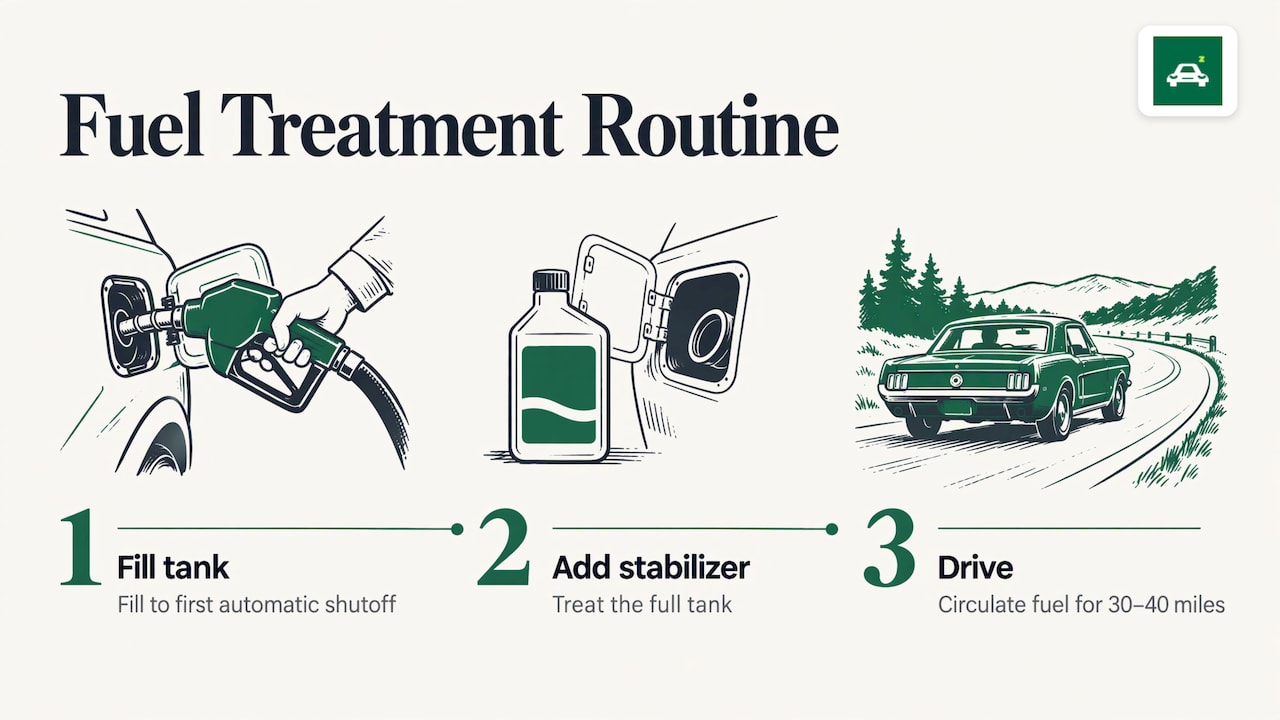
Fuel is where classic owners get hurt most. Ford says to fill the tank to the first automatic shutoff. State Farm’s routine is to add fuel stabilizer to a full tank and then drive 30 to 40 miles so the treated fuel circulates through the system. Pouring stabilizer in and parking the car immediately leaves the treated fuel in the tank only, while the lines and injectors hold the old stuff.
Ethanol matters here. Hagerty says that if you do not drain the tank, the fuel should be ethanol-free, or stabilized if it contains ethanol. Its winter-storage advice for vintage cars warns that fuel can draw in moisture that rots a steel tank from the inside, leaving rust chunks that clog the fuel system. A full tank keeps less air, and less moisture, in contact with the metal.
On All Cylinders’ authors say a quality stabilizer removes the need to drain the system for three or four months of storage, but that draining becomes increasingly advisable for longer periods. If you own a carbureted classic, ask a specialist about draining, since old fuel can clog the small passages.
Step 4: Protect the battery
A dead battery is the most common storage casualty. You have two proper options:
- Smart battery tender. Consumer Reports recommends a tender that shuts off automatically when the battery is full, because overcharging can damage the battery or cause a fire.
- Disconnect it. State Farm says to wipe down the battery and disconnect the negative cable, and Ford says to disconnect the cables when storing for more than 30 days without recharging.
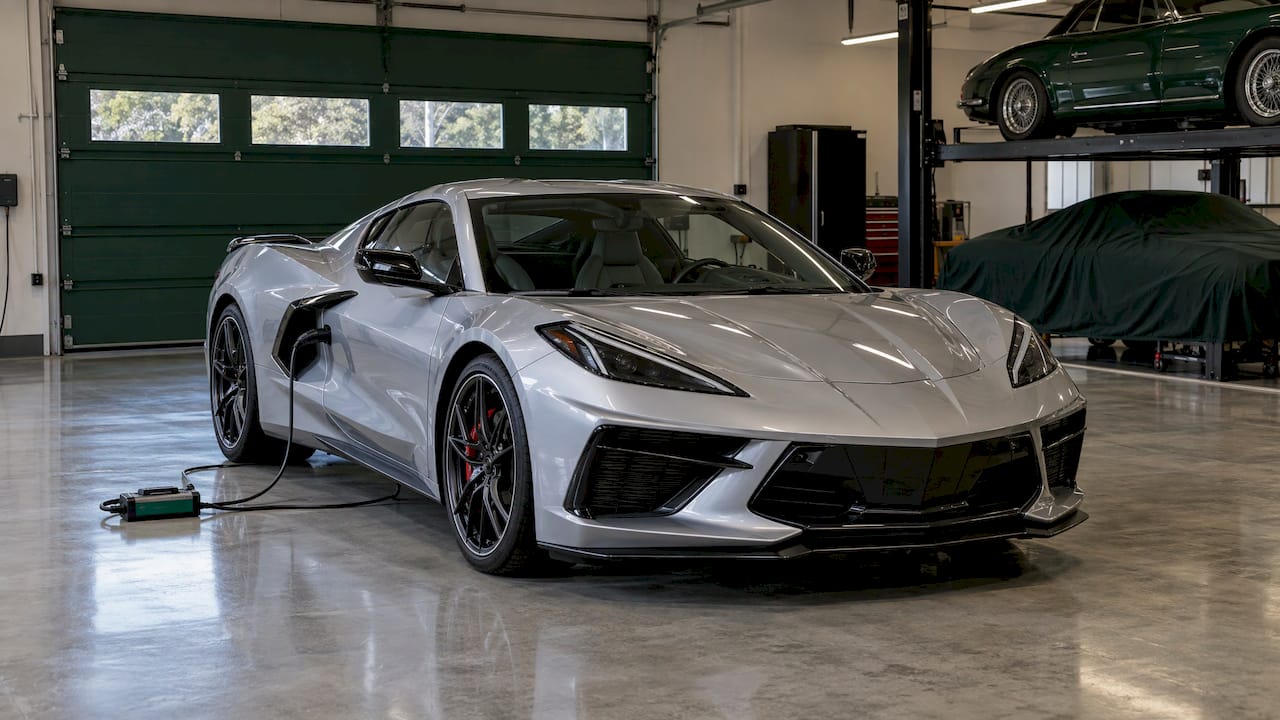
Disconnecting resets clocks and, on modern exotics, can upset electronics and require relearning procedures, so a tender is usually the better route for a late-model car. For the details on how a tender works and which type suits long stays, see our guide to a battery tender for car storage. Battery maintenance is part of the care in our storage program, so the car is kept charged without you having to plug anything in or visit.
Step 5: Set the tires
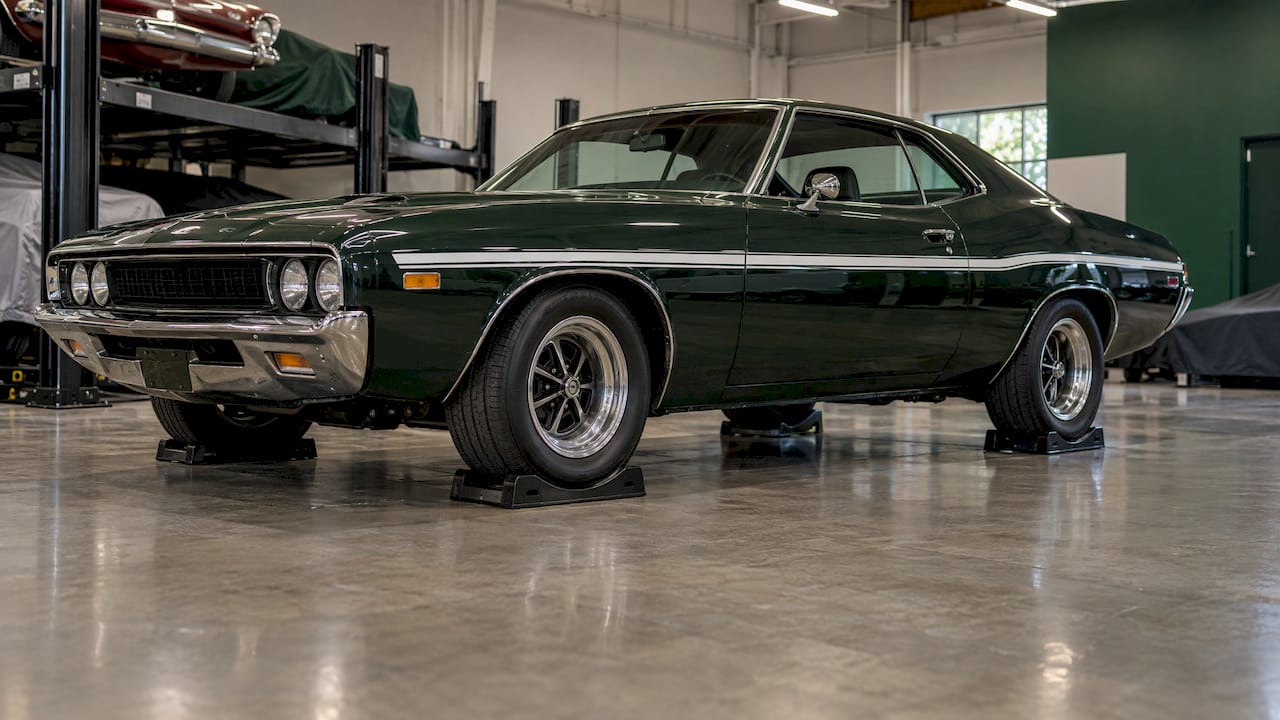
Tires lose pressure over time and can develop flat spots where they carry the car’s weight. State Farm suggests adding 10 pounds of pressure to the tires, or putting the car on jacks. Hagerty reports that flat spots can develop within a year, and recommends lifting the car slightly on jack stands or tire cradles. On All Cylinders notes that three or four months of storage is unlikely to harm a properly inflated modern tire, but it advises slightly over-inflating and checking PSI every few weeks.
Never exceed the maximum pressure printed on the tire sidewall, and reset to the door-jamb placard pressure before you drive. For a refresher on why correct pressure matters, read why proper tire pressure matters. Our deeper guide is how to prevent tire flat spots in storage.
Skip the parking brake for long stays. Brake pads can rust to the rotors, and wheel chocks hold the car in place instead.
Step 6: Seal out moisture and rodents
Two risks slip past a good wash. AAA Northeast’s John Paul points to mold and mildew inside the cabin and rodents entering through the intake or tailpipe.
- Moisture: put desiccant packs in the cabin, set on a disposable baking pan because they can stain. State Farm also suggests a dehumidifier in moist or humid environments.
- Rodents: AAA recommends blocking the engine air intake and tailpipes just before covering the car, and it cautions that the blockages must be removed before you start the engine. State Farm also mentions covering dash vents and gaps in the engine bay. Consumer Reports suggests dryer sheets or traps placed away from children and pets.
- Cover: AAA advises a high-quality breathable cover once the car is clean and dry. Kelley Blue Book says it should fit snugly and be secured, because a loose cover can abrade the paint. Avoid plastic tarps, which trap moisture.
A written note on the steering wheel listing every plug, rag and block is cheap insurance against starting the car with a blocked exhaust. A climate-controlled facility handles humidity for you. Our guide on what humidity level works best for car storage explains the target range.
Step 7: Check insurance and paperwork
State Farm points out something most storage guides skip: humidity and moisture in a storage space can lead to fungus and mold, which may result in an exclusion of coverage. Review your policy or talk to your agent, and take moisture-reducing steps. Ask your insurer too whether you may reduce coverage while the car is stored, and what the policy requires of the storage location.
Extra steps for classic cars
Winterizing a classic car follows the same list with higher stakes. The additions that matter most:
- Warm drive before the oil change, as Hemmings describes, so moisture leaves the exhaust and the oil drains well.
- Fuel suited to the car. Ultimate Corvette’s winter guide suggests fresh gasoline meeting the model’s specification, a nearly full tank that leaves room for expansion, and ethanol-free fuel for older cars with original fuel-system parts.
- Underbody wash. Wheels, wheel wells and the accessible underbody collect salt and grime.
- Record what you did. Hagerty’s advice to keep a written record matters more when the car sits for years.
For a full walkthrough, see our guides on how to store a classic car, classic car winter storage and classic car storage costs and planning.
Waking the car up
The same care applies when you take the car out. Speedway Tire & Service says not to start a car that has sat for months if you see a fuel leak, smell strong gasoline, find a nest or a blocked exhaust, see serious wiring damage, or notice a tire with a bulge, deep crack or exposed cord. When it looks clean:
- Remove every plug and block you installed.
- Reset tire pressures.
- Start the car in an open, ventilated area and watch warning lights and temperature.
- Take a short, controlled test drive that tests acceleration, steering, braking and lights.
Consumer Reports adds that after more than six months, you should change the oil before driving and check drive belts for cracks. Hagerty cautions against starting the engine and shutting it off quickly: it does more damage than leaving it alone because the cylinders are dry. Run it long enough, about half an hour, to bring the oil and fluids to temperature.
Why regular driving beats parking and forgetting
Consumer Reports lists what a long-idle car can suffer: a dead battery, rusted brakes, dried-out and leaking seals, and rodents. Its chief mechanic recommends driving the car at least weekly for 20 minutes. Ford’s routine for storage of 30 days or more asks you to start the engine every 15 days and run it for at least 15 minutes. That is easy in a home garage in July and hard when you travel, or when the car is in another city.
That gap is where an exercise program earns its place. NapGarage storage includes exercise drives, together with inspection reports and photo check-ins delivered to your phone, so you can see the car’s condition without making the trip.
What we think
A storage checklist is only as good as the weeks after you finish it. Owners follow the steps on day one, then travel, and nobody tops off the tires or checks the battery in month three.
That is why we built NapGarage around enthusiast-grade storage and not just parking space. The car sits in climate-controlled space. Battery maintenance, fluid checks, detailing and exercise drives continue while it is stored, and inspection reports and photo check-ins reach your phone so you can see how the car is doing without driving to the facility.
The app is part of the same idea: you request pickups and details from your phone and keep up with the car as easily as you would with a car in your own driveway. For collectors, that keeps the half-day of preparation working for the whole season, not just the first week.
NapGarage Team
Put the checklist to work
If you would rather not carry out the weekly checks yourself, NapGarage connects you with climate-controlled storage for exotic, classic and collector cars, with battery maintenance, fluid checks, exercise drives, detailing, inspection reports, photo check-ins and enclosed transport. You manage pickups and details from the app.

See the exotic and classic car storage options or visit NapGarage to request a quote. Facilities are listed by city, including Los Angeles, Miami, Las Vegas and Sterling, Virginia.
FAQ
Is it okay to leave a car sitting for a month?
A modern car in good health usually handles a month, provided the battery is charged and the tires are properly inflated. Beyond 30 days, Ford’s guidance calls for the full storage routine, including fresh oil, a full tank and a plan for the battery. Starting it every couple of weeks and letting it reach full temperature helps.
Is it safe for a car to sit idle for three months?
Yes, with preparation. Hagerty counts up to three months as short-term storage. Change the oil, fill the tank with stabilized fuel, keep the battery on a smart tender and control moisture. Without those steps, a battery that goes flat is the usual outcome.
Should I store a classic car with a full tank or an empty one?
For three or four months, a full tank of stabilized fuel is a common approach, because it keeps the metal inside the tank covered and limits moisture. Ethanol-free fuel is preferred for older cars. For storage that stretches well beyond that, or for a carbureted engine, talk to a specialist about draining.
Do I need climate-controlled storage?
It is the best protection against humidity, mold and temperature swings. State Farm recommends considering a climate-controlled indoor unit for classic cars and winter storage, and notes that moisture damage can lead to an insurance exclusion.
Sources
- Ford: preparing a gas-powered vehicle for long-term storage
- Hagerty: MotorWatch’s tips for seasonal storage
- Hagerty: What happens when cars sit
- Hagerty: 6 winter storage tips for your vintage ride
- AAA Northeast: the do’s and don’ts of winter car storage
- Consumer Reports: maintaining a car that isn’t driven much
- Kelley Blue Book: how to store a car long-term
- Honda: preparing a vehicle for long-term storage
- Hemmings: cold storage for classic cars
- On All Cylinders: classic vehicle winterization routine
- Ultimate Corvette: winter storage guide
- Speedway Tire & Service: what to check before driving again