How Often to Drive a Stored Car: A Practical Schedule

Drive a stored car at least every two to four weeks, for 20 minutes or more, at real road speed. Manufacturer and consumer guidance ranges from every 15 days to every six weeks, and the common thread is that the engine has to get fully hot. A short idle in the garage does not do that. For an exotic, classic or collector car, the simplest way to keep that rhythm is to store it where exercise drives, battery care and inspection reports are part of the service, which is what the storage facilities we list offer.
NapGaragenapgarage.comKeep Your Car Ready Between DrivesNapGarage combines climate-controlled storage with exercise drives, battery maintenance and inspection reports to help care for collector cars.VisitKey Takeaways
- Plan on a real drive of at least 20 minutes every one to four weeks. Weekly is the safest rhythm, and Consumer Reports suggests it for rarely driven cars.
- Driving beats idling. A drive brings the engine, transmission, brakes and tires up to operating temperature, and idling does not.
- A battery maintainer or a disconnected negative cable protects the battery between drives.
- Every drive is also an inspection: look for leaks, low fluids, tire pressure and rodent damage.
- Exercise-drive service from a specialty storage facility keeps this schedule going when you travel, or when the car sits for a whole season.
Table of Contents
- What the manufacturers and testers actually say
- Why driving works and idling does not
- How long and how far each drive should be
- What each drive should do for the car
- Turn every drive into an inspection
- The first drive after a long sit
- A realistic schedule
- Keeping the schedule when you are not there
- What to look for in an exercise-drive service
- Storing for winter
- Our view on exercise drives
- Find climate-controlled storage with exercise drives
- FAQ
- Sources
What the manufacturers and testers actually say
The advice is not uniform, and the differences come from how long the car sits and what the car is.
| Source | Interval | What it asks for |
|---|---|---|
| Ford, gas-powered vehicles in long-term storage | Every 15 days | Run at least 15 minutes at fast idle until normal operating temperature, shift through all gears with the brake applied |
| A 2025 Lexus storage bulletin filed with NHTSA | Every 6 weeks | Run 15 minutes or longer below 1,500 rpm, raise engine speed above 3,000 rpm 10 times, drive at least 30 feet |
| Consumer Reports, rarely driven cars | Once a week | Drive at least 20 minutes, use the brakes frequently |
| J.D. Power, October 2024 | About once a week | Run about 15 minutes to help the battery recharge; more than a month without starting risks a flat battery |
The range is wide, from weekly to every six weeks, but the reasoning behind all of it is the same. Fluids, seals, brakes and the battery are made to work while the car is moving. Left alone, oil drains off the upper engine, rotors rust, tires settle into a flat spot and the battery slowly discharges.
For a car you care about, we suggest working from the tighter end. A drive every two weeks is a sensible floor, and weekly is better if you can manage it.
Why driving works and idling does not
A lot of owners start the car in the garage for a few minutes and call it done. The trouble is that a short idle never brings the oil and exhaust system to full temperature. Moisture from combustion stays in the oil and exhaust, and the brakes, tires and gearbox get nothing from it.
Consumer Reports’ chief mechanic, John Ibbotson, explains in the magazine’s guidance on rarely driven cars that driving is what matters, because it brings the engine, transmission, differential, tires and brakes to operating temperature. That is also what helps prevent leaks and rust-seized brakes.
The battery follows the same logic. Consumer Reports says driving is better than idling for topping off a battery, and that driving at least 20 minutes roughly every two weeks should keep it functional.
When you cannot drive, a battery maintainer is the usual answer. We cover the options in our guide to a battery tender for stored cars.
How long and how far each drive should be
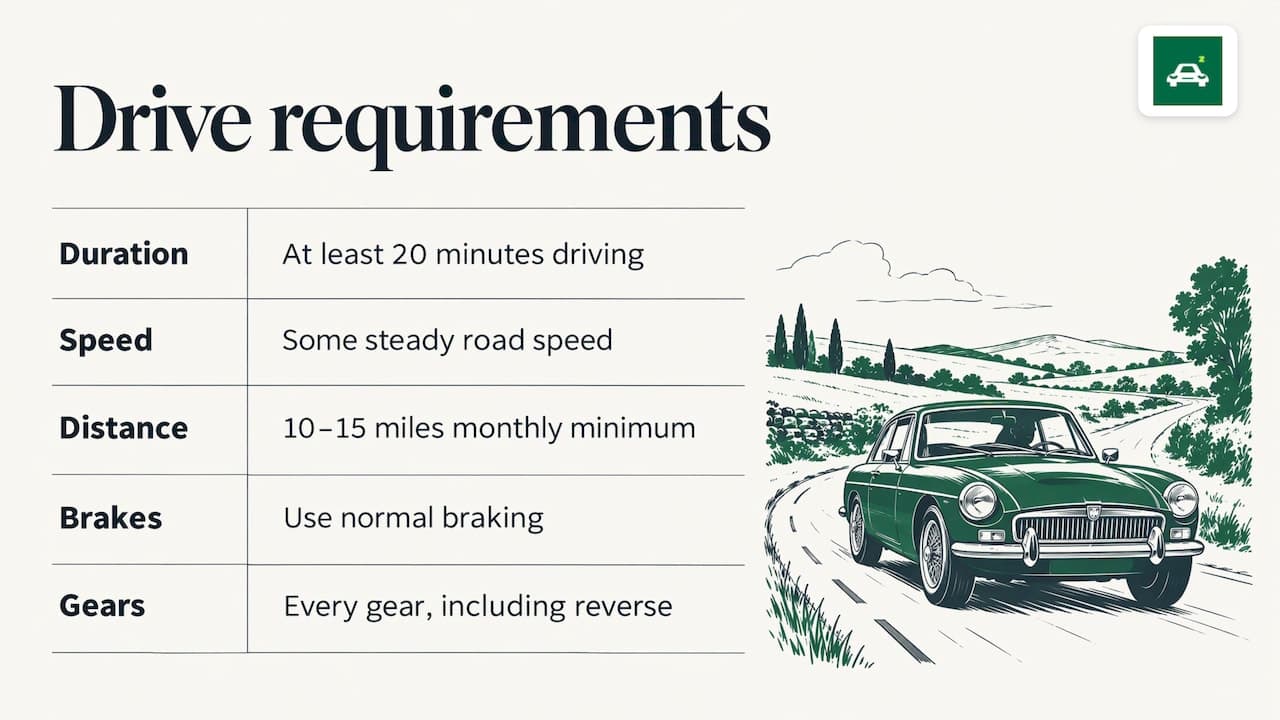
Think of the drive as a small job with a minimum standard.
Duration. At least 20 minutes of actual driving. Ford’s idle procedure runs 15 minutes minimum, but the engine must reach normal operating temperature, so on a cold day or with a large engine you will need longer.
Speed. Include some steady road speed, not only a loop around the block. Moving the car also shifts the tire contact patch, which helps prevent flat spots. Our article on preventing tire flat spots in storage goes deeper on that.
Distance. Foremost’s classic-car maintenance tips suggest short trips of about 10 to 15 miles each month to keep fluids moving and prevent parts from seizing. Treat that as the lowest end of the range for a classic, not the target.
Brakes. Use them. Consumer Reports notes that frequent braking removes rust from the rotors, and the Lexus bulletin asks for driving with normal braking at least once every eight weeks for the same reason.
Gears. Go through all of them, including reverse. Ford specifically asks to shift through all gears with the brake applied during the stationary run.
What each drive should do for the car
Battery
A drive tops up the charge that the car’s clocks, alarms and modules slowly draw down. The Lexus bulletin calls for 12V battery maintenance every 30 days after the first 60 days of storage. Ford says to check and recharge as needed, keep connections clean, and disconnect the cables if the car will sit more than 30 days without recharging. Consumer Reports adds that disconnecting the negative cable stops the car’s systems from drawing power when driving is not possible.
Fluids and fuel
J.D. Power notes that fuel begins to degrade after about 30 days, and that deposits can harm the fuel system after several months. It also suggests keeping the tank at least a quarter full to limit moisture. Oil should be changed before long-term disuse and again when the car returns to regular use; Consumer Reports says to change it before driving again if the car sat more than six months.
Tires
Factory manuals often say to check pressure weekly. Consumer Reports’ experts say once a month is enough for a rarely driven car. Check belts for cracks too, particularly before driving a car that has sat for several months.
Brakes and moving parts
Surface rust on rotors cleans off with normal braking. Seized calipers are what you are trying to avoid, and regular driving is how you avoid them.
Turn every drive into an inspection
Before you start, walk around the car. Look under it for drips, check tire pressure, and look in the engine bay for nesting material or chewed wires. After the drive, check the oil, coolant, brake and transmission fluid levels, then look again for leaks. Our vehicle storage inspection checklist for collectors lays out what to look at and in what order.

The first drive after a long sit
If the car has been dormant for months, go slowly. Hagerty’s guidance for collector cars, in its steps for bringing a car out of storage, runs roughly like this:
- Test the brakes first with a hard, then harder, pedal press held for 10 seconds.
- Lubricate the top end of the engine before cranking, since oil drains away from it while the car sits.
- Pressurize the fuel system before the first start.
- Let the engine idle a few minutes while you check for leaks and noises.
- Take a short, slow drive around the block, listening for unusual noises or vibrations.
After that, return to the regular 20-minute-plus routine.
A realistic schedule
| Time in storage | What to do |
|---|---|
| Weeks 1 to 4 | One drive of 20 minutes or more, weekly if you can, with battery maintainer connected between drives |
| Month 2 and beyond | Drive every one to two weeks, check tire pressure monthly, inspect fluids and look for rodent signs |
| Six months or more | Fresh oil before the next regular drive, belt check, and a slow first outing |
The schedule is simple on paper. It is hard to keep when you travel, when the car is a two-hour drive from where you live, or when the weather turns. That is where most stored cars slip.
Keeping the schedule when you are not there
Most owners fall behind not because they do not know the interval, but because a weekly drive is a recurring obligation. A car that is stored for the season, or stored at a facility away from home, needs someone else to do it properly: a drive at real speed, a walk-around, a battery check, a record of what was found.
The facilities on NapGarage specialize in exotic, classic and collector cars, and the care we list includes exercise drives, battery maintenance, fluid checks and detailing, all in climate-controlled storage. Inspection reports and photo check-ins arrive on your phone, so you see the result of each visit without going to the facility. You can also request pickups and details through the mobile app, and enclosed transport is available.
If you want to see what a check-in looks like, our piece on car storage photo check-ins explains what those reports show. Humidity matters as well as driving, and our guide to the right humidity level for car storage covers it.
What to look for in an exercise-drive service
When you compare facilities, ask for specifics that match the schedule above:
- Frequency. How often is the car driven, and can you set a weekly or biweekly rhythm?
- Duration and conditions. Are drives long enough to reach full operating temperature, and do they include road speed?
- Reporting. Do you get an inspection report and photos after each visit, with findings on fluids, tires and leaks?
- Battery care. Is a maintainer used, and who checks it?
- Environment. Is the space climate-controlled, and how is the car protected between drives?
- Access. Can you request pickup or a detail through an app when you want to drive it yourself?
We built our listings around these questions. You can browse by city on our exotic and classic car storage page, or read our broader guide to classic car storage: how to choose, prepare and budget.
Storing for winter
If the car will sit through a cold season, the same principles apply, with a few additions: a fresh oil change, a full tank with stabilizer, tires inflated correctly and the battery on a maintainer. Our winter car storage guide walks through the preparation, and our step-by-step classic car storage guide covers the full process. For more on intervals, see our own article on how often stored cars should be driven.
Our view on exercise drives
We think a stored car should be driven like a car that is cared for, not started like a car that is forgotten.
The people who own exotic, classic and collector cars tend to know exactly what the car needs. What they lack is the time to deliver it every week, and the visibility to know it happened. That is why we focus only on enthusiast-grade storage and build the experience around the owner’s phone.
Exercise drives, battery maintenance, fluid checks and detailing belong in one routine, because each supports the others. A drive reveals a leak, the inspection report records it, and the photo check-in shows you the car afterward. You do not have to visit the facility to stay informed, and you can ask for a pickup in the app when you want the keys.
That is the standard we hold the storage facilities on NapGarage to, and the one we would want for our own cars.
NapGarage Team
Find climate-controlled storage with exercise drives
If you want the schedule above handled for you, start with our exotic and classic car storage listings. Each facility offers climate-controlled space for exotic, classic and collector cars, with the care described above, and you can request a quote for the one that fits your car.

You can also look up facilities by location, including Philadelphia, Miami and Las Vegas.
FAQ
How often should you start a stored car?
Ford says every 15 days, and the Lexus bulletin filed with NHTSA says every six weeks. Whatever the interval, the run needs to reach full operating temperature. We recommend a real drive of 20 minutes or more every one to two weeks.
Should you start a car in storage if you cannot drive it?
A short cold start does little, because it never gets the engine fully hot. If you cannot drive, a battery maintainer or a disconnected negative cable protects the battery, and a stationary run should last long enough to reach normal operating temperature, as Ford specifies. For a collector car, an exercise-drive service is the more complete answer.
How long should an exercise drive be?
At least 20 minutes, according to Consumer Reports, with frequent use of the brakes. Include some steady road speed, and use the stop afterward to check fluids, tire pressure and the engine bay.
What does a stored-car exercise service cover?
At the facilities we list, exercise drives sit alongside battery maintenance, fluid checks, detailing, inspection reports and photo check-ins. You see the results on your phone. Ask each facility how often the car is driven and how it reports findings.
Sources
- Ford: preparing a gas-powered vehicle for long-term storage
- NHTSA: Long-Term Vehicle Storage Guidelines (2025)
- Consumer Reports: How to maintain a car that isn’t driven much
- Consumer Reports: How to make your car battery last longer
- J.D. Power: How long can a car sit without being driven
- Hagerty: 5 steps to bring your car out of storage
- Foremost: classic car maintenance tips