How to Prevent Condensation in a Car, Parked or Stored

Condensation inside a car comes from one thing: humid air meeting a surface colder than its dew point. You stop it by removing moisture sources, keeping air moving, and holding the car at a steady temperature and humidity. For a daily driver, that means dry mats, fresh air and a few minutes of AC. For an exotic, classic or collector car that sits for weeks, it means ventilation and humidity control that you can’t improvise in a driveway. That is why many owners choose a climate-controlled facility that sends inspection reports and photo check-ins to their phone. You can find those facilities through NapGarage.
NapGaragenapgarage.comProtect Your Car From MoistureNapGarage pairs climate-controlled storage with inspection reports and photo check-ins, helping you monitor your car without visiting the facility.VisitKey Takeaways
- Condensation forms when warm, moist cabin air touches cold glass or metal. Breath, wet mats and damp clothing are the usual moisture sources.
- For everyday driving: remove damp items, run the AC, turn recirculation off and keep seals and drains in good shape.
- For stored cars: park the car clean and completely dry, give the air a way to move, and keep humidity stable rather than chasing a perfect number.
- Condensation that keeps returning in dry weather points to a leak or a blocked drain. Dehumidifier packs can’t fix an active leak.
- Regular inspections catch moisture early. Climate-controlled storage with photo check-ins does that without you driving to the facility.
Table of Contents
- Why condensation forms inside a car
- How to prevent condensation in a car you drive every day
- Quick fix: how to clear a fogged windshield
- When condensation keeps coming back
- Why storage changes the problem
- How to prepare a car for storage so moisture doesn’t build
- Ventilation and humidity in car storage
- What to do at the first sign of mold
- Perspective
- Find climate-controlled storage for your car
- FAQ
- Sources
Why condensation forms inside a car
The science is simple. Condensation is what happens when water vapor in the air cools and turns into liquid water, and the U.S. Geological Survey names the moisture on the inside of car windows after people exhale as a common example.
Three things combine to create it:
- Moisture in the cabin. Breath, wet jackets, damp floor mats, a leftover umbrella or a half-finished drink all add vapor. Wet items keep evaporating for hours after you leave.
- A cold surface. Glass is thin and uninsulated. On clear nights it loses heat to the sky, so it becomes the coldest surface in the car.
- Time and still air. A sealed cabin traps humid air. As the car cools overnight, the air’s relative humidity climbs until the vapor has nowhere to go but onto the glass.
The National Weather Service describes the same process outdoors as dew. It forms when a surface cools to the dew point, and clear skies and light wind favor it. That is why a car parked under open sky can be coated in water by morning, even before you add anything from inside the cabin. If the glass falls below 32°F, the condensed water becomes frost.
Motor1 points out why fogging so often shows up first thing in the morning: the windows have cooled overnight, then the cabin air warms and fills with breath the moment you get in.
How to prevent condensation in a car you drive every day
You can’t remove humidity from the world, so the goal is to take away moisture sources and move damp air out. These habits do most of the work.
Keep wet things out of the cabin
Take out damp towels, swimsuits, wet umbrellas, damp coats and boots, and food or drink, in every season. White’s Automotive Center lists these as the routine culprits. Shake out floor mats and let them dry fully before they go back in. In wet climates, rubber liners hold less water than carpet mats and are easier to dry.
Use the AC, even in winter
The AC compressor pulls moisture out of the air. AutoZone recommends running it even in cool weather to clear cabin humidity, and using the HVAC fan to bring in fresh air. Turn off recirculation when the weather is humid. White’s notes it simply recycles damp air.
A good habit: for the last few minutes of a drive, switch the AC on and point the airflow at the glass. You park with drier air in the cabin.
Crack a window when it’s safe to
In mild, dry weather, opening a window slightly while parked lets moist air escape. It isn’t practical in rain or in a public lot, but it helps when the car is in your own garage.
Maintain what keeps water out
The same AutoZone guide lists worn seals, a blocked AC drain, a dirty cabin air filter and a weak AC system as common causes. Check and condition weather stripping once or twice a year and replace the cabin air filter about once a year.
Use desiccant as a helper, not a fix
Reusable dehumidifier bags and silica gel packs absorb moisture overnight and recharge in sunlight or a warm oven, according to AutoZone. An open container of baking soda also helps. Lithia Motors notes a container of baking soda or DampRid works for up to 60 days. Think of these as maintenance. If a pack fills up every few days, something is still wetting the car.
Park smart
Glass that sees the open sky cools fastest. A Pilkington technical bulletin says glass can run about 4 to 5°F cooler than still outside air on clear nights, and that parking with the windshield facing a house or wall blocks that heat loss and makes condensation and frost far less likely. A garage or carport does the same job.
Quick fix: how to clear a fogged windshield
When you’re already in a fogged car, work in this order:
- Turn on the front defrost and set the fan to high.
- Use warm air and turn the AC on.
- Switch recirculation off so fresh air comes in.
- If fog lingers, crack two windows about half an inch.
- Don’t drive until the whole windshield is clear. A small wiped peephole hides pedestrians, cyclists and brake lights.
All U.S. passenger cars are required to have a defrosting and defogging system, so the controls are there for this. Using them early, before you pull away, is quicker than fighting fog while moving.
When condensation keeps coming back
An occasional foggy morning is normal. Persistent moisture is a signal. Motor1 lists persistent fogging, wet carpets, a musty smell, a sweet odor or an oily film on the glass as signs of a blocked drain, a damaged weather seal, a dirty cabin air filter or a leaking heater core. Have a qualified technician check these.
Do a quick visual pass first:
- Lift the floor mats and press the carpet underneath with your hand.
- Look in the trunk and the spare-tire well for standing water.
- Notice whether one side of the car fogs worse than the other.
- Smell for mustiness. A sweet, syrupy smell with a damp passenger-side carpet is a classic heater core sign.
If the car lives in a garage, check the building too. Water and humid air can enter around the door. A gap under a garage door lets in moisture, drafts and pests, and sealing it is part of keeping the air around a parked car stable.
Why storage changes the problem
A car that moves every day dries itself out. It gets warmed, vented and driven. A stored car doesn’t. It sits through temperature swings with whatever moisture was inside when you parked it, and the damage shows up slowly: musty upholstery, mildew on leather, corrosion in places you don’t look.
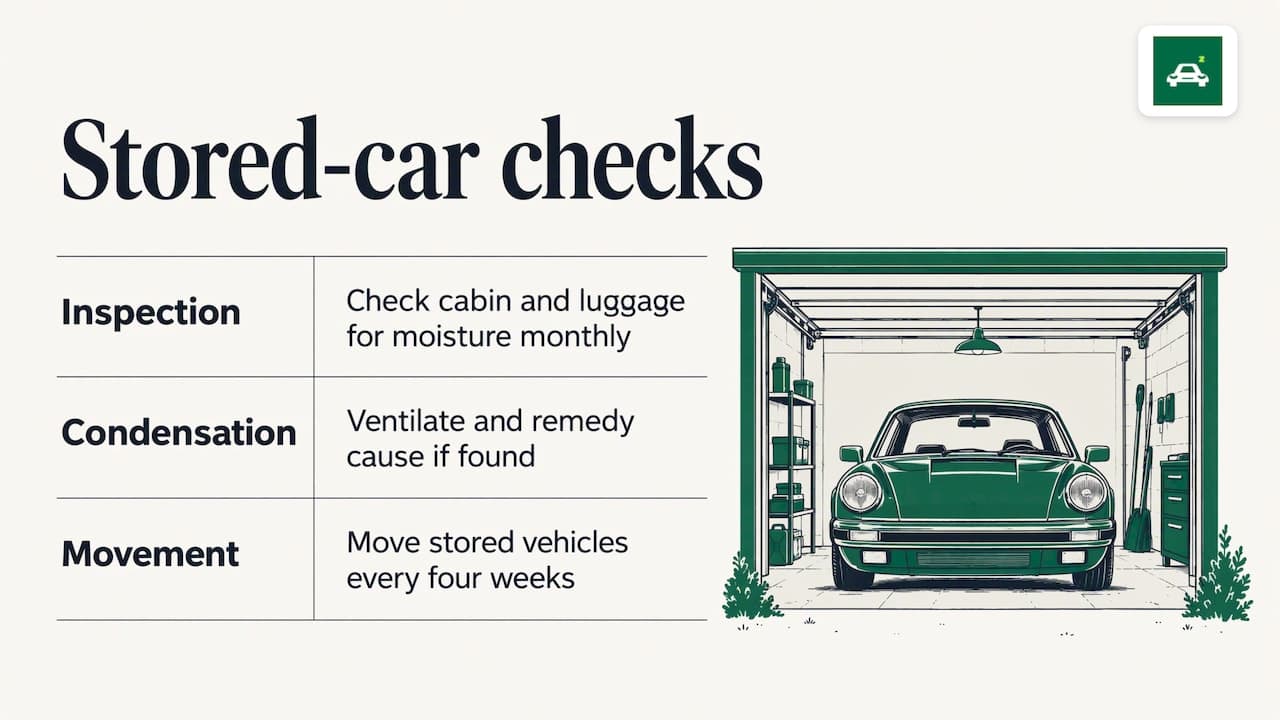
Manufacturers know this. A BMW storage standard filed with NHTSA calls for monthly inspections of stored vehicles, including checking the passenger and luggage compartments for moisture. If condensation is found, the instruction is to ensure adequate ventilation and remedy the cause. It also requires moving the vehicles every four weeks to prevent tire pressure loss.
That one standard captures the three jobs of storage: check, ventilate, move.
How to prepare a car for storage so moisture doesn’t build
If you’re storing the car yourself for a season, start with the cabin.
- Wash and vacuum, then make sure everything is bone dry. Trapped dampness in carpet or a trunk is the main cause of stored-car mildew. Dry the car completely before it goes in.
- Remove all food, wet items and loose fabrics. Anything that holds water or smell goes out.
- Place desiccant packs inside. AAA Northeast advises desiccant moisture-drying packs to prevent mold and mildew, set on a disposable baking pan because the packs can stain.
- Block ground moisture. For a car on dirt or gravel, AAA suggests heavy plastic sheeting or a tarp the size of the car under it to limit moisture rising from the ground.
- Don’t leave the parking brake on. AAA warns it can rust and stick.
- Use a breathable cover, never plastic over the body or upholstery. Covers that don’t let air pass trap moisture against the paint.
For older vehicles, the National Park Service’s guidance on preparing historic vehicles from a museum conservator goes further. It covers leaving the fuel filler cap off for several weeks so trapped fuel and moisture can evaporate, lightly oiling the tank and carburetor interior to reduce corrosion from condensed moisture, and draining coolant and leaving the system open until dry. Treat that as a reference for vintage mechanical systems, and follow your manufacturer’s guidance for anything modern.
For more prep detail, see our guides on how to store a classic car and winter car storage.
Ventilation and humidity in car storage
Ventilation in storage has a specific meaning. You don’t want a draft blowing through the building, and you don’t want a sealed box. You want gentle air movement and a stable temperature so surfaces never fall far below the dew point.
A collector-car climate-control guide recommends a stable 40 to 50% relative humidity and 59 to 68°F for collector storage, with relative humidity kept below 60% to prevent mold. The same guide stresses that stability matters more than hitting perfect numbers. Daily swings are what drive condensation, because every time the temperature falls, the dew point is closer.
Here is how the main approaches compare for a car that sits for months:
| Approach | What it does | Where it falls short |
|---|---|---|
| Unheated garage, no control | Keeps rain off | Temperature swings still cause condensation on glass and metal |
| Desiccant packs in the cabin | Absorb modest amounts of vapor | Can’t keep up with an active leak or a damp building |
| Home dehumidifier | Lowers room humidity | Needs power, emptying and monitoring, and a failure goes unnoticed |
| Climate-controlled storage | Holds temperature and humidity steady with ventilation | Requires choosing a facility with the right care routine |
For the details of the humidity target, read our piece on what humidity level is best for car storage.
What a good storage routine includes
Storage should include more than a roof. A stored car also needs someone to look at it. A useful routine covers:
- A cabin check for dampness, odor and glass fogging, following the monthly pattern the BMW standard describes.
- Battery maintenance, so the car starts when you want it. See our guide to a battery tender for stored cars.
- Fluid checks and periodic exercise drives. We cover how often stored cars should be driven and how to prevent tire flat spots.
- Documentation, so you see what the car looks like each time. Our vehicle storage inspection checklist lists what to look for.
- Detailing that leaves the car dry. See detailing while your car is stored.
What to do at the first sign of mold
If you find a musty smell or a dusting on leather or carpet, act quickly. The collector-car guide’s advice: isolate the car, document the growth with photos, vacuum with a HEPA vacuum, and escalate to a professional conservator if growth is under upholstery or in hidden cavities. Then find and fix the moisture source. Cleaning without fixing the cause means the mold returns.
Perspective
Most owners treat condensation as a cold-morning annoyance. For a car in storage, it’s the early warning for everything that follows: mildew, corrosion, tired seals and a car that doesn’t feel the way you left it.
We built our approach around enthusiast-grade storage. A climate-controlled space is the foundation, because stable conditions keep surfaces from crossing the dew point. The routine around it is what turns a good room into real care: battery maintenance, fluid checks, detailing, exercise drives and inspection reports.
The part owners tell us they value most is knowing without driving over. Photo check-ins and inspection reports reach your phone, and you request a pickup or details through the mobile app. You see the cabin, the glass and the paint, and you spot a problem the week it starts rather than the season after.
Collectors shouldn’t have to choose between a car that’s protected and a car that’s easy to get to. Managing both from your phone is what we think storage should be.
NapGarage Team
Find climate-controlled storage for your car
If you own an exotic, classic or collector car and don’t want to manage dehumidifiers, desiccant packs and monthly cabin checks yourself, NapGarage helps you find climate-controlled storage with battery maintenance, fluid checks, detailing, exercise drives, inspection reports and photo check-ins to your phone. You can request quotes and compare facilities near you.

You can start from the storage by city page or see our classic car storage guide for how to choose, prepare and budget.
FAQ
Does air conditioning stop condensation in a car?
Yes, it helps. The AC removes moisture from the air, even in cool weather with the heater on. Turn recirculation off so the system pulls in fresh air instead of reusing damp cabin air. If fog is still heavy, check the cabin air filter and the AC drain.
Should I crack a window when I park?
In your own garage in mild weather, a slightly open window lets damp air escape, as AutoZone suggests. In rain, or anywhere the car is exposed, it can let in more moisture than it removes. For long storage, a climate-controlled space handles air movement for you.
Do dehumidifier packs and baking soda work in a car?
They absorb a modest amount of moisture and help with overnight dampness and odors. They work best on a clean, dry cabin. If the car stays damp or the packs fill quickly, look for a leak, a wet carpet or a blocked drain.
How often should a stored car be checked for moisture?
Monthly is a sound pattern. The BMW storage standard filed with NHTSA calls for monthly inspections of the passenger and luggage compartments for moisture, plus moving the vehicle every four weeks. Facilities that send inspection reports and photo check-ins make that routine visible without a trip.
Is condensation inside a car always a leak?
No. Breath and wet items create plenty of normal condensation. Suspect a leak when fogging returns daily in dry weather, the carpet is damp, there’s a musty or sweet smell, or one side fogs worse. A technician should check blocked drains, seals and the heater core.
Sources
- Condensation and the Water Cycle, U.S. Geological Survey
- Dew and Frost Development, National Weather Service
- How do I get ice off my car? PBS News
- Why Your Car’s Windows Fog Up Even When It’s Not Raining, Motor1
- Smart Tips To Deal With High Humidity In Your Vehicle, White’s Automotive Center
- How to Prevent Condensation in Your Car, AutoZone
- How to Dehumidify Your Car, Lithia Motors
- Condensation on Exterior Surface of High Performance Glazing, Pilkington
- BMW Standard SI Template, NHTSA
- Conserve O Gram Volume 10 Issue 3, National Park Service
- The Do’s and Don’ts of Winter Car Storage, AAA Northeast