Exotic Car Transport: How to Ship a High-Value Car Safely
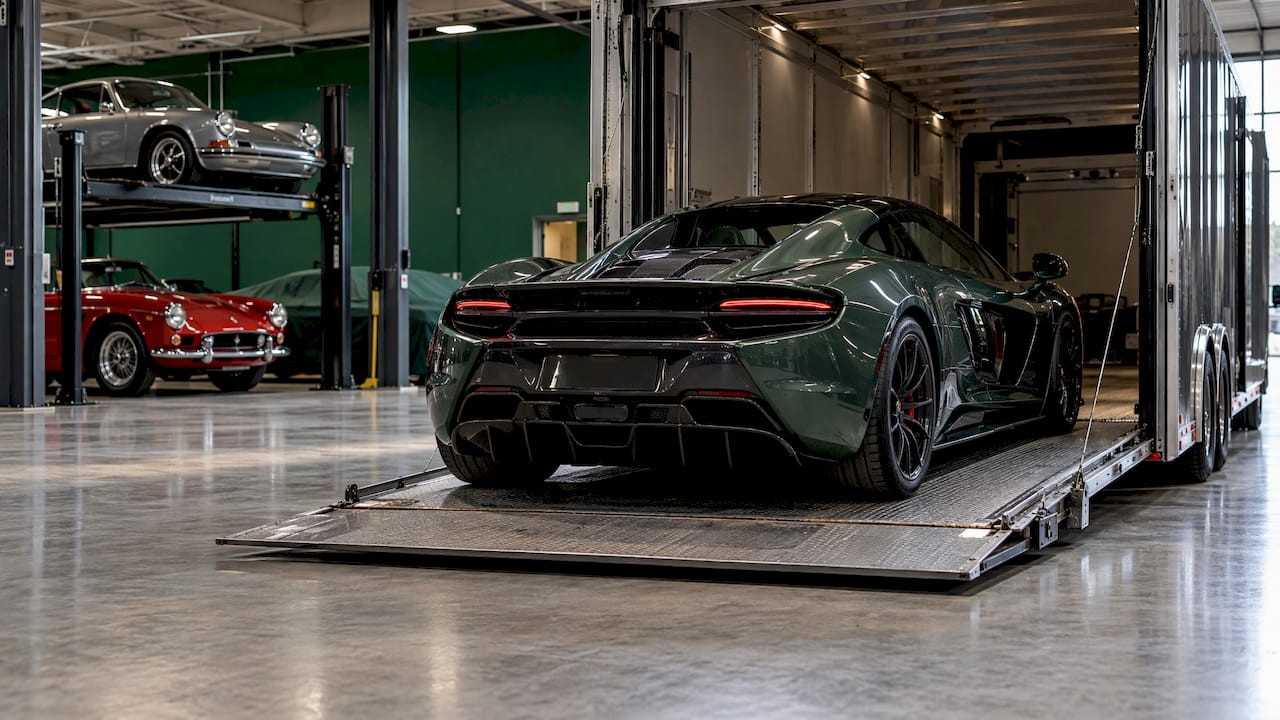
Exotic car transport is best done in an enclosed trailer, with a carrier whose insurance and loading procedures you have verified, and with the car’s condition documented before and after the trip. Get those three things right and the move is routine. Skip one and a problem is hard to prove. If your car also needs a home at either end of the trip, we pair enclosed transport with climate-controlled storage through NapGarage, so pickup, care and delivery sit under one plan.
NapGarageKeep Your Car Protected After TransportNapGarage offers climate-controlled storage with maintenance and photo check-ins to help care for your car between trips.VisitKey Takeaways
- Enclosed transport protects a restored or high-value car from rock damage, salt, hail and fluid drips that open carriers are not liable for.
- Check the carrier on the FMCSA database, ask for proof of cargo insurance, and read the bill of lading, because that document decides how a claim is handled.
- Wash, photograph and prepare the car before pickup, and never sign at delivery until you have inspected it in full daylight.
- Expect to pay more for enclosed (at least 20% over open) and more again for a direct carrier (20% to 30% over a broker).
Table of Contents
- How exotic car transport works in the United States
- Why enclosed transport is the standard for exotic cars
- How to vet a transporter: experience, insurance and paperwork
- How to prepare your exotic car for pickup
- What happens at pickup, in transit and at delivery
- What affects the cost of shipping an exotic car
- Transport and storage work best together
- Our perspective: transport is part of a car’s care routine
- Find climate-controlled storage with enclosed transport
- FAQ
- Sources
How exotic car transport works in the United States
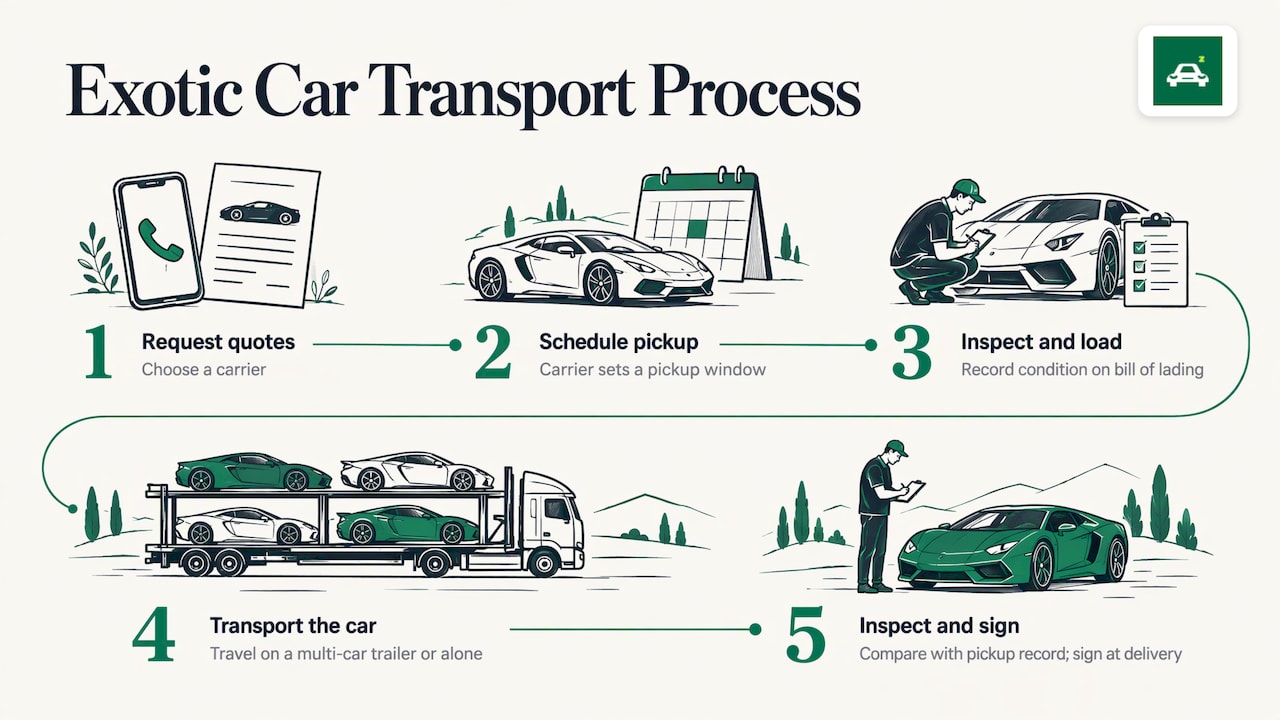
Most exotic car shipping follows the same sequence. You request quotes and choose a carrier. The carrier schedules a pickup window. A driver inspects the car, notes its condition on a bill of lading, and loads it. The car travels with other vehicles on a multi-car trailer or, for the most valuable cars, sometimes alone. At delivery, you inspect the car, compare it with the pickup record, and sign.
Two kinds of company sell this service, and the difference matters. A carrier owns trucks and moves the car itself. A broker does not own trucks and arranges the move through carriers it hires. The Federal Motor Carrier Safety Administration (FMCSA), the federal agency that regulates interstate trucking, explains that brokers must be registered with FMCSA as brokers and carriers need a USDOT number. That page is written for household moves, but the registration distinction is the same one you should look for when hiring anyone to haul a car across state lines.
Why does it matter for an exotic? With a broker, the person you talk to is not the person who will put hands on the car. With a direct carrier, you know whose trailer your car rides on. Consumer Reports says that if you care about the car, pickup and arrival times are critical to you, or you value communication, a direct carrier is worth a 20% to 30% premium over a broker.
Why enclosed transport is the standard for exotic cars
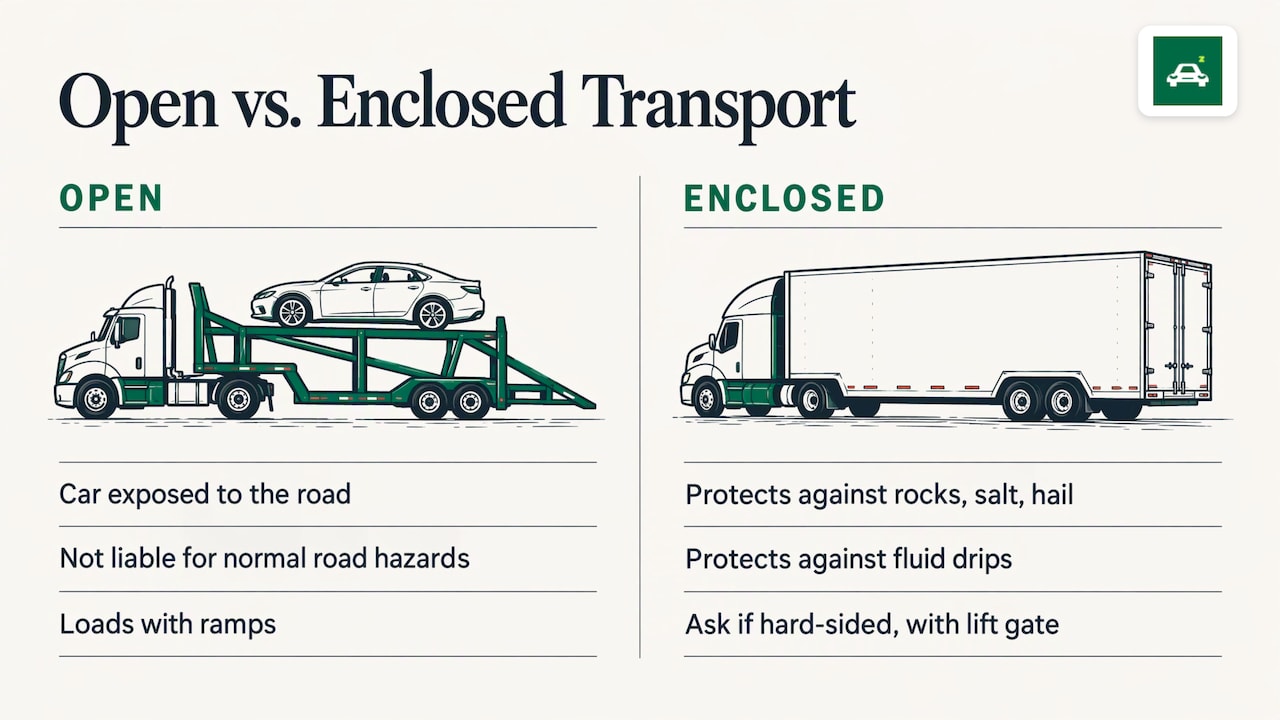
An open carrier leaves the car exposed to the road. An enclosed trailer does not. Hagerty’s shipping guide says enclosed transport should be the only choice for a restored or high-value vehicle because it protects against rock damage, salt, hail and fluid drips, while open carriers are not liable for normal road hazards.
Three details separate a good enclosed move from a poor one.
Ground clearance. Hagerty advises that low-clearance or narrow-track cars go on a trailer with a lift gate, which raises the car level instead of driving it up a steep ramp. Ferrari Lake Forest’s service team adds that undercarriage damage can happen during loading alone when an operator underestimates clearance. Splitters, front lips and low exhausts are the usual casualties.
Soft-sided trailers. Not every trailer sold as enclosed is the same. Hagerty warns that curtain-sided trailers load with ramps just like open haulers, so confirm the equipment before you commit. Ask whether the trailer is hard-sided and whether it has a lift gate.
Tie-down method. Ask how the car will be secured and where the straps attach. Ferrari Lake Forest notes that quality operators welcome questions about loading and tie-down placement. How a carrier answers tells you a lot about the rest of the shipment.
If your car already lives in an enclosed, climate-controlled garage, an enclosed trailer keeps that standard of care going on the road. Our guides on enclosed classic car transport and shipping a collector car safely go deeper on equipment and process.
How to vet a transporter: experience, insurance and paperwork
A slick website tells you nothing. These checks do.
Check the registration and record
Consumer Reports recommends looking up the carrier’s record on the FMCSA Company Snapshot page at safer.fmcsa.dot.gov. Ask the company for its USDOT motor carrier number, then confirm that the name, status and insurance on file match what you were told. FMCSA’s search tool also shows complaint history.
Understand which insurance covers what
This is where owners get surprised. According to Consumer Reports, bodily injury and property damage (BIPD) insurance is mandatory for car carriers but covers the truck and the company, not the vehicles it hauls. Cargo insurance covers your car once it is loaded, and it is not federally required. So ask for the cargo policy specifically, with a certificate that names the coverage amount.
Hagerty suggests looking for at least $100,000 per-vehicle liability on enclosed transport, a clear claims procedure, and proof of insurance alongside the USDOT number. For many exotics, $100,000 is below the car’s value, so compare the figure with what yours is worth before you book.
Read the bill of lading
Hagerty points out that the bill of lading, not the insurance policy, is the contract of carriage that decides how a claim is handled. Read it before the driver arrives. Check the liability terms, how damage is noted and the deadline for filing a claim.
Close the gap in your own coverage
The seller’s coverage ends at sale, and the transporter’s liability does not begin until the car is loaded, which can be days later. Hagerty advises arranging agreed-value collector car coverage as soon as money and title change hands. Call your own insurer before the pickup date and ask whether the policy covers the car in transit.
Watch for theft risk
Consumer Reports warns that transporters of desirable cars can be targeted by thieves. Share pickup and delivery details only with the people who need them, and avoid posting the car’s route or schedule publicly.
How to prepare your exotic car for pickup
Preparation takes an hour or two and protects you in a dispute. Combine the guidance from Hagerty and Consumer Reports:
- Wash the car. Consumer Reports says a clean car makes your “before” photos show prior condition accurately. Dirt hides chips and scratches.
- Photograph everything. Shoot every panel, the wheels, the roof, the interior and the odometer, with date stamps. Include close-ups of existing marks.
- Write operating instructions. Hagerty recommends written instructions covering starting, cut-off switches and alarms. Consumer Reports suggests printing them in a large font for the dashboard. A driver who cannot start a hypercar or release a parking brake is how cars get damaged.
- Leave about a quarter tank of fuel. This is Hagerty’s guidance.
- Charge the battery and check antifreeze. Also from Hagerty. A weak battery turns loading into a jump-start problem.
- Remove loose items. Take out toll transponders and valuables. Never leave the title in the car. Consumer Reports notes most carriers allow up to 100 pounds of belongings in the trunk if the rear view stays clear, but confirm with yours.
- Have the driver note existing damage on the bill of lading at pickup, and keep your copy.
If you are shipping a car you just bought, a pre-purchase car inspection report with photos and video gives you a documented baseline before the car is ever loaded. If the car is stored with us beforehand, our car storage preparation checklist covers the battery, fluids and cleaning in more detail.
What happens at pickup, in transit and at delivery
Pickup. Be there, or send someone who can speak for you. Walk around the car with the driver. Ask about the loading plan: which ramp or lift gate, who drives it on, and how it will be strapped. Ferrari Lake Forest’s service team calls this conversation a diagnostic for the whole shipment. If the answers are vague, that is information.
Transit. Ask whether the carrier offers tracking and updates. Consumer Reports says direct carriers are more likely to offer real-time tracking and better schedule adherence than brokers. Exact timing depends on distance, route and the carrier’s other stops, so treat the delivery window as a window.
Delivery. This is the step that protects your claim. Ferrari Lake Forest advises:
- Do not sign until you have inspected the car in full daylight.
- Compare it with your pre-shipment photos.
- Check that the odometer matches the pickup documentation.
- Report any damage to the carrier’s claims department within 24 hours.
The reason is simple: claims become significantly harder if you sign without noting damage. If the light is poor or the driver is rushing you, note that on the paperwork as well. Do not sign a clean delivery receipt and plan to sort it out later.
What affects the cost of shipping an exotic car
Prices move with the market, fuel costs and season, so any dollar figure printed in an article ages quickly. What stays constant is the structure of the price:
| Factor | Effect on price |
|---|---|
| Enclosed vs. open | Consumer Reports says enclosed carriers can cost at least 20% more than open ones |
| Direct carrier vs. broker | Consumer Reports puts the direct carrier premium at 20% to 30% on a cross-country move |
| Distance and route | Longer trips cost more in total. Major corridors are easier to book than rural pickups |
| Car type | Low-clearance cars need a lift gate, which limits which trailers can take them |
| Timing | Tighter pickup windows and peak seasons cost more |
These percentages come from Consumer Reports’ 2026 guide. Treat a quote far below the others with suspicion, because the cheapest quote often comes from a broker who has not yet found a truck.
For a car with a six- or seven-figure value, the extra 20% to 30% buys you a known carrier and a clear line of responsibility. On a car that matters, that is usually money well spent.
Transport and storage work best together
Most exotic cars do not just travel. They arrive somewhere and sit. A car that spends the winter in a garage with no battery maintenance can arrive at its destination with a dead battery, flat spots on the tires or stale fluids, no matter how good the trailer was.
That is why we think of transport as one step in the care of the car. At a NapGarage facility, the car can be kept in climate-controlled storage with battery maintenance, fluid checks, detailing and exercise drives, and the owner receives inspection reports and photo check-ins on their phone. The same app is where you can request a pickup. Our guide to car pickup and delivery for stored collector cars explains how that works, and enclosed transport for car shows covers the show-season version.
The photo check-ins have a second use. They give you a dated record of the car’s condition at the facility, which is exactly the kind of baseline you want before any shipment.
Our perspective: transport is part of a car’s care routine
We focus only on enthusiast-grade car storage, so we look at transport from the car’s side of the story. A collector car is not cargo. It is an investment that someone loves, and every handoff, from garage to trailer and trailer to garage, is a moment when its condition can change.
That is why we build around documentation. Inspection reports and photo check-ins that arrive on your phone mean you always know what shape the car is in, and you do not need to drive to the facility to find out. When the car moves, the same record gives you the starting point you need at delivery.
We also believe in enclosed transport for exotic and collector cars, and in a storage plan that continues the same level of care once the car arrives: climate control, battery maintenance, fluid checks, detailing and exercise drives. Ordering a pickup or asking for details through the app should be as easy as sending a text. Collectors should spend their time enjoying the cars, not chasing logistics.
NapGarage Team
Find climate-controlled storage with enclosed transport
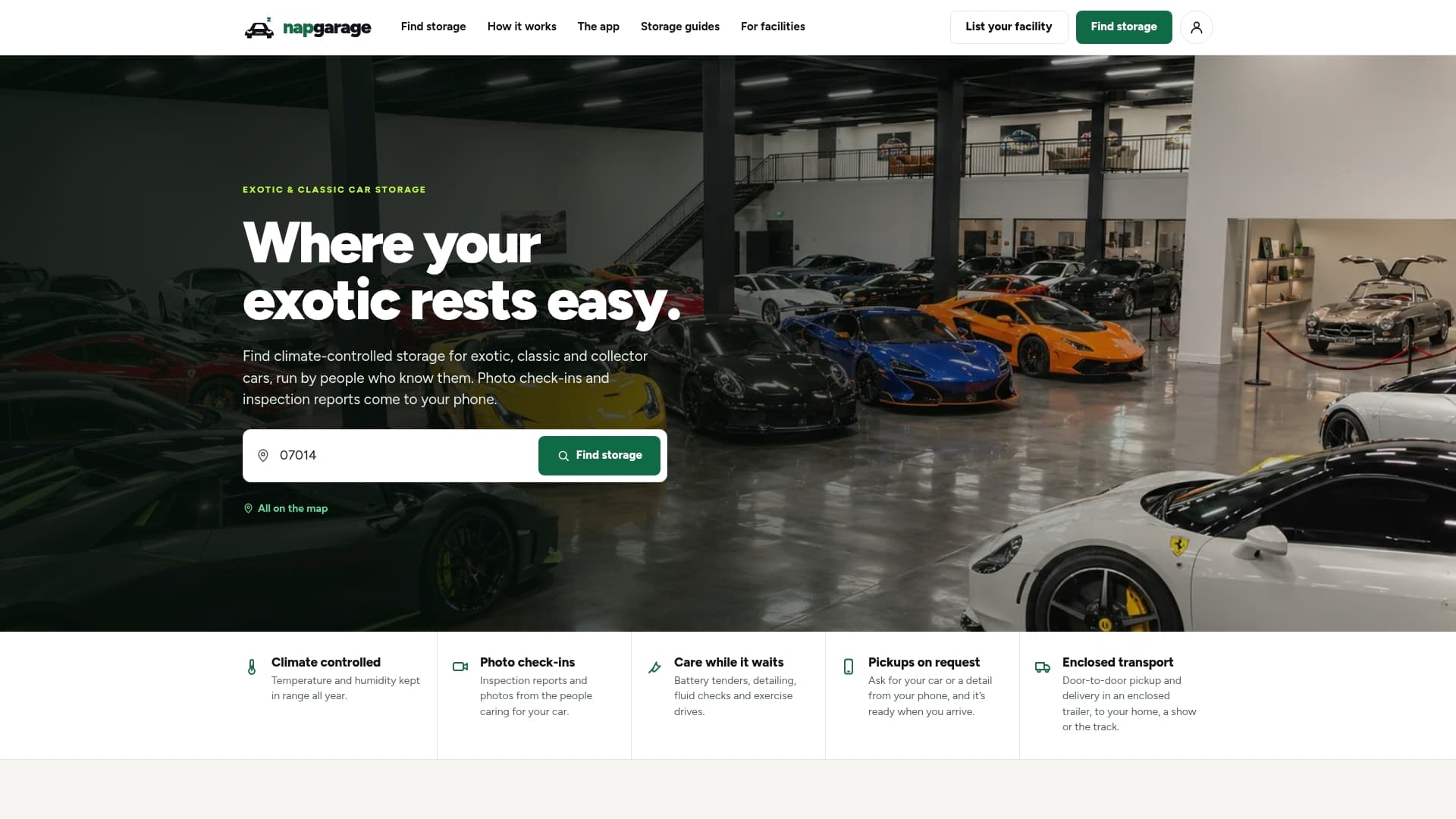
If you are moving an exotic or classic car and need a place for it at the other end, start with the NapGarage storage directory. You can browse facilities, see what each one offers and send a quote request. We list enclosed transport among the services collectors can arrange, and you can also browse storage by city, including Miami, Las Vegas and Sterling, Virginia.
For a closer look at what good storage includes and what it costs, read our guide to exotic car storage. For detailing before or after a move, see exotic car detailing.
FAQ
Is enclosed transport worth it for an exotic car?
For a restored or high-value car, yes. Hagerty’s guide says it should be the only choice, because it shields the car from rock damage, salt, hail and fluid drips that open carriers are not liable for. Consumer Reports says enclosed shipping costs at least 20% more than open.
How do I know a car transporter is legitimate?
Ask for the USDOT number and check the company on FMCSA’s database, including its insurance and complaint history. Then ask for proof of cargo insurance. Consumer Reports notes that the mandatory BIPD coverage does not protect the cars on the truck.
How much insurance should an exotic car transporter carry?
Hagerty recommends at least $100,000 per-vehicle liability for enclosed transport, plus a clear claims procedure. If your car is worth more, ask about higher cargo limits and confirm your own agreed-value policy covers the car in transit.
What should I do if my car arrives damaged?
Do not sign the delivery paperwork until you have inspected the car in full daylight and compared it with your pickup photos. Note any damage on the bill of lading. Ferrari Lake Forest advises reporting it to the carrier’s claims department within 24 hours.
Should I use a broker or a direct carrier?
Consumer Reports says a direct carrier that owns its fleet costs 20% to 30% more than a broker on a cross-country move. For a car you care about, or when pickup times and communication matter, it recommends paying that premium.
Sources
- How to Ship or Transport a Car, Consumer Reports
- Transporting Your Car Within the States, Hagerty
- How to Safely Transport a Ferrari, Ferrari Lake Forest
- Movers vs. Brokers, FMCSA