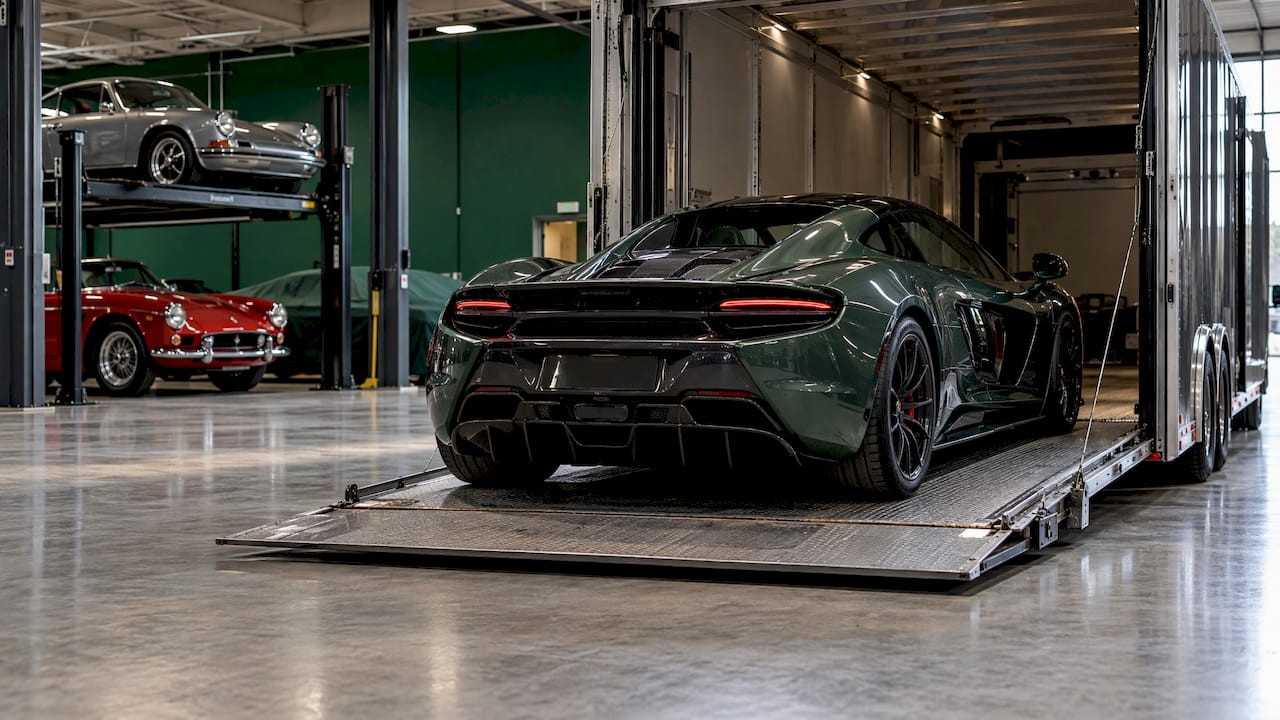
Enclosed Classic Car Transport: Costs, Benefits and Process
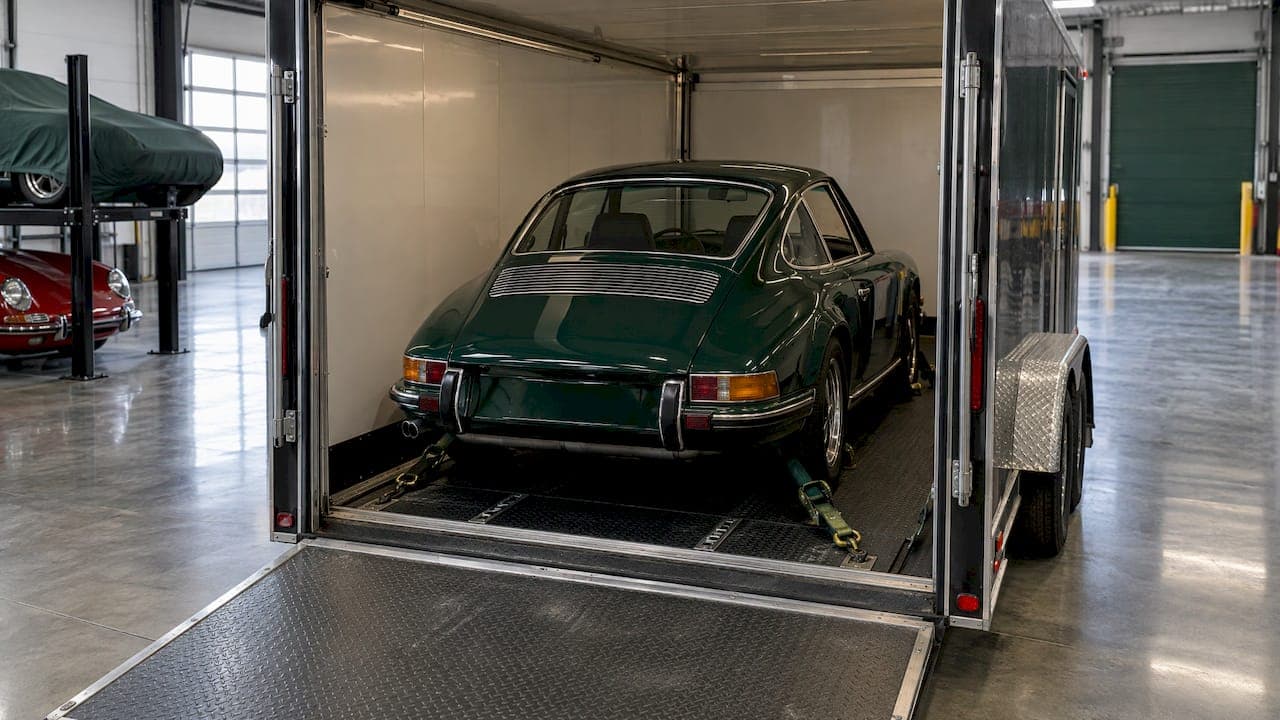
Enclosed classic car transport moves your car inside a closed trailer, out of the weather, away from road debris and out of public view. For a collector car that is going into storage or coming out of it, the best setup is one where the haul and the garage work together: the same team documents the car’s condition at pickup, tracks it on the road and checks it in at the facility. That is how we think about it at NapGarage, and the rest of this guide gives you what you need to judge any enclosed move: what it costs, when it pays for itself, and what to check before the truck arrives.
NapGarageKeep Your Classic Car Cared ForNapGarage pairs climate-controlled storage with inspection reports and photo check-ins, so you can stay updated on your car while it is stored.VisitKey Takeaways
- Enclosed transport typically costs roughly 40% to 60% more than open transport, and the premium buys protection from weather, debris and prying eyes.
- Collector-grade cars are usually priced on the enclosed side of the line: one industry report treats it as the practical baseline above roughly $60,000 to $70,000.
- Condition documentation is your protection: photograph the car, mark existing damage on the Bill of Lading, and inspect again at delivery in daylight.
- Enclosed trucks are scarcer than open ones, so book early and keep your dates flexible.
- If the car is heading to climate-controlled storage, ask for a facility that arranges enclosed transport and sends inspection reports and photo check-ins to your phone.
Table of Contents
- What enclosed transport actually is
- What you get for the extra money
- When enclosed makes sense, and when you might not need it
- What enclosed classic transport costs
- How an enclosed move works, step by step
- Insurance in plain terms
- Timing and availability
- Moving a car into or out of storage
- Find enclosed transport and storage in one place
- Our perspective
- FAQ
- Sources
What enclosed transport actually is
An enclosed trailer has walls, a roof and a lockable rear door. Think of it as a garage on wheels. Open transport, the kind you see on the interstate carrying cars on two exposed decks, leaves every vehicle in the wind, sun, rain and road grit.
The differences that matter to a classic owner:
- Capacity. Enclosed trailers carry far fewer cars than open haulers. That is the main reason for the price gap, and it also means fewer cars competing for the driver’s attention.
- Loading. Many enclosed carriers use a hydraulic lift gate, which raises a low car level before it enters the trailer. That avoids scraping a front lip or exhaust on a steep ramp.
- Tie-downs. Enclosed carriers typically secure the car with soft nylon straps or wheel nets over the tires, rather than chains at the frame. That keeps stress off old suspension parts and paint.
- Trailer style. Hard-side trailers have rigid aluminum or fiberglass walls. Soft-side trailers use heavy vinyl over a metal frame. Hard-side is generally considered the premium option for high-value cars.
What you get for the extra money
The benefits are easy to picture, and they are the ones a classic owner worries about most.
Weather. Rain, hail, snow, road salt and sun never touch the paint. A freshly detailed show car stays that way. Cold-weather routes in winter are where this matters most, because salt spray is brutal on chrome, trim and underbody.
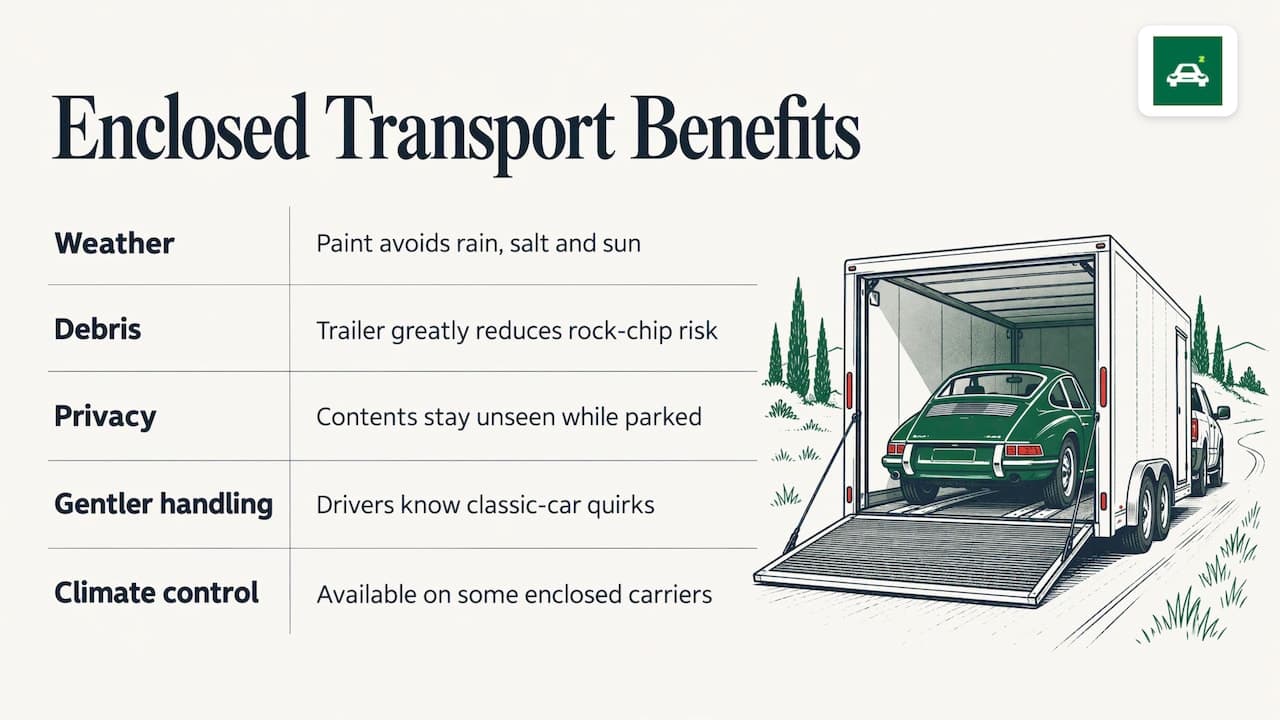
Debris. A single rock thrown at highway speed can chip paint or crack glass. On a period-correct car, replacement windshields and trim can be hard to find and expensive. Inside a trailer, that risk largely disappears.
Privacy and security. In a closed trailer nobody sees what is inside while the rig is parked overnight. A rare car that is visible for 2,000 miles is a car people remember.
Gentler handling. Experienced enclosed drivers know classic quirks: low clearance, manual chokes, unusual brakes, no power steering. You want that experience when your car has none of the modern conveniences.
Climate control. Some enclosed carriers offer temperature-controlled trailers. That is relevant for concours-level cars with original leather and wood trim moving through extreme weather.
When enclosed makes sense, and when you might not need it
There is no single legal cutoff, but the market has a clear pattern. A recent industry piece on shipping exotic and luxury cars describes enclosed as the practical baseline for vehicles priced above roughly $60,000 to $70,000, because the $300 to $700 difference over open is small next to the cost of repairing even minor cosmetic damage. Many people use a simpler test: if a chip, scratch or rainy delivery would hurt you financially or emotionally, go enclosed.
Go enclosed when:
- The car is valuable, original, freshly restored or show-quality.
- It cannot be replaced from a dealer, whatever its price.
- It sits low, has delicate bodywork or has unusual running gear.
- The route is long, goes through winter weather or crosses the country.
- The car is going into or coming out of climate-controlled storage, where the goal is to keep it protected end to end.
If you own a rugged driver, an unrestored project headed to a shop or a car whose value does not justify the premium, open transport on a short, dry route can be a reasonable choice. That is the exception. For the cars our readers own, it rarely is.
What enclosed classic transport costs
Prices move with fuel, season and demand, so treat every figure as a range and get live quotes. Here is how published numbers line up.
| Source | Open | Enclosed | Notes |
|---|---|---|---|
| Forbes Advisor, sample Brooklyn, NY to Charlotte, NC move | $1,053 average ($736 to $1,500) | $1,590 average ($1,020 to $2,500) | Enclosed about 40% to 60% more per mile |
| Classic Cars Journal, 2026 | Not listed | $900 to $1,500 regional, $1,200 to $1,500 mid-distance, $1,800 to $3,000 or more coast to coast | Driven by distance, size, condition, timing |
So a short regional haul commonly lands in the $900 to $1,500 range, and a coast-to-coast enclosed move can run from $1,800 to $3,000 or more. Treat those as 2026 reference points, not a quote.
What moves the price
- Distance and lane. Short moves cost the most per mile. Busy corridors, such as Florida to the Northeast, are easier to fill than rural pickups.
- Season. Southbound demand rises in the fall, and enclosed space gets tighter in early summer and during show season.
- Vehicle. Size, weight, ground clearance and whether the car runs all change the quote. A non-running car usually needs a winch and adds a surcharge.
- Timing. A flexible pickup window of several days is the most dependable way to get a better rate. A rush job costs more because enclosed trucks run fewer units and tighter schedules.
To make the premium concrete: on a $60,000 car, an extra few hundred dollars is around 1% of its value. Against paint correction on a high-end car, which can run into the hundreds or more for even a small flaw, the math favors enclosed.
How an enclosed move works, step by step
The typical sequence is simple. The mistakes happen in the details.
1. Collect quotes with accurate details
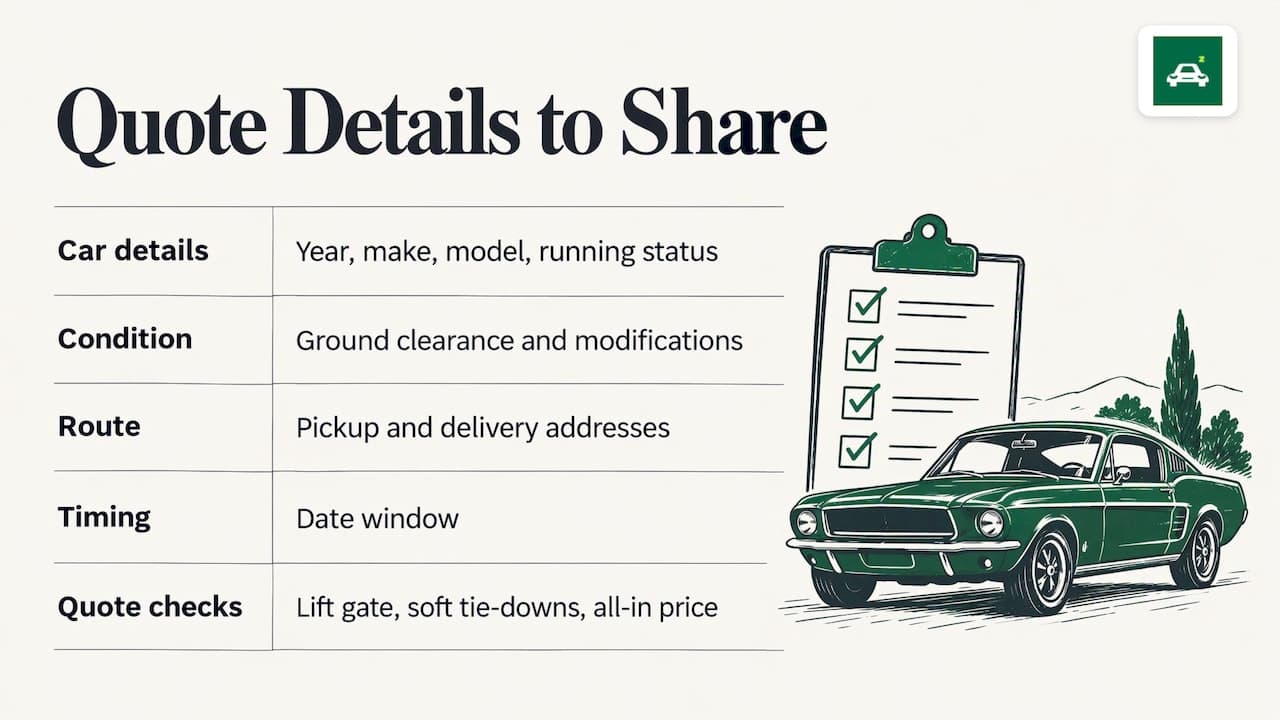
Give every quote the same information: year, make, model, whether it runs, ground clearance, modifications, pickup and delivery addresses, and your date window. Vague details produce low quotes that rise later. Ask whether the quote is for a lift gate and soft tie-downs, and whether the price is all-in.
If the car is going to a storage facility, ask the facility first. When transport is arranged through the same place that will store the car, one team knows the car, the route and the destination. NapGarage lists enclosed transport among the services it offers collectors, and our guide to shipping a collector car safely goes deeper on the planning side.
2. Verify the carrier
Check the carrier’s legal name, its USDOT and MC numbers, and a current certificate of insurance that shows the named insured and policy dates. Look at the per-vehicle cargo limit, the deductible, material exclusions and how to file a claim. Carriers carry cargo insurance, but limits, deductibles and exclusions differ, so read the certificate rather than assuming. Also ask your own classic car insurer whether your policy extends to transit, and whether your agreed-value coverage applies while the car is on a truck.
3. Prepare the car
Wash it so existing marks are visible. Take dated, time-stamped photos or video of every panel, the roof, bumpers, wheels, glass, undercarriage, interior and odometer. Then:
- Charge or disconnect the battery as the carrier advises.
- Check tire pressure.
- Fix or note any fluid leaks.
- Keep the fuel level low, around a quarter tank.
- Remove loose items, toll tags and anything valuable.
- Give the driver any special instructions: a hidden kill switch, a tricky choke, a fussy parking brake.
If you are building out a show setup, a car show display preparation guide is a good reference for the finishing details, such as plates and presentation, that you will handle once the car arrives. For trailer-side checks, a trailer inspection checklist shows what to look at before any load goes in.
4. Inspect and sign at pickup
The driver and you walk around the car together and record its condition on the Bill of Lading, the shipment contract and condition report. Existing damage should be marked on the form before you sign. Declare the car’s value if the paperwork asks for it. Make sure the trailer is the type you booked, and that the car is loaded by lift gate or low-angle ramp if it sits low.
5. Stay informed in transit
A reliable carrier gives updates and, on better equipment, GPS tracking. Ask how often you will hear from the driver and who to call if the schedule changes.
6. Inspect at delivery, in daylight
Compare the car to your photos and the Bill of Lading before you sign. Check the roof, glass, undercarriage and tires. If you see new damage, write it on the paperwork while the driver is present. Once you sign clean, a claim becomes much harder.
When the destination is a storage facility, the same inspection logic carries into storage. Our vehicle storage inspection checklist shows what a good arrival report should cover.
Insurance in plain terms
Two kinds of coverage get confused. Liability insurance covers injury and property damage to other people. Cargo insurance is what covers your car while it is loaded, moving and unloaded, subject to the policy’s terms and exclusions. Enclosed carriers often carry higher per-vehicle cargo limits than open carriers, but you should confirm the actual figure on the certificate.
An agreed-value policy from a classic car insurer is a separate layer that can pay at the appraised value of the car, not at a carrier’s limit. If your car is worth more than the carrier’s per-vehicle limit, talk to your insurer before the move, not after.
Timing and availability
Enclosed trucks are fewer, and pickup windows are generally wider than for open carriers. If you are working around an auction pickup, a closing date, a show or a storage move-in, book as early as you can and ask for a window instead of a single day. Winter southbound runs and early summer are busy, so plan ahead there. For show-specific planning, see our guide to enclosed transport for car shows.
Moving a car into or out of storage
Most collectors do not ship a car just to ship it. They move it because it is going into a winter garage, coming out for a season, heading to an event or changing hands. That is where a storage partner that handles pickups pays off. With NapGarage, you can request pickups and details through a mobile app, and facilities in our network send inspection reports and photo check-ins to your phone, so you can see the car’s condition without driving to the building. Our guide to car pickup and delivery for stored collector cars explains how that routine works day to day. If you are still choosing a place to keep the car, start with how to choose, prepare and budget for classic car storage.
Find enclosed transport and storage in one place
NapGarage focuses on enthusiast-grade storage for exotic, classic and collector cars. Listed services include climate-controlled storage, battery maintenance, detailing, fluid checks, exercise drives, inspection reports, photo check-ins and enclosed transport, all managed from your phone. To see facilities and request a quote, browse exotic and classic car storage or search by city.
If you want a nearby option, we list locations such as Miami, Las Vegas, Indianapolis and Sterling, Virginia.
Our perspective
A classic car is most exposed in the hours when nobody who loves it is watching. On a truck, in a lot, in an unfamiliar garage. That is why we treat transport and storage as one job.
Enclosed transport protects the car on the road. Climate-controlled storage protects it between drives. What ties them together is information: a clear record of the car’s condition when it leaves you, when it arrives, and while it sits. That is why our approach centers on inspection reports and photo check-ins delivered to your phone, and on pickups and details you can request from the app.
We focus exclusively on enthusiast-grade car storage. Battery maintenance, fluid checks, detailing and exercise drives are part of the care model, so the car you collect in spring is the car you left in fall. When you can stay updated without making the drive, you can own the car the way you meant to.
NapGarage Team
FAQ
Is enclosed transport worth it for a classic car?
For most collector cars, yes. The premium is usually a few hundred to a couple of thousand dollars, depending on distance, and it removes exposure to weather, debris and public view. If damage would hurt you financially or emotionally, it is the right choice.
How much more does enclosed cost than open?
Published figures put the premium at about 40% to 60% more per mile. Coast-to-coast enclosed moves of classic cars commonly run $1,800 to $3,000 or more. Your quote will depend on route, season, vehicle size and how flexible your dates are.
How long does it take to book and deliver?
Enclosed pickup windows are often wider than open ones because there are fewer trucks, so plan ahead and stay flexible. Transit time depends on the lane: a cross-country run takes longer than a regional one. Ask the carrier for a pickup window and an estimated delivery range in writing.
What paperwork should I have?
Keep the Bill of Lading, your dated photos, the carrier’s insurance certificate and your own insurer’s confirmation. At pickup and delivery, note any damage on the Bill of Lading before you sign.
Sources
- How Much Does It Cost To Ship A Car? (2026 Guide), Forbes Advisor
- Classic Car Shipping Explained: Process, Pricing, Insurance and Expert Tips
- Shipping a Luxury or Exotic Vehicle: What Changes at the High End