How to Prevent Tire Flat Spots in Storage

A tire flat spot forms when a car sits in one place and the same patch of tread carries the load for weeks. You prevent it by taking weight off the tires or by changing which part of the tire carries it, and the most reliable version of that is a car that is moved on a schedule while it is stored. That is why we built NapGarage around storage with exercise drives, battery maintenance, fluid checks, inspection reports and photo check-ins rather than a locked door and a cover.
NapGaragenapgarage.comKeep Stored Tires From Sitting StillNapGarage combines climate-controlled storage with exercise drives, battery maintenance, fluid checks, and photo check-ins to help care for collector cars.VisitKey Takeaways
- Flat spots come from prolonged stationary loading: the tire stays deflected under the car’s weight, and cold weather, high-performance tires and low-profile tires make it more likely.
- The tire industry’s own guidance is to remove weight from the tires if you can, and otherwise to keep pressure correct and move the car regularly, at least every three months and every 30 days for high-performance tires.
- Pressure above the placard is a temporary storage measure only. Reset to the vehicle placard before you drive.
- Most flat-spot vibration fades with highway driving after a few weeks of sitting. Storage beyond roughly three months or six months raises the chance of a permanent flat spot.
- If the shake persists after a proper drive, have a tire specialist look at the tires and suspension.
Table of Contents
- What actually causes a flat spot
- How long before it becomes a problem
- The prevention plan, in order of effectiveness
- A simple storage-day routine for your own garage
- Flat spots after storage: what to expect and what to do
- Why a managed facility beats a good intention
- Find storage that keeps tires and car in shape
- FAQ
- Sources
What actually causes a flat spot
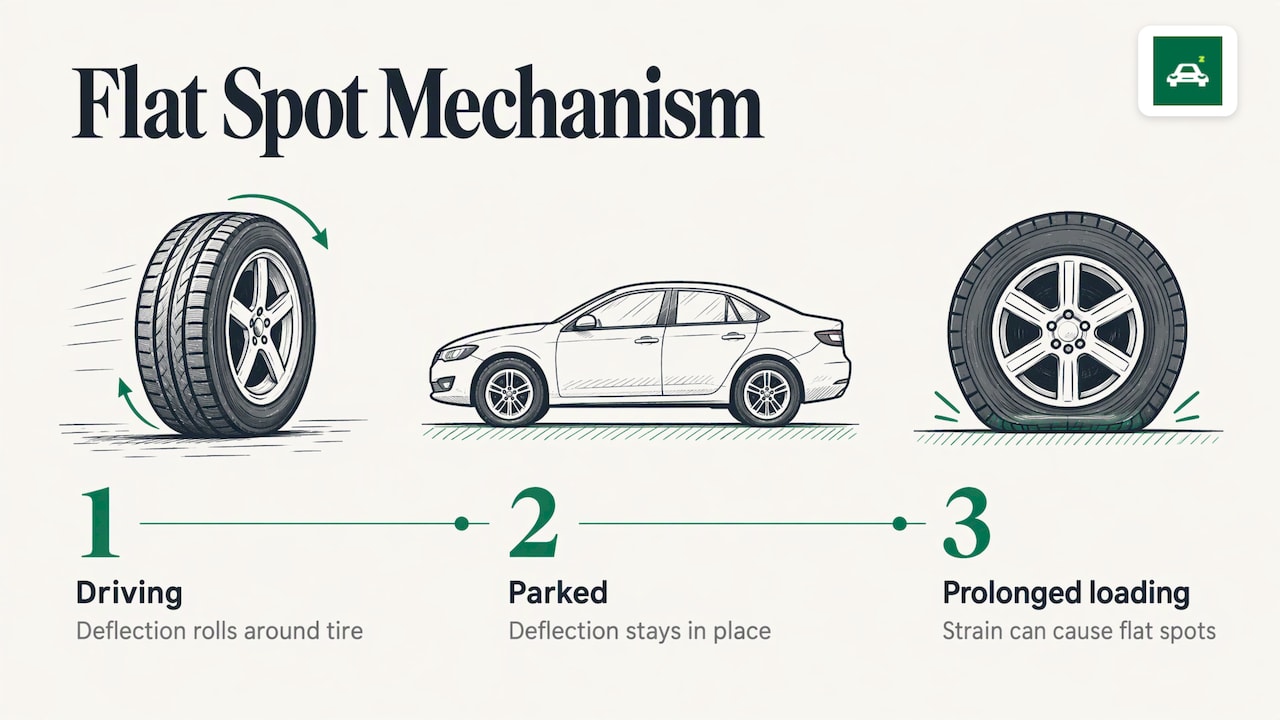
A tire is not a solid wheel. It is a flexible structure that holds its shape through air pressure and its internal construction. Where the tire meets the ground, it deflects slightly. While you drive, that deflection rolls around the tire, so no single spot is stressed for long.
Park the car and the deflection stays put. The U.S. Tire Manufacturers Association says in its November 2024 tire information bulletin that prolonged stationary loading strains the tire through deflection and can cause a temporary flat spot. The same bulletin lists sunlight, ozone and other damaging storage conditions as separate risks, which is why where you store matters as much as how.
Some cars are more exposed than others. Hagerty notes that the vehicle’s weight presses the tread against the floor, and that cold temperatures, high-performance tires and low-profile tires increase susceptibility. That is a fair description of most exotic and collector cars: heavy relative to the contact patch, shod in performance rubber and often stored through winter.
Inflation to specification does not make you immune. Toyota’s January 2025 long-term storage bulletin says a parked vehicle can develop a flat spot even when tires are inflated to specification, and it directs monthly pressure checks. That bulletin covers specific 2025 Toyota models, but the physics it describes applies to any car on its tires.
How long before it becomes a problem
There is no single number, because tire design, floor surface and temperature all matter. The published guidance gives a useful range:
| Time stationary | What manufacturers and bulletins say |
|---|---|
| 30 to 45 days | General Motors’ dealer-inventory bulletin says flat-spot vibration can develop in this window, depending on tire design, surface and weather. It usually fades after a few minutes of highway-speed driving. |
| 45 to 90 days | Vibration usually fades after about 10 minutes of highway-speed driving, per the same GM bulletin. |
| Over 90 days | The GM bulletin says storage beyond this may produce permanent flat spots that require tire replacement. |
| Six months or more | Yokohama’s technical advisory says flat spotting after six or more months without movement may not disappear. |
Treat these as a planning guide, not a promise. A mid-engine car on soft, low-profile tires in an unheated garage in January sits at the unfavorable end of every range.
The prevention plan, in order of effectiveness
1. Take the weight off, or move the car
The tire industry’s order of preference is consistent. The U.S. Tire Manufacturers Association says that for a vehicle stored on its tires, you should remove the vehicle’s weight from them. If that is not possible, unload the car completely, maintain recommended pressure and move it at least every three months. Continental’s storage and handling guidance says the same: raise the vehicle on blocks if possible, and if not, unload it as much as you can. Yokohama specifically names seasonal vehicles such as show cars as candidates for blocks.
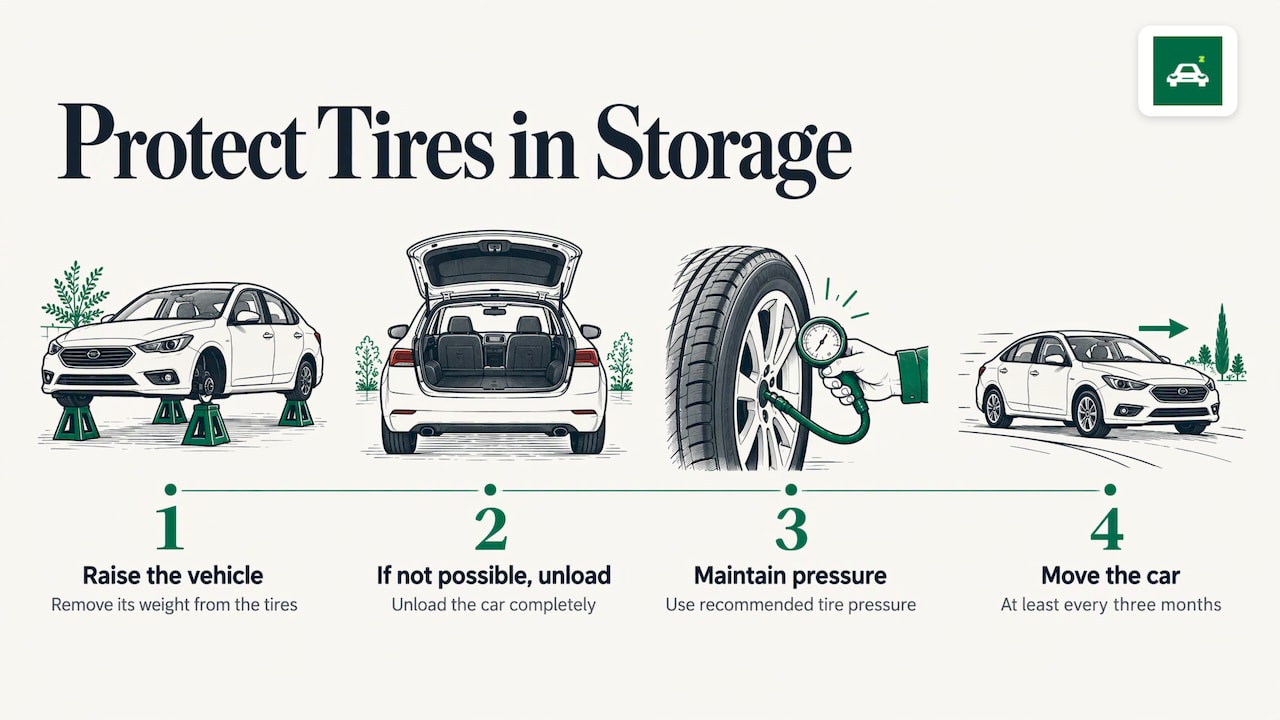
Raising a collector car safely is its own job. A car lifted on the wrong points can damage suspension, floors or sills, and a low exotic with a flat underbody is not forgiving. If you go this route, use the lift points in the owner’s manual and stable supports rated for the car’s weight.
2. Move the car on a schedule
For most owners, this is the step that actually gets skipped. Two intervals appear in the guidance:
- At least every three months for a general vehicle stored on its tires (U.S. Tire Manufacturers Association).
- Every 30 days for high-performance tires with nylon belt overlays, per the same bulletin, and for dealer inventory in General Motors’ guidance.
Moving does not mean starting the engine in place. The point is to roll the car so a different part of each tire takes the load. Toyota’s bulletin for its covered models directs driving at least 30 feet, which gives you a sense of scale: the goal is a fresh contact patch, and a real drive does more. We cover timing in more depth in our guide to how often stored cars should be driven.
This is where storage with exercise drives earns its place. A car in a facility that moves it, checks the battery and looks at the fluids is handled by someone on a rhythm, so the 30-day interval does not depend on your winter schedule or a trip abroad. When you look for exotic and classic car storage near you, those services are the ones to look for.
3. Set the pressure correctly
Pressure is where well-meaning advice goes wrong, so read the fine print.
- Normal storage: Michelin’s current flat-spotting guidance recommends keeping tires at vehicle placard pressure, the number on the sticker in the driver’s door jamb, and explicitly does not recommend overinflating to prevent flat spots.
- High-performance tires held on the ground: The U.S. Tire Manufacturers Association says high-performance tires with nylon belt overlays can be temporarily inflated to the sidewall maximum, with pressure reset to the placard before driving.
- Other published numbers: Continental permits inflation to the sidewall maximum while the car stays on its tires, and Yokohama says to raise pressure by 25% over the loaded-vehicle requirement if you cannot raise the car. General Motors’ dealer guidance uses 44 psi (300 kPa) for inventory vehicles, again with a reset at delivery.
The common thread is the last step. Any storage inflation comes back down to the placard value before the car moves. Forget it and you drive on a stiff, over-pressured tire. Because the manufacturers differ, check your own tire maker’s guidance for your tire before choosing a number, and check pressure monthly whatever you pick, as Toyota’s bulletin directs.
4. Choose the right place
The tire bulletin describes the ideal: indoor storage that is clean, dry, mildly tempered and shaded, with modest ventilation, away from petroleum products, solvents, direct sun, extreme cold or heat and ozone-generating equipment such as electric motors. Cold makes flat spotting worse, and sun and ozone age the rubber regardless of position. For outdoor-parked cars, Yokohama recommends opaque covers on the tires.
Humidity belongs in the same conversation. It does not cause flat spots, but a space that protects tires from temperature swings usually needs to protect the rest of the car from moisture too. See our notes on what humidity level is best for car storage and how to prevent condensation in a stored car.
5. Think carefully about cradles and ramps
Curved foam ramps and cradles are heavily marketed and dominate the search results for this topic. Michelin’s position is measured: cradles are theoretically intended to keep the tire round, their curvature must match the tire, and Michelin has no data verifying that they reduce flat spotting. It adds that tires stay at risk if they are overinflated or exposed to chemicals or excessive heat.
In practice, that means a cradle is one possible tool, not a replacement for pressure checks, a clean dry space and a car that gets moved. If you use one, match it to your tire size and keep checking pressure.
A simple storage-day routine for your own garage
If you are storing the car at home for a season, this sequence follows the guidance above:
- Wash the car and clean the tires and wheels, and clear anything that could drip onto the floor.
- Check pressure with a good gauge on cold tires and record it.
- Choose your method: weight off the tires on proper supports, or the car on its tires with pressure set per your tire maker’s guidance.
- Park on a clean, dry, sealed surface, out of direct sun, away from solvents and motors.
- Put a reminder in your calendar for 30 days.
- At each interval, check pressure and move the car so the tires rest on fresh tread.
- On the day you take it out, reset to the placard pressure before the first drive.
The rest of the car needs attention too, which is covered in our step-by-step checklist for preparing a car for storage and our guide to winter car storage.
The weak link is step 5. The routine works only if someone does it every month for the whole season, in January weather, while you may be traveling.
Flat spots after storage: what to expect and what to do
The first drive after a long sit often brings a rhythmic thump or shimmy that you feel in the seat or steering wheel. Most of the time it is temporary. The tire warms, flexes and returns to its round shape.
- How long it takes: Michelin says typical temporary flat spotting generally relaxes after more than 20 minutes at normal highway speeds, though time and distance vary. GM’s bulletin puts it at about 10 minutes for the 45 to 90 day range. Yokohama says flat spots usually disappear after a drive of 25 miles or more.
- Drive gently first: Start at moderate speed, check the pressure is back at the placard value and let the tires warm up.
- When it does not go away: Michelin says persistent vibration after driving warrants inspection by a tire specialist, because tire or suspension problems may be involved. That is also the right answer after storage beyond three or six months, when the flat spot may have become permanent.
If your first outing is a show or a meet, you may want to think about parked car plate privacy while the car sits on display. Do the highway shakedown drive before you arrive, so the tires are warmed up and round when the judges look at it.
Why a managed facility beats a good intention
Every step above is simple. The failure point is consistency. Pressure checks, movement and a clean environment have to happen month after month, and collectors with several cars or a busy calendar are the people most likely to miss one.
A facility built for enthusiast cars turns that into a service. NapGarage lists climate-controlled storage for exotic, classic and collector cars with battery maintenance, fluid checks, detailing and exercise drives, plus inspection reports and photo check-ins that arrive on your phone. You can request a pickup or details through the mobile app, and enclosed transport is part of what we offer. That means you see the car’s condition without driving to the building, and the car does not spend the winter on one patch of tread. Our vehicle storage inspection checklist for collectors shows what a good report should cover.
Our perspective
We built NapGarage on one belief: a collector car should not just be stored, it should be looked after. Flat spots are a perfect example. They are not a mystery and the fixes are well known. What defeats owners is that the fixes repeat: check the pressure, move the car, look at the tires, do it again next month.
That is why we focus exclusively on enthusiast-grade storage, with exercise drives, battery maintenance, fluid checks and detailing alongside a climate-controlled space. Our inspection reports and photo check-ins mean you can see how the car and its tires are doing from your phone, and you can request a pickup or details in the app when you want the car back.
The tire makers’ guidance is clear that movement and correct pressure matter. We would rather a car be cared for on a rhythm than rely on a once-a-season reminder.
NapGarage Team
Find storage that keeps tires and car in shape
If you are comparing options for the season, start with exotic and classic car storage, where you can see facilities with climate control, exercise drives, inspection reports and photo check-ins and send a quote request. You can also browse storage by city, including Sterling, Virginia, Miami and Las Vegas.

For a longer read on seasonal planning, see our piece on a better plan for classic car winter storage and our full tire flat-spot guide.
FAQ
Do flat spots on tires go away?
Usually, yes, when they are temporary. Michelin says typical temporary flat spotting generally relaxes after more than 20 minutes at normal highway speeds, and Yokohama says they usually disappear after a drive of 25 miles or more. Flat spots from six or more months without movement may not disappear, and persistent vibration should be checked by a tire specialist.
Should I overinflate my tires for storage?
Check your tire maker’s guidance for your specific tire. Michelin recommends keeping placard pressure and does not recommend overinflating, while the U.S. Tire Manufacturers Association, Continental and Yokohama describe temporary increases for certain tires and situations. Whatever you do, return to the placard pressure before driving.
How often should I move a stored car?
The U.S. Tire Manufacturers Association says at least every three months, and every 30 days for high-performance tires with nylon belt overlays. General Motors’ dealer guidance also uses 30 days. Moving it enough that each tire rests on a new patch of tread is the goal.
Do tire cradles and storage ramps work?
They are designed to keep the tire’s shape by supporting it in an arc. Michelin notes that the curvature must match the tire and says it has no data verifying that cradles reduce flat spotting. Keep checking pressure and storing the car in a clean, dry, temperate space either way.
Sources
- U.S. Tire Manufacturers Association, Tire Information Service Bulletin, November 2024
- Hagerty, The Best Tips for Winter Car Storage and Care
- Toyota Motor Sales USA, Long-Term Vehicle Storage Guidelines
- General Motors, dealer information bulletin on vehicle storage
- Michelin USA, Tire Flat Spotting
- Continental Tire, Tire Storage and Handling Guidelines
- Yokohama, Technical Service Advisory on tire storage