Rare Car Storage: How to Choose Safe, Climate-Controlled Space

The right storage for a rare car is a climate-controlled, monitored building where someone actually looks after the car while it sits: battery, fluids, cleanliness, the occasional drive, and a record of all of it. A parking space with a roof does none of that. NapGarage is built around this kind of care for exotic, classic and collector cars: climate-controlled storage with battery maintenance, fluid checks, detailing, exercise drives, inspection reports and photo check-ins, and a mobile app to request pickups and details. This guide explains what to check, what it costs in the US, and how to compare facilities.
NapGarageKeep Your Rare Car ReadyNapGarage pairs climate-controlled storage with battery maintenance, fluid checks, detailing, exercise drives, inspection reports, and photo check-ins.VisitKey Takeaways
- True climate control means active humidity management, not just a heater or air conditioner. Ask for the humidity setpoint.
- Professional storage commonly runs $100 to $500 a month, and a spot in New York or Los Angeles can reach $750.
- Service matters as much as space: battery care, fluid checks, exercise drives and photo reports keep a car ready to drive.
- Confirm your insurance and the facility’s liability limit before the car moves.
- Our exotic and classic car storage listings let you compare facilities and request a quote in one place.
Table of Contents
- What makes storage “rare car” grade
- Climate control: what to ask for
- Security and fire protection
- What care while the car is stored looks like
- Managing the car from your phone
- What rare car storage costs in the US
- Insurance: check before the car moves
- A short checklist for comparing facilities
- Find a facility through NapGarage
- Our perspective
- FAQ
- Sources
What makes storage “rare car” grade
Storage facilities exist in every state, but quality varies widely. GearJunkie’s guide to classic car storage tells owners to weigh four things: the type of parking (outdoor, covered, indoor, or climate-controlled indoor), security matched to the car’s value, extra member services, and location.
For a car you cannot replace, that list becomes a stricter one:
- Indoor, climate-controlled space. Outdoor and covered lots expose paint, rubber and interiors to sun, moisture and temperature swings.
- Security that fits the value. Cameras, alarms and controlled access, not a padlocked unit in a general storage yard.
- Staff who handle the car. Someone who knows what a low-slung exotic or a carbureted classic needs when it is moved or started.
- Records. Inspection notes and photos, so you know the condition of the car without driving to the building.
- Distance you can live with. Facility owners quoted in Classic Motorsports say the car-barn idea is hyperlocal, with owners unwilling to travel more than 10 or 15 minutes to get their cars. Some customers fly in and keep a car near an airport for visits.
That last point is why searches like “exotic car storage near me” and “classic car storage near me” are the right starting point: the best building is one you will actually use. You can browse facilities by city on our storage by city page.
Climate control: what to ask for
“Climate-controlled” is used loosely. Butter Classics points out that temperature control and climate control are different things: true climate control includes active dehumidification. Below roughly 40% relative humidity, rubber seals and leather can crack. Above 60%, condensation and mold become a risk.
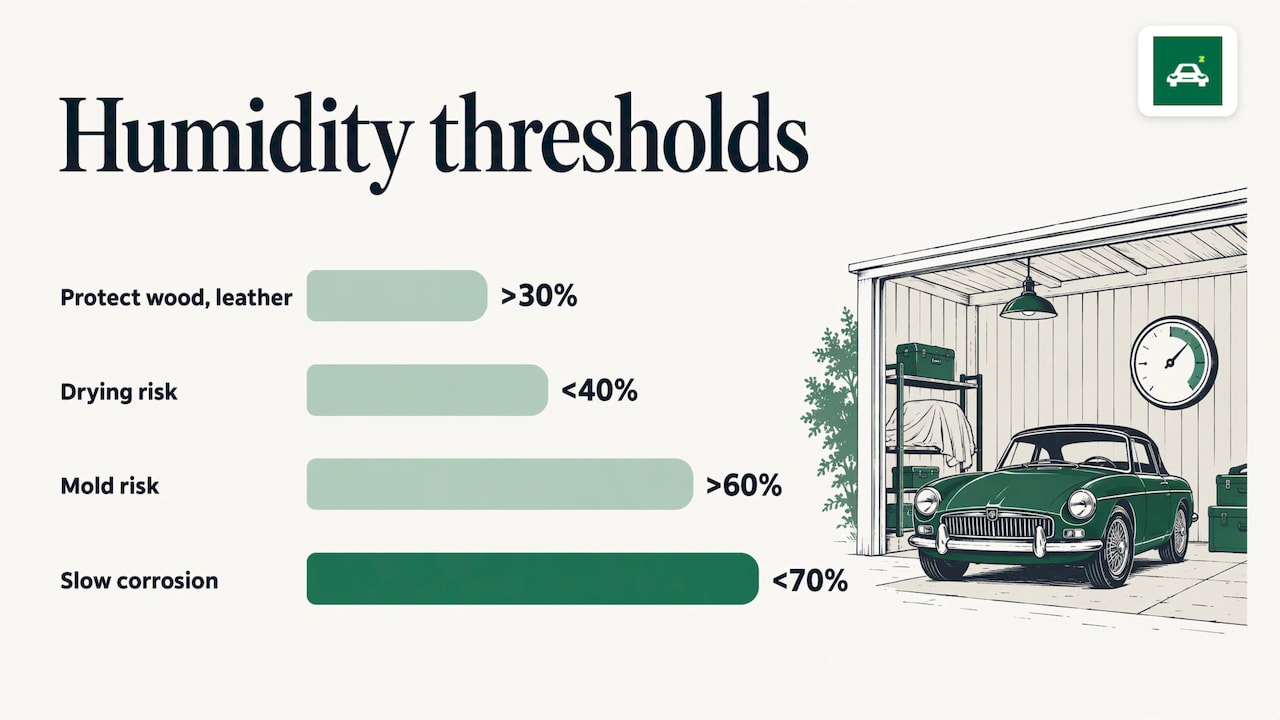
Modern Car Collector describes the gold standard as 50 to 70°F with 40 to 60% relative humidity. The Canadian Conservation Institute, a federal preservation-science body, recommends keeping relative humidity below 70% to slow corrosion and above 30% to protect wood and leather components. It also advises dust covers, sealed floors and rust-preventive coatings on bare metal.
The practical questions for any facility:
- What is the humidity setpoint, and what range does it hold?
- Where are readings taken, and how often?
- Who responds when conditions drift, and how fast?
The Motorcar Society suggests treating “climate-controlled” as a question, not a label: ask what the operator controls, what it measures and who acts when readings move. Our guides on humidity-controlled car storage and whether climate storage is worth it for collector cars go deeper on ranges.
Security and fire protection
A rare car is a target and a concentration of value. Insurer guidance gives a clear checklist, even though it was written for the UK:
- Chubb’s risk consultants look for alarms linked to emergency services, fire suppression, safe fuel handling, protection against water ingress, and staff who keep the building clean and orderly.
- Aviva’s storage guide adds secure key management such as electronic key cabinets or safes, professionally installed intruder alarms, adequate spacing between vehicles, and a salvage plan that puts the most valuable cars first.
In a US facility, translate that into questions: Are the cameras covering every bay, and is footage kept? How are keys stored and who can take them? What fire suppression is in the building? What happens if a pipe leaks overhead? Butter Classics lists missing camera coverage, no humidity control and signs of rodents as red flags.
What care while the car is stored looks like
A car that sits is not a car at rest. Batteries discharge, fuel ages, tires develop flat spots and seals dry out. GearJunkie’s preparation advice covers the basics: wash the car, change the oil, fill the tank (adding fuel stabilizer for storage of six months or more) and use a battery tender.
A good facility takes these jobs off your hands. Through NapGarage, storage comes with:
- Battery maintenance, so the car starts when you return. If you are weighing when to replace an aging battery before the car goes in, this explainer on how often a car battery needs replacing is a good primer.
- Fluid checks, so leaks or low levels are caught early.
- Exercise drives, because a car that is driven now and then keeps its mechanical parts moving. Aviva’s guide recommends driving a stored car at least every few weeks.
- Detailing, so the car comes out clean and ready.
- Inspection reports and photo check-ins sent to your phone.
- Enclosed transport, for moving the car without exposing it to the road.
This is the service side that owners value. Facility owners interviewed by Classic Motorsports say customers are used to high levels of service and want to call ahead and arrive to a clean, prepped car ready to leave.
Some of the heat and UV protection also happens on the car itself. For a car that spends time parked outside the facility, this overview of keeping a car cool when parked explains how heat builds up in a cabin.
Managing the car from your phone
Owning a rare car should not mean driving to a warehouse to find out whether it is fine. The NapGarage app lets you request pickups and details, and photo check-ins and inspection reports reach your phone, so you can stay current on the car without visiting.
Whatever facility you choose, put the handling rules in writing. The Motorcar Society advises spelling out all responsibilities, including who may move your car and how each movement is recorded. Also ask how many times the car can come and go before extra fees apply: Classic Motorsports reports most facilities cap the number of trips without additional charges.
What rare car storage costs in the US
Prices follow quality, city and service level. These published figures give a realistic range:
| Source | Figure | What it covers |
|---|---|---|
| Modern Car Collector (June 2026) | $100 to $500 per month | Professional storage, depending on quality and location |
| Classic Motorsports (2026) | $150 to $750 per month | A collector-car spot, from less expensive areas to New York or Los Angeles |
| GearJunkie (2022) | $45 to $450 per month, citing HomeAdvisor | General car storage options, with clubs costing thousands per year |
The range widens once you add service. A bare space costs less than a bay with battery care, drives and reports, and a social club with on-staff mechanics costs more again. Our cost of car storage guide breaks prices down by type and city. Modern Car Collector’s EL Puckett frames the monthly fee as insurance against far larger losses, which is a useful way to think about it when the car is worth six or seven figures.
For how we think about budgeting and preparing, see our guide to classic car storage: how to choose, prepare and budget.
Insurance: check before the car moves
Storage does not replace coverage. Butter Classics recommends calling your insurer before the car is moved, confirming whether the policy pays agreed value or actual cash value (specialty collector policies typically offer agreed value), and checking the facility’s liability cap, which is often far below collector values. Review exclusions for water, rodent and vandalism damage.
Values also move. Puckett notes that because collector car values fluctuate significantly, keeping coverage aligned with the market is an ongoing job, not a one-time task.
A short checklist for comparing facilities
- Humidity setpoint and who monitors it.
- Cameras, alarms, fire suppression and key control.
- Services included: battery, fluids, drives, detailing.
- How you receive updates: reports, photos, app.
- Access rules, and the fee for extra trips.
- The facility’s liability limit versus your car’s agreed value.
- Drive time from your home or nearest airport.
Before delivery, follow our step-by-step checklist for preparing a car for storage, and for longer stays see how to store a classic car and the plan for classic car winter storage. To keep condition and value over the years, read classic car preservation.
Find a facility through NapGarage
NapGarage focuses only on enthusiast-grade storage for exotic, classic and collector cars. Browse exotic and classic car storage to compare facilities, or look at a specific market such as Miami, Las Vegas or Sterling, Virginia. Submit a quote request and you will hear from a facility about your car.

Each listing is built around the care described above: climate control, maintenance, inspections and photo updates on your phone.
Our perspective
We built NapGarage on one idea: a rare car should be looked after, not just parked. Space is the easy part. The value is in what happens between the day you drop the car off and the day you want it back.
That is why we focus on enthusiast-grade storage. A collector wants to know the battery is maintained, the fluids are checked, the car gets exercised and the interior stays clean. They also want proof without a long drive, which is why we pair inspection reports and photo check-ins with an app where you can request a pickup or ask for details.
When you compare facilities, compare the routine, not only the room. A building with real climate control and a team that documents every visit gives you something a bare storage unit cannot: confidence that the car is exactly as you left it.
NapGarage Team
FAQ
How much does rare car storage cost?
Professional storage typically runs $100 to $500 a month according to Modern Car Collector, and a collector-car spot can reach $750 a month in New York or Los Angeles. Services such as battery care, exercise drives and reports change the price, so compare what each quote includes.
Is climate-controlled storage necessary for a rare car?
It is the standard for valuable cars. Stable temperature and humidity between about 40 and 60% protect rubber, leather, paint and metal. Ask for the humidity setpoint, because active dehumidification is what separates true climate control from simple heating or cooling.
How often should a stored car be driven?
Aviva’s guide recommends driving a stored car at least every few weeks. Through NapGarage, exercise drives are part of the care offered, along with battery maintenance and fluid checks.
Do I need to change my insurance when I store my car?
Call your insurer before the car moves, and confirm the coverage basis (agreed value or actual cash value) and the facility’s liability limit. Review exclusions for water, rodent and vandalism damage, and keep the insured value in line with the market.
Sources
- How to Find the Best Classic Car Storage, GearJunkie
- How to Store a Collector Car, Modern Car Collector
- What you need to know about classic car storage, Classic Motorsports
- Classic Car Storage Options, Butter Classics
- Caring for vehicles, Canadian Conservation Institute
- Considerations for storing classic vehicles, Chubb
- Protecting your classic or high-end car, Aviva
- Classic Car Storage: Give the Garage a Plan, Motorcar Society